

Film
Spiritato with Elizabeth Kenny | Music to her Majestie: Odes for the last Stuart
St Giles’ Cripplegate, Barbican
Share this

FIRST PUBLISHED 06 FEB 2025
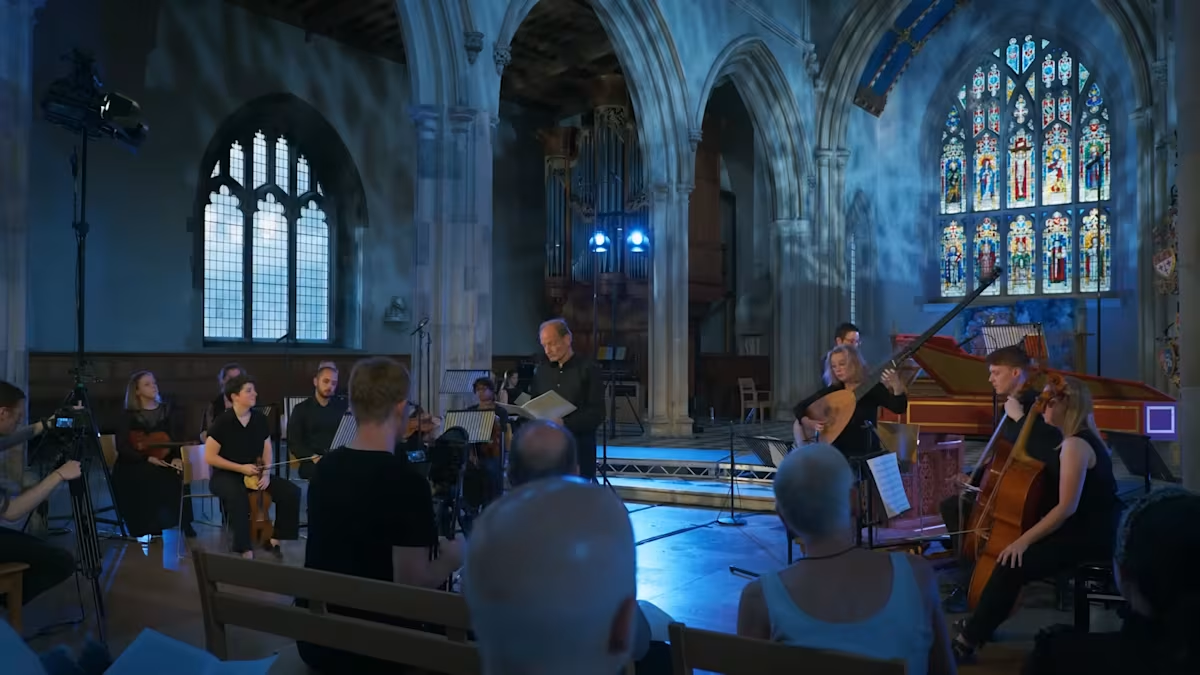
On the birthday of Queen Anne (6 Feb 1665 – 1 Aug 1714), we share ‘Music to Her Majestie’, Spiritato’s programme, which paints a unique portrait of a remarkable monarch. Often overlooked, Queen Anne was a life-long 'Patroness of Arts' and oversaw both the end of the Restoration and the arrival of a new, virtuosic Italian style. Under the direction of Kinga Ujszászi, and joined by lutenist Elizabeth Kenny and guest soloists, the ensemble explores exquisite works dedicated to the last Stuart.
Beginning with Purcell’s beautiful music for her wedding as a young princess, via the modern premiere of Inspire us, genius of the day by John Eccles, full of hope for Britain’s new Queen in 1703, and concluding with Handel’s glowing ode for her birthday of 1713, his masterpiece: Eternal Source of Light Divine. Each work features the finest composer and leading poet of the day and shines a light on two decades of politics and power at the dawn of the 18th century.
Performed and filmed at St Giles’ Cripplegate, Barbican on 10 Sep 2023, the project was generously supported by Continuo Foundation, Angel Early Music, and The Gemma Classical Music Trust.
PROGRAMME
Henry Purcell From hardy climes and dangerous toils of war
A Song yt was perform'd to Prince George upon his marriage wth ye Lady Ann, 1683
John Eccles Inspire us, genius of the day
Ode for the Birth Day, 1703
George Frideric Handel Eternal Source of Light Divine
Ode for the Birthday of Queen Anne, 1713
Spiritato
TRUMPET Russell Gilmour, William Russell
OBOE Joel Raymond, Nicola Barbagli
VIOLIN Kinga Ujszászi (director), Rodrigo Checa, George Clifford, Elizabeth MacCarthy, Karin Björk, Claudia Delago-Norz
VIOLA: Joanne Miller, Nichola Blakey
CELLO: Jacob Garside (+ VIOLA DA GAMBA) Alice Manthorpe Saunders
VIOLONE/BASS: Peter McCarthy
BASSOON: Inga Maria Klaucke
THEORBO Elizabeth Kenny
ORGAN/HARPSICHORD: Nicolás Mendoza
VOCAL ENSEMBLE: Nardus Williams*, Zoë Brookshaw*, Charlotte La Thrope, Nicholas Mulroy*, Charles
Daniels*, Ciara Hendrick*, Jamie Hall, Chris Lombard, Jimmy Holliday*, Robert Davies
*soloists
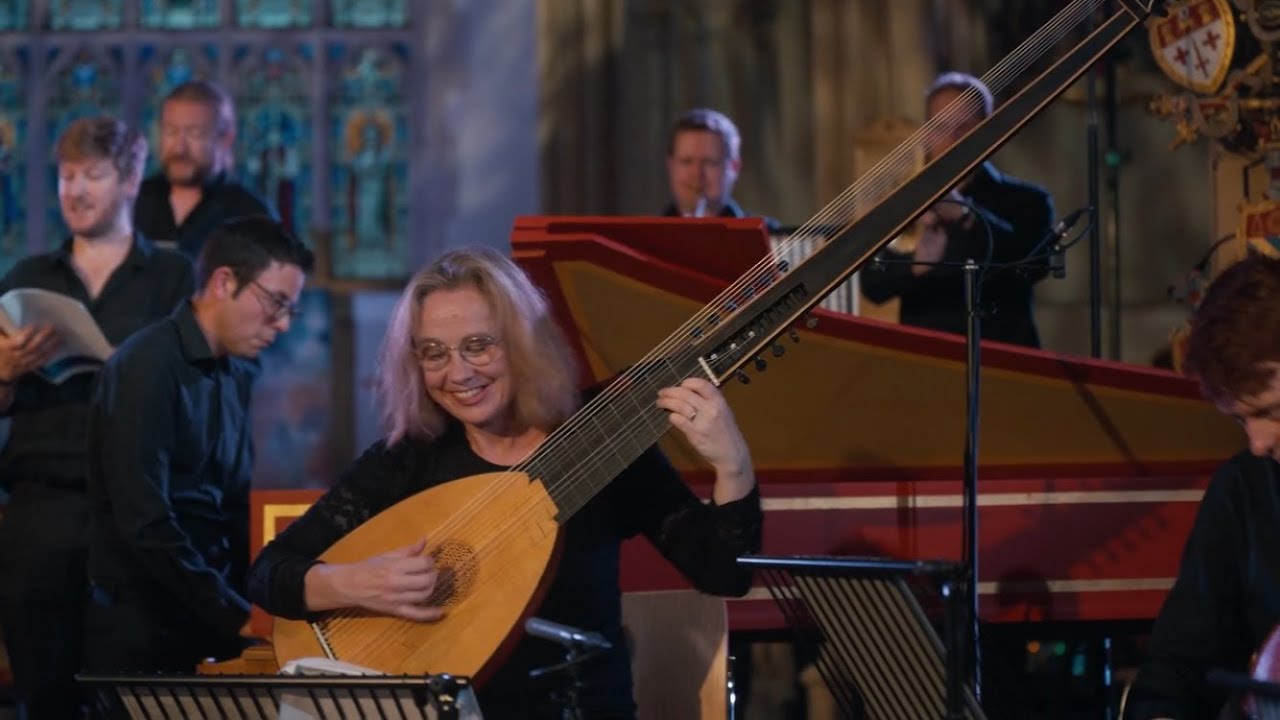 ▶
▶Spiritato with Elizabeth Kenny and guest soloists at St Giles’ Cripplegate, Barbican | 10 Sep 2023
PROGRAMME NOTES | BY DR ESTELLE MURPHY
Queen Anne was a lover of music. As princess, she was taught guitar by the famous virtuoso guitarist Francesco Corbetta (c1615–1681). She also had a singing master, as well as harpsichord and other music teachers, one of whom was probably Giovanni Battista Draghi. Her 18th-century biographer Abel Boyer tells us that she ‘had an excellent ear, which qualified her for a true dancer and gave her a great relish for music, insomuch that she was accounted one of the best performers on the guitar’. Anne’s melodious speaking voice, so commented upon by writers and eyewitnesses in her day, was trained by none other than the famous singing actress Elizabeth Barry. With such a strong interest in music, it is no surprise to learn that she attended public concerts and operas, including Purcell’s The Fairy Queen.
Anne’s musical upbringing meant that she understood the power it could hold in relation to fashioning a particular public image. The musical court ode – a large-scale work for soloists, choir, and instruments – was an ideal ceremonial device with which to fashion the monarch. The ode was used each year to celebrate New Year’s Day and the monarch’s birthday, and for a period to welcome the king back to London from time spent at Windsor. These recurrent works were supplemented by odes composed for additional celebrations of note, such as military victories, royal weddings, peace treaties, and for other royal birthdays. Its lyrics served to promote the visions of the sovereign regarding political and religious policies. It was also used to show or avoid partisanship, to enhance the public perception of the monarch’s power and right to the throne, to show stability in periods of volatility, and to reinforce his or her intentions for the nation. All of these intentions and more are present in the odes by Purcell, Eccles, and Handel.
On 28 July 1683, Prince George of Denmark and Princess Anne, later Queen of Great Britain, were married in the Chapel Royal at St James’s Palace. Included in the music for the day was From hardy climes – an ode, described as ‘A Song yt was perform’d to Prince George upon his Marriage wth ye Lady Ann’ in its surviving manuscript. Its anonymous lyrics were set to music by Henry Purcell, whose word-setting skills breathe drama and life into the celebratory wishes. Its opening vocal movement praises Prince George’s valour and honour in previous ‘dangerous toils of war’. The setting for solo bass voice was likely originally intended for the virtuoso bass singer John Gostling, a favourite of Charles II, whose evocative low notes and impressive range are evident in Purcell’s vocal line here.
The ode is full of hope for the future and emphasizes themes of love and the idea that the marriage is by ‘Heav’n design’d’. These are perhaps best shown in the ground-bass movement for tenor solo beginning ‘The sparrow and the gentle dove’. The recurrent bassline of running quavers here emphasises the idea of continuance and musically realises the wish that the love should endure. There is an awareness in the ode too, highlighted in Purcell’s setting of the lines in the closing chorus, that the marriage would produce future heirs to the British throne: ‘So shall the race from your great loins to come / Prove future kings and queens of Christendom’. Sadly, despite seventeen pregnancies, Queen Anne and her husband did not have any heirs who survived childhood.
Anne was crowned queen in 1702. At this time, John Eccles (1668–1735) was Master of the Queen’s Musick, and so the task fell to him to provide the ode to celebrate the birthday. Inspire us, genius of the day, Eccles’s first ode for Anne, is particularly special, for it was not originally intended for the new queen’s birthday; it was initially written for the birthday of William III and, being unperformed at the time of his death in March 1702, was then altered to suit Queen Anne for her birthday on 6 February 1703. The ode poetry, written by Peter Anthony Motteux, had to be revised. Words such as ‘king’ and ‘William’ can be seen scribbled out or etched away and replaced by ‘queen’ and ‘Anna’ in the surviving manuscript source at the British Library.
There are some other more curious amendments too. The original text of the movement beginning ‘From this happy day’ replaces the phrase ‘Europe’s joys’ with ‘Britain’s joys’. The change to ‘Britain’ here is significant, for Queen Anne chose from the very beginning of her reign to emphasize her Englishness or Britishness, with much of the poetry and songs from her reign fashioning images of her as Britannia, the nursing mother of her people. In addition, some parts of this ode were not simply amended, but were entirely rewritten, being inserted into the manuscript on a different type of paper. Unsurprisingly, these movements are more suited to a female monarch, with gendered language, such as, for example, references to ‘leaves and flow’rs’ and the queen’s ‘virtue’ in the chorus ‘By seasons and by fleeting hours’. Eccles sets the verse beginning ‘No Albion, thou canst ne’re repay’ as a ground bass movement – by this time a staple of the ode genre. Here again the theme of constancy is evoked in the repeated triple-metre bassline, the poetry praising the queen’s ceaseless toils and continual thoughts for the care of her nation. Queen Anne embodies Britain itself in the verse ‘Firm as a rock’, in which the goddess Britannia is evoked. The more militaristic lines here refer to how she ‘quells its foes’, but these are tempered with softer lines such as ‘she awes at once and charms’. Nonetheless, we are reminded that ‘Crowns that female heads disclaim / now totter at a female name’. Queen Anne was the first female monarch to reign alone since Elizabeth I and so it is unsurprising to find such emphasis of her gender, in what can be understood as a celebration of female kingship.
By the time that Handel set his birthday ode for the queen in 1713, Prince George had died, and Queen Anne, having no heirs, had become the last Stuart monarch. Eternal source of light divine, with words by Ambrose Phillips (1674–1749), is the only court ode Handel ever set to music. It shows Handel composing within an established tradition with which he was not familiar. For one, he would not have composed for countertenor, so common in the English Chapel Royal, being more familiar with the male castrato voice of the Italian opera. He chooses to open the ode not with the usual instrumental overture but with a highly expressive and virtuosic arioso for the high tenor/countertenor voice of ‘Mr Eilfurt’ (Richard Elford (1677–1714)), the foremost London church singer. He is accompanied in the movement by a solo trumpet, which echoes the voices in what is almost a duet between the two parts above sustained chords. The ground bass movement ‘Let rolling streams’ fits well within the ode tradition. The meaning of the poetry is illustrated in the bassline, which is characterised by lively octave leaps. Further breaking away from the structure of previous odes, a refrain is sung after each poetic stanza of the ode: ‘The day that gave great Anna birth / Who fix’d a lasting peace on Earth’. Handel treats the refrain with great musical variety, even using an echo chorus in the final movement.
The overall theme of the ode is Queen Anne as a peacemaker, and this is intertwined with pastoral imagery and the image of the monarch as divine. Some reference to the queen’s health (which by this time was poor) is made in the duet ‘Kind Health descends on downy wings’. While we are not certain if Handel’s ode was actually performed before the queen, she granted Handel a pension of £200 for life. This act itself was one of self-fashioning, showing the queen to be a woman of musical taste, appreciative of London’s then favourite composer, wishing to bolster the image of the monarchy as in touch with current trends and tastes. The overall impression one receives of Queen Anne through the odes composed for her is of a woman whose duty of care for her nation was paramount, and who wished to provide for her people a stable, peaceful, and bright future.
--------------------
PRODUCTION
Film/Recording VOCES8 Studios
Directed by Tom Mungall
Lighting Laurence Russell, Paul Anderson (additional equipment by Sparks Theatrical Hire).
Organ and harpsichord provided and tuned by Keith McGowan
With thanks to The Trustees, Patrons and Friends of Spiritato, Jake Kirner and all at St Giles’ Church and Laurence Russell and Paul Anderson at Sparks Theatrical Hire.
This project was supported by a grant from Continuo Foundation
Supported by Continuo Foundation
Share this
Keep reading
Jordi Savall & Le Concert des Nations | Le concert spirituel
Jordi Savall and his orchestra Le Concert des Nations held this special 'Concert spirituel' during the 2010 Festival Musique et Histoire in Fontfroide Abbey, in Narbonne, France.
Šarovít, duende, meraki… Inside Nocturnalia’s musical language
Continuo Connect catches up with Pablo Tejedor-Gutierrez from Nocturnalia Ensemble, first-time Continuo grantees, about their upcoming season.
In conversation: Bolette Roed
Continuo Connect talks to the Danish recorder player Bolette Roed about her group, the Elephant House Quartet, and Copenhagen Baroque Festival.