

Feature
Sisters of polyphony
Laurie Stras on unearthing the music of Florentine nuns | Part I
Share this

BY LAURIE STRAS | FIRST PUBLISHED 24 JAN 2026
Laurie Stras is Professor Emerita of Music at the University of Southampton, and Director of Musica Secreta and Celestial Sirens. Alongside popular music, and music and disability studies, Stras is renowned for her pioneering work on Early Music. Her research on female musicians in 16th-century Italy has earned international recognition and major awards, and resulted in influential publications.
In this interview for Continuo Connect, Stras takes us deep into the world of Renaissance musical detective work: she uncovers the stories behind the extraordinary Biffoli–Sostegni manuscript, traces the lives of the nuns who sang from it, and explains how damaged fragments can become living music once more. Her insights illuminate the scholarship and passion that shaped Musica Secreta’s acclaimed recording, ‘Ricordanze: a record of love’.
In musicological circles, you are known for uncovering long-lost or overlooked music. What draws you to this kind of archival detective work?
Ah, I just love the thrill of the chase! I can’t think of anything nicer than spending a whole day, a week, even a month in the company of books, letters, accounts that are almost impossible to read, that may even crumble alarmingly in my fingers. I’m also fascinated by the everyday-ness of Renaissance music, the way it suffused the days of the people who made it. I’m perhaps more drawn to anonymous music than anything, because I can meet it on its own terms, without having the baggage of some kind of genealogy or an expectation because of the composer’s reputation. If I can put a name to it – great, but I’d rather be able to put it into a context, because that’s where you find the stories, and that’s how you can start to discern what it might have meant to the people who created, shared, and performed it.
Why is the Biffoli-Sostegni manuscript so significant? Who are some of the key figures involved in its history?
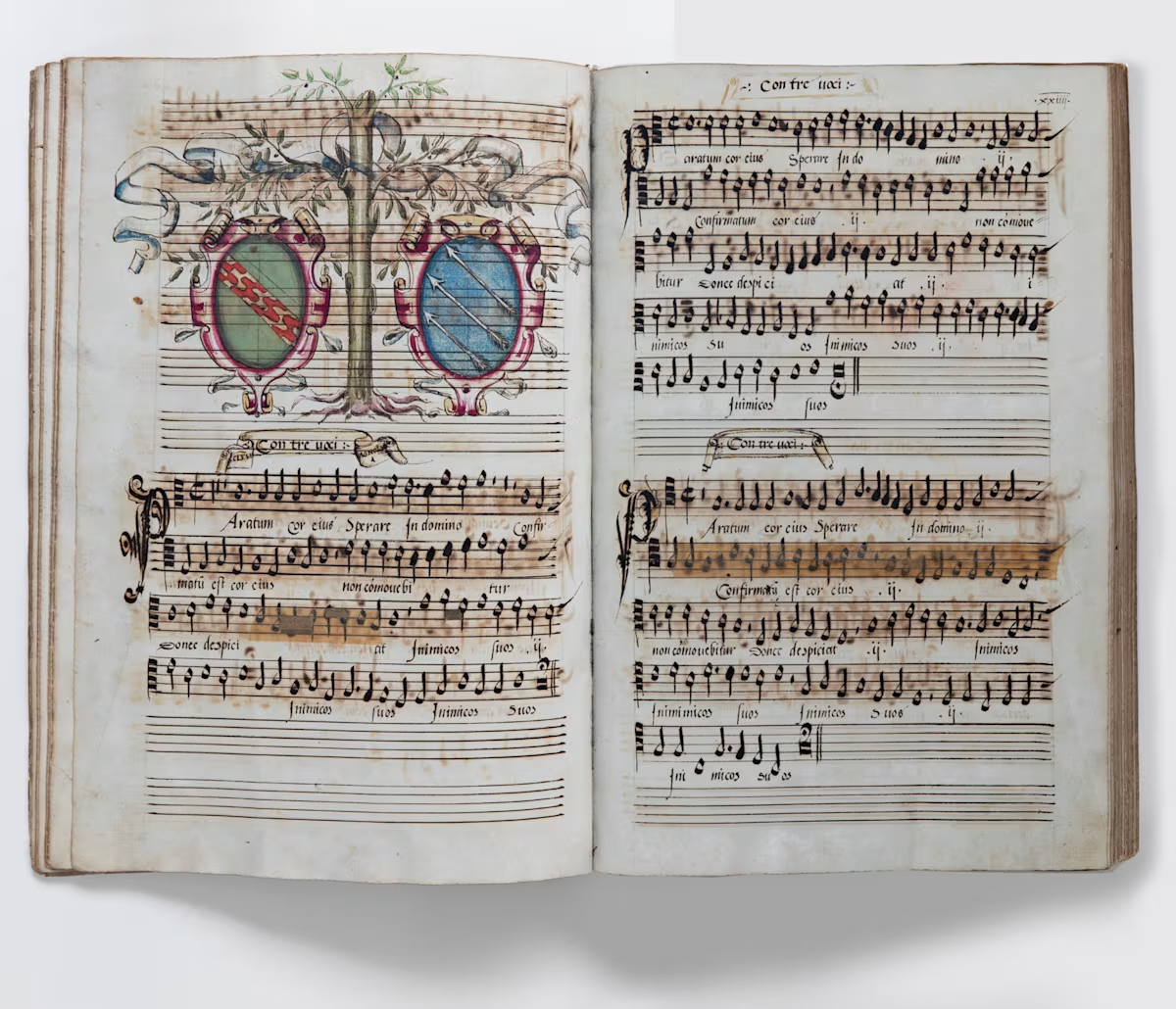
The Biffoli-Sostegni manuscript was copied in 1560 for two nuns who lived at the Clarissan convent of San Matteo in Arcetri, a small community about a mile south of Florence. It is the only 16th-century manuscript of polyphony that we can definitively locate in a convent, so it is an invaluable resource for learning about nuns’ music-making. The majority of records we have for this kind of study is found in chronicles, account books, descriptions, proscriptions, or letters, so while we know about how involved women were in making music in the Church, we know very little about the music itself.
The nuns that give their names to the manuscript, Suor Agnoleta Biffoli and Suor Clemenzia Sostegni, have left some historical traces: both were admitted in the 1540s, and both lived until the 1600s. Suor Clemenzia was abbess of the convent at least twice from 1600 until 1602, and again in 1608; and some of her correspondence with the archbishop survives. We know less about Suor Agnoleta, but we do know she had a sister, Gemma Biffoli, who was the victim of an attempted murder by the tenor Francesco Rasi.
And there is this strange connection to San Matteo’s most famous nun, Suor Maria Celeste Galilei, Galileo Galilei’s elder daughter. Galileo’s two daughters, Virginia and Livia, entered San Matteo in the early 1600s, and became Suor Maria Celeste and Suor Arcangela. Their brother Vincenzo married Gemma Biffoli’s granddaughter Sestilia – Suor Agnoleta’s great niece. Suor Maria Celeste has a connection to Suor Clemenzia, too, since she was admitted to the convent to replace the old woman – the convent was only allowed a certain number of nuns on a regular dowry, and a new girl could only be admitted when one of those nuns died.
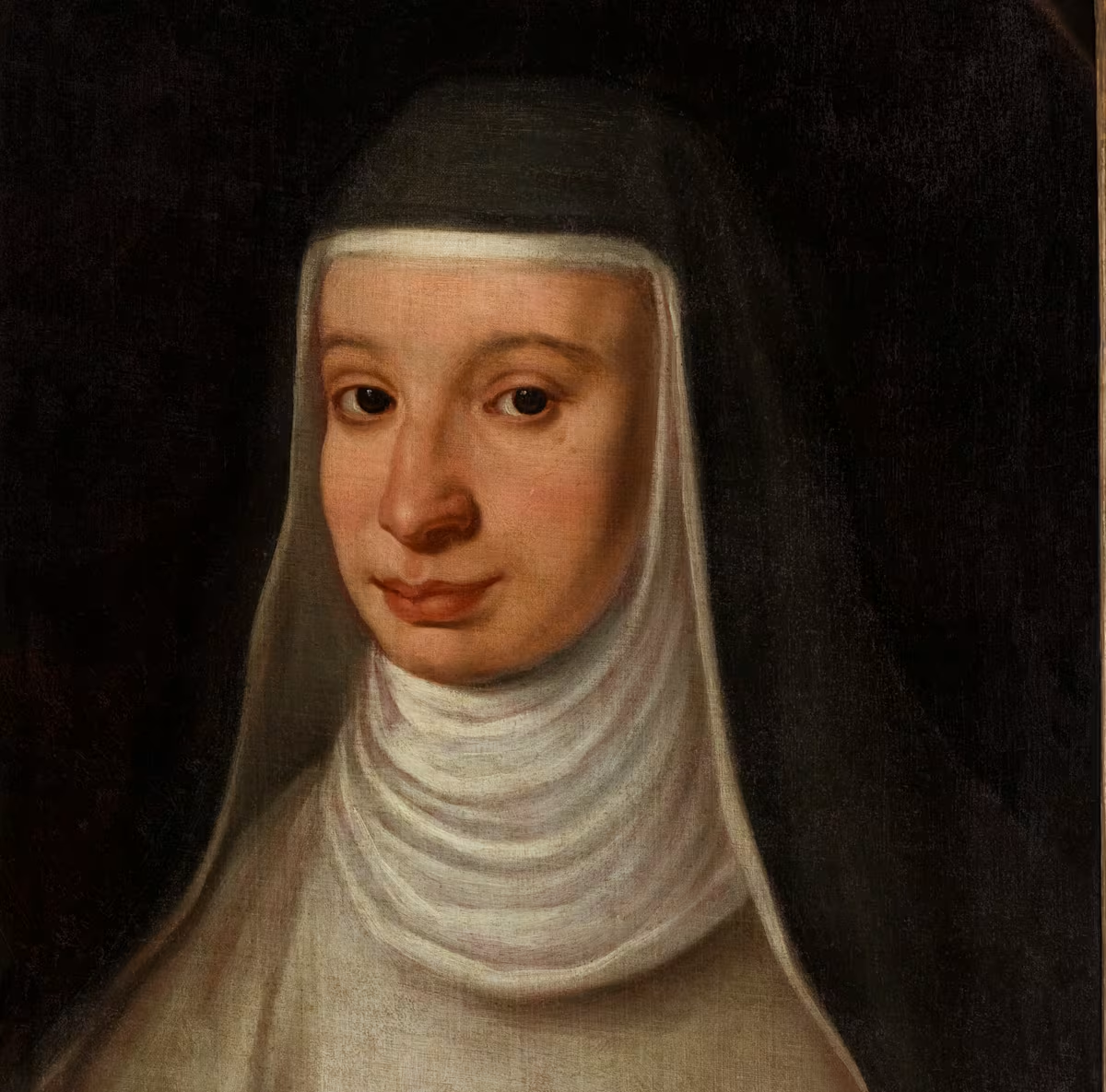
About five years before her death in 1634, Suor Maria Celeste took responsibility for teaching canto fermo (psalm recitation in chant) at the convent, and for organising the Divine Office, the daily cycle of eight services in the choir. She almost certainly had the Biffoli-Sostegni manuscript at her disposal to find music for the most important feasts. I love the feeling of continuity that the familial connections between these women gives to the bigger picture of musical life at the convent.
You’ve spent many years studying this particular manuscript – what first drew you to it, and what has kept you returning?
I first became interested in the manuscript just over ten years ago, when I came across the work of Lucia Boscolo, who published a codicological study back in 1996. I was looking for concordant settings of the motets I eventually attributed to Suor Leonora d’Este. The Biffoli-Sostegni manuscript has a setting of the text Salva sponsa Dei, the Magnificat antiphon for Second Vespers for Saint Clare, and I wanted to see if it was the same one. It was not! And it is very odd indeed. I found the manuscript fascinating and beautiful, and promised myself I’d return to it when I finished my book on women and music in 16th-century Ferrara. I thought at best it might have interesting repertoire for Musica Secreta and Celestial Sirens, even if there was nothing left to learn about its history.
The nuns’ book was copied by a Fra Antonius Morus, whose name is often modernised to Antonio Moro. We know very little about him, but he copied at least two other manuscripts that are very important to Florentine musical history: the so-called Vallicelliana Partbooks, which contains sacred repertoire from the 1530s; and the ‘P.M.’ collection of Lamentations settings, which is now in the Biblioteca Nazionale in Florence.
When Musica Secreta was invited to Florence in 2018, I decided to add a few days to the trip to look at the P.M. manuscript, and that’s where I found the complete Lamentations for Good Friday by Antoine Brumel. I rushed back to the flat to show Deborah (Roberts, my co-director), and once we were back in the UK and I’d confirmed no one else had made the discovery, we were so excited! We knew we had to record the Lamentations, so I thought maybe some of the motets in the Biffoli-Sostegni manuscript would work well to complete the disc. I transcribed the astonishing Salve regina first, and it completely bowled us over with its strange beauty. So we chose a handful of Marian motets from the manuscript to record with the Brumel Lamentations for our 2019 album, From Darkness Into Light (Obsidian CD719).
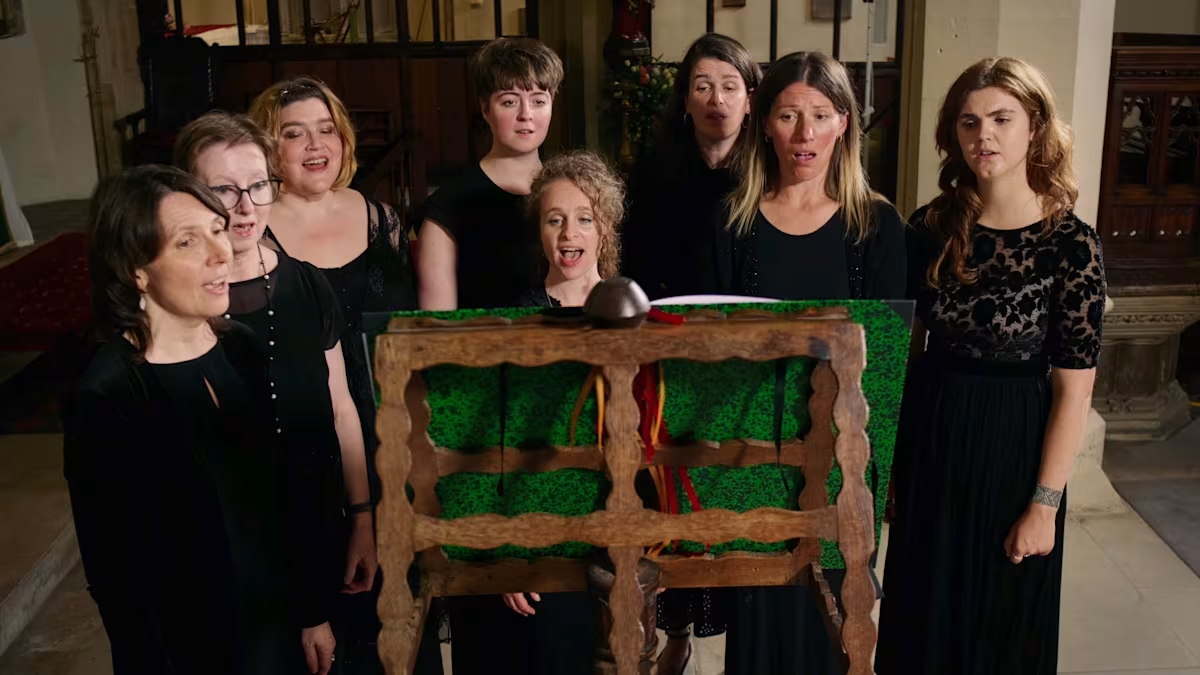
The Salve Regina from the Biffoli-Sostegni manuscript, performed by Musica Secreta on their album, From Darkness Into Light
Boscolo hadn’t published full transcriptions of any of the works apart from the Salva sponsa Dei, and the more I transcribed, the more intrigued I became. The music was so varied: there were pieces that could date from the late 15th century as well as motets that probably were composed for the nuns contemporaneously with the book’s production in 1560; some pieces are really quite difficult to sing, others basic enough to be taught by rote. But there also seemed to be a unifying aesthetic that aligned with the works I’d attributed to Suor Leonora d’Este – a love of fleeting dissonance, close canons at the unison, and these moments of harmonic stillness.
I was particularly captivated by the settings of the Vespers psalm antiphons for St Clare, too – they are almost unique in the Renaissance repertoire. It’s overwhelmingly more common for composers to set the psalms themselves, or just the Magnificat antiphons. And here were these pieces set for four high voices, uncompromising in following the ascending modes of the antiphon chants, surprisingly challenging to sing, that felt like they were the emotional heart of the manuscript – a musical setting of the order’s origin story, telling of the life and death of St Clare. We included them on our 2022 disc, Mother, Sister, Daughter (Lucky Music, LCKY001).
Iam sanctae Clarae (anon.) from the convent of San Matteo in Arcetri, performed by Musica Secreta on their album, Mother Sister Daughter
But I was sidetracked even then by finding the Alto book of Maddalena Casulana’s five-voice madrigals, so I didn’t settle down to really concentrating on transcribing/reconstructing the whole manuscript until 2023, when I was lucky enough to be awarded a Leverhulme Emeritus Fellowship for 12 months of study and recording – the results of which are on our 2025 disc, ‘Ricordanze; a record of love’ (Lucky Music, LCKY005) and my Cambridge Element, ‘Music at a Florentine Convent: The Biffoli-Sostegni Manuscript and Suor Maria Celeste Galilei’, which was digitally released back in December, and will also appear in print on 31 January.
In your work on it, what was the most thrilling or revealing moment of discovery?
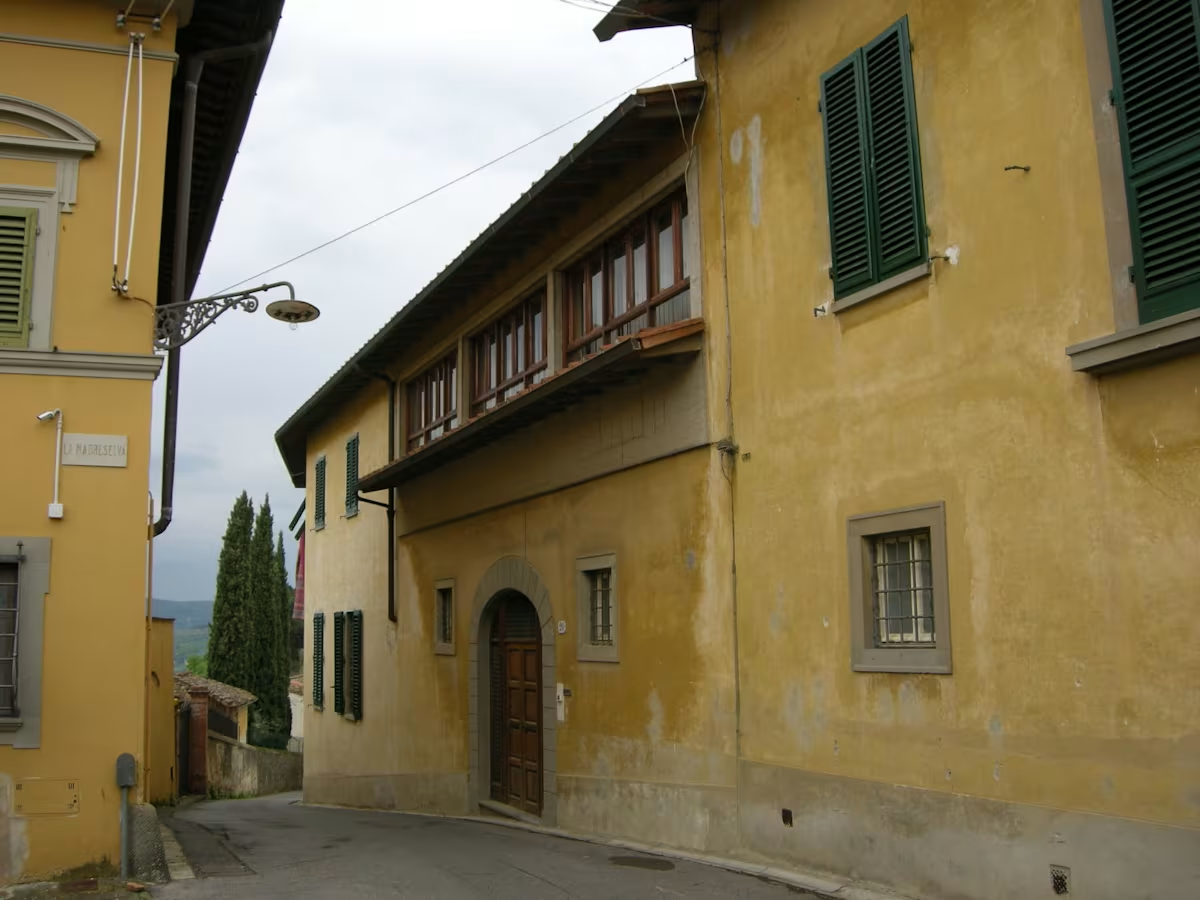
Goodness, there have been so many, but probably the moment in February 2020 I opened the bound volume of the convent’s Ricordanze – the only 16th-century document still surviving in the archive of San Matteo in Arcetri – and almost instantly found Suor Clemenzia and Suor Agnoleta, the dates they entered the convent, their fathers’ names, and even the size of their dowries. I had been searching in vain in the archives of another convent, convinced that such a beautiful manuscript couldn’t have had its origin in such a modest place. San Matteo was not a very prestigious house and its nuns were not from Florence’s elite families, and yet here was proof that it had a rich musical life. And then I had to close the book up and walk away because I had a flight booked that afternoon, and Covid was already in northern Italy. I wasn’t able to return for another two years.
What kinds of decisions do you find yourself making as a scholar and performer when working on damaged or incomplete sources such as this? Where do you draw the line between historical fidelity and imaginative interpretation?
There are two issues here: the recomposition of incomplete music, and then performance decisions around instrumentation and transposition. The manuscript is substantially damaged by ink corrosion, and because it is a choirbook, sometimes two parts are missing at more or less the same point in the music because the pages have been eaten through at exactly the same place. Almost all of the 78 works in the Biffoli-Sostegni manuscript are anonymous – only three composers (Moro himself, Adriano Willaert, and Francesco Bocchini) are named, and five other composers can be identified by concordances, so it’s mostly not possible to complete missing parts from other sources. There is an added challenge with this music because it’s for equal voices. Even in the 16th century, counterpoint instruction treatises didn’t include equal-voice composition because it almost requires the composer to break the rules. I’ve only really gained the confidence to do this sort of reconstruction through what now amounts to ten years of working almost exclusively with this kind of texture, and – of course – a great deal of trial and error.
Performance decisions are a little more fun: I have documents that show exactly what the Archbishop of Florence was down with and what he was not, in terms of what instruments nuns could use in choir (organs and viols, good; violins and lutes, absolutely not) where and when they were allowed to sing solo, and whether they were allowed to ornament (are you kidding? No). But, as we also know, the rules were broken all the time, and what the nuns did in their enclosed spaces could not be observed directly by their priest. I would say, though, that there is a lot of evidence for both sexes that singing polyphony with instruments was the predominant method of performance, and in convents that was most often with an organ, with or without additional support from bass instruments.
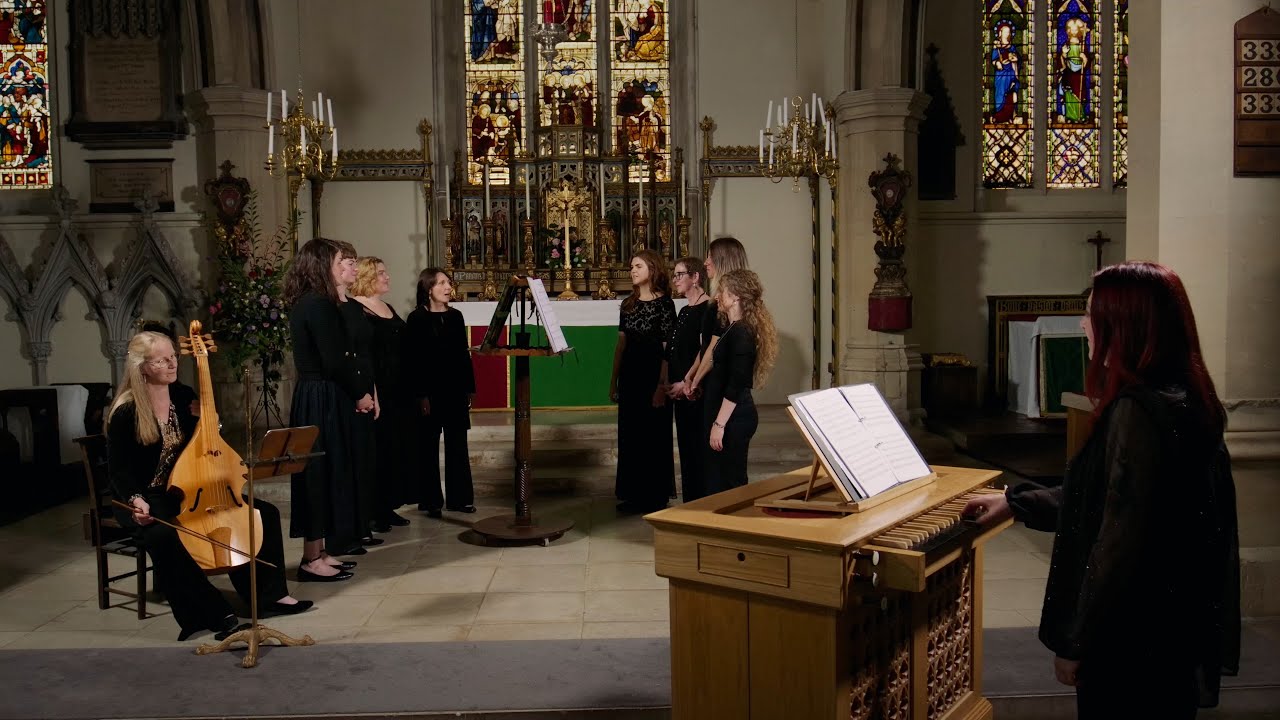 ▶
▶Messa sopra Recordare Virgo Mater: Agnus Dei (Anon.) | from Musica Secreta’s latest album, Ricordanze: A record of love
None of the pieces in the Biffoli-Sostegni manuscript requires selective transposition, as a convent choir might have used for published works by Suor Raffaella Aleotti or Suor Chiara Margarita Cozzolani – that is, the cantus transposed down an octave, or the bassus and perhaps the tenor transposed up with the organ covering them at their written octave.
There is no right way or wrong way to perform all 16th-century polyphony – each piece needs to be taken on its own merits. Does the bassus operate almost independently of the upper voices, or do they intertwine so that no one voice carries a functional bass line? Is there a well-defined melody, or a clear duet texture between two voices? Do the singers need to transpose up or down to make the tessitura comfortable, and can that transposition be accommodated by instruments tuned in meantone? Who do we have available for this gig? All these questions and more affect how we choose to perform the music, and those choices are not set in stone.
You can continue with the second part of Laurie Stras’s interview for Continuo Connect here. Musica Secreta’s latest album, ‘Ricordanze: a record of love’ is available to purchase on Musica Secreta’s website as well as on Bandcamp. Laurie Stras’s book, ‘Music at a Florentine Convent: The Biffoli-Sostegni Manuscript and Suor Maria Celeste Galilei’, will be available in hard copy from Cambridge University Press from 31 Jan 2026.
Share this
Keep reading
From kitchen to cathedral: the accidental art of festival-making
Rachel Podger, a Continuo Foundation Patron, has spent two decades creating a festival as open-hearted and inquisitive as her own music-making. She tells Ashutosh Khandekar how the Brecon Baroque Festival evolved almost by chance.
LIFEM 2026: Interview with Eun Sol Lee
The Early Music Shop caught up with Sol to find out more about her year since she won the competition, and what we have to look forward to in her performance at LIFEM this year...
JS Bach, and a cabinet of curiosities: Jorge Jiménez
Violinist, director and composer Jorge Jiménez talks to Simon Mundy about his latest album Curiosa: Lost & Found Tunes, his new Bach weekend in Ipswich, and his freelance career balancing life in rural Essex with regular work in Spain.