

Feature
Beethoven revisited
Violin sonatas, historical practices, and the art of spontaneity
Share this

BY JACQUELINE ROSS | FIRST PUBLISHED 24 JAN 2026
Acclaimed violinist Jacqueline Ross enjoys a varied career that spans both modern and historically informed performance practices. In her piece for Continuo Connect, she reflects on her evolving relationship with Beethoven’s violin sonatas, and her research-led titular project, through which she explores how period instruments, early sources, and a renewed sense of spontaneity have been reshaping her approach to some of Beethoven’s most familiar works.
With Beethoven’s bicentenary year approaching in 2027, it seems a good time to take a fresh look at some of his most beloved works – the violin sonatas. It wasn’t that long ago that Beethoven’s music would hardly have been considered ‘Early Music’, or in any need of rediscovery. But since the beginning of this century, there has been a resurgence of interest in historical performance practices of the late-18th and early-19th centuries. With this new research, we can discover a treasure-trove of information and ideas which, for me, have opened up a fresh and exciting approach to playing Beethoven.
As a violinist, I first studied and performed Beethoven’s sonatas together with grand pianos. Although I greatly enjoyed the wonderful warm resonance of a modern Steinway, matching the projection and power of these instruments became a constant challenge. This sometimes led to projecting excessively and sustaining with greater force – often at the expense of nuanced dynamic variation and harmonic shaping, particularly in the pianissimo (pp) – mezzopiano (mp) range. Performing the sonatas with fortepiano, as they would have been played in Beethoven’s time, revealed many new possibilities: Concerns of projection and balance between violin and piano were no longer paramount, allowing a more natural dialogue of equal voices to emerge. This, in turn, led me to change to gut strings (used by violinists well into the 20th century). I found that they offered a more poignant sense of ‘speaking’ than the metal strings, whose tone quality can be comparatively uniform.
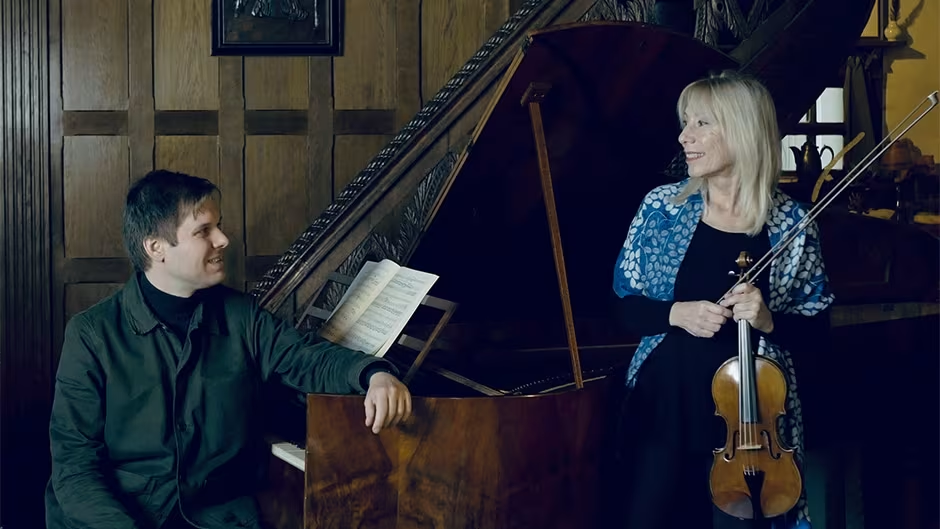
When I first began working on Beethoven Revisited, I was looking for ways in which historical performance techniques could be used to help communicate the drama and excitement I heard in Beethoven’s music. This project has developed into what now seems like an epic journey, involving three years of researching and performing the complete set of ten violin sonatas, along with Beethoven’s three early works for violin and fortepiano: a set of Variations, a Rondo, and Six German Dances. Further plans are now leading up to the Beethoven bicentenary in 2027 and beyond, including recordings of the complete works together with fortepianist Artem Belogurov, a specialist in historical keyboards and expressive techniques.
My research began by delving into the fascinating early biographies of Beethoven – from his pupil, Ferdinand Ries (1784–1838), we have these intriguing insights into the composer’s character as teacher:
‘If I made a mistake ... or struck wrong notes or missed intervals ... he rarely said anything. However, if I lacked expression in crescendos etc, or in the character of a piece, he became angry, because, he maintained, the first was an accident, while the latter resulted from inadequate knowledge, feeling, or attention.’
…and as performer:
‘His improvising was ... the most extraordinary thing one could ever hear, especially when he was in a good mood or was irritated. The wealth of ideas which poured forth, the moods to which he surrendered himself, the variety of interpretation, the complicated challenges which evolved or which he introduced were inexhaustible.’
I also discovered wonderful descriptions of artistic music-making during Beethoven’s time, often hidden in 18th- and early 19th-century reviews, instrumental manuals, and teaching materials. For example, there is substantial evidence that performers were expected to use far greater flexibility in tempo and rhythm than has traditionally been used in this repertoire. CPE Bach (1714–1788) described how ‘one can often commit the most beautiful offences against the beat…’ by either moving the tempo forward or backward as an ensemble, or by moving the tempo through rubato as an individual within an ensemble. Similarly, the French violinist and composer Pierre Baillot (1771–1842) discussing the importance of tempo flexibility in his book, L'art du violon (‘The Art of the Violin’) writes: ‘The character of a passage is generally enough to lead the performer to improvise it according to the inspiration of the moment...when he is carried away by expressiveness’.
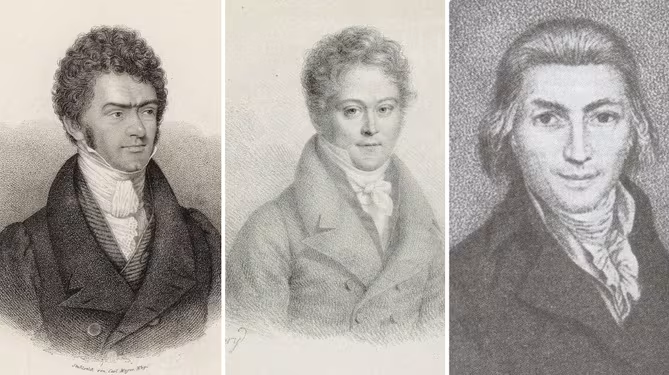
I found it particularly interesting that the German composer and pianist, Daniel Gottlob Türk (1750–1813), used the image of an orator to describe accenting or highlighting notes for expressive means. In his Klavierschule (‘School of Clavier Playing’), he writes: ‘Another means of accent ... is lingering on certain tones. The orator not only lays more emphasis on important syllables and the like, but he also lingers upon them a little.’ This idea of exploring a greater sense of spontaneity, together with a more personal reading of tempo and rhythm, have greatly influenced our interpretation of Beethoven’s music.
There are many neglected instrumental techniques to rediscover in these early treatises. For example, in keyboard playing, the practice of ‘arpeggiation’ (the spread of chords) greatly affects the timing of a passage; for violinists, ‘portamento’ (the use of audible sliding) was used to create more of a singing, ‘cantabile’ effect and adds to a personal sense of timing. In terms of ensemble playing and dialogue, Artem and I found that this more flexible timing allows freedom from strictly vertical readings of Beethoven’s scores and leads to a more conversational effect. Marion Ranken (1884–1966), a violin student of Joseph Joachim described this freer rhythmic approach beautifully: ‘You must consider the notes free from the fetter of the beat and, above all, must play the passage with swing and intention and with the goal always in view’.
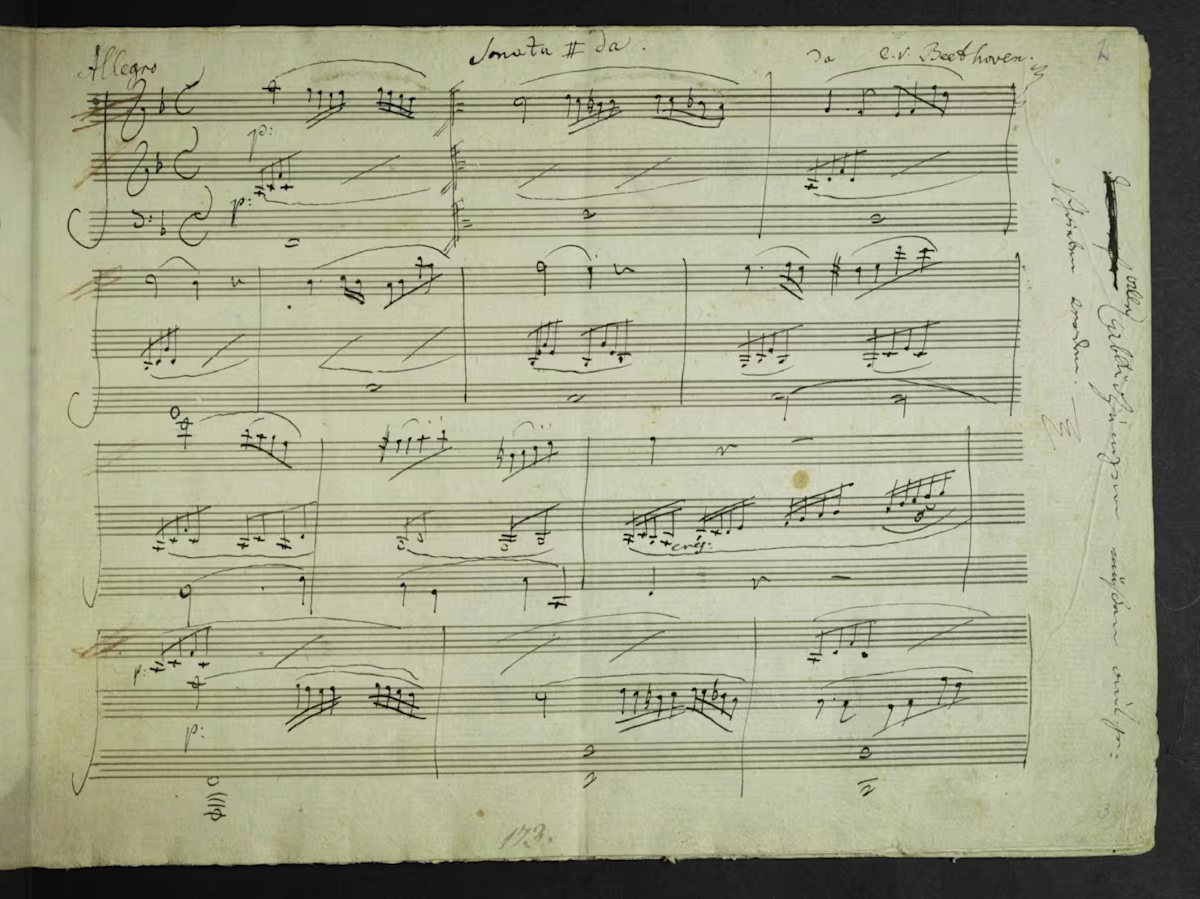
Another fascinating portal into performing Beethoven’s music comes from his pupil, Carl Czerny (1791–1857), who left us a treasury of information on each movement of the ten violin sonatas, including metronome marks, short descriptions on character, and practical performance advice. Selected remarks from Czerny, illustrated here in audio clips from our live concert at Finchcocks, Richard Burnett Collection on 28th September 2025, are particularly illuminating:
Violin Sonata No. 5 in F, Op. 24 | I: Allegro
‘One of the most beautiful and melodious of Beethoven’s Sonatas, which, in every sense, calls for the refined performance of both players. The time is a tranquil Allegro; which, however, here and there does not exclude a more animated movement.’
Violin Sonata No. 5 in F, Op. 24 | IV: Rondo – Allegro ma non troppo
‘Of the like melodious character as the first movement...[but] many of the passages demand a fiery and brilliant performance.’
Violin Sonata No. 4 in A minor, Op. 23 | III: Allegro molto
‘To be played as light and quick as the first movement [which is marked Presto], but more impassioned.’
The ten violin sonatas reveal a composer who thought in dialogue, gesture, and character. Ultimately, by taking on board the expressive freedoms described by Beethoven’s contemporaries, and by working with instruments closer to those he knew, we can approach these masterful works as living conversations, charged with spontaneity and imagination. In this sense, it is an invitation to performers and audiences alike to listen afresh, to remain curious, and to rediscover the vividness that continues to make Beethoven’s music feel so vitally present.
Jacqueline Ross and Artem Belogurov will perform an all-Beethoven programme on 13 February 2026 at Turner Sims (Southampton University), where they will also give masterclasses as part of the ‘Artistic Temperaments Festival’. The programme will be featuring the first and third sonatas from the Op. 12 collection, and the first of the Op. 30 sonatas, alongside two of the rarely-heard early works: the Twelve Variations on a theme from Mozart’s ‘Marriage of Figaro’, and the Six German Dances.
Share this
Keep reading
Exploring the golden age of the ‘City of Dreams’
‘City of Dreams’ is an exploration of two centuries of Renaissance Florence at Brighton Early Music Festival. We spoke to Oliver Webber, founder of Monteverdi String Band, and writer Saria Steyl about how the project came together.
LIFEM 2026: Interview with Eun Sol Lee
The Early Music Shop caught up with Sol to find out more about her year since she won the competition, and what we have to look forward to in her performance at LIFEM this year...
The Best of Rachel Podger
This playlist celebrates 'the unsurpassed British glory of the baroque violin' (The Times) - that is of course Rachel Podger.