
Film
Ensemble Hesperi with Hesperi Voices | Celestial music did the Gods inspire
Temple Church, London
Share this


FIRST PUBLISHED 7 MAR 2026
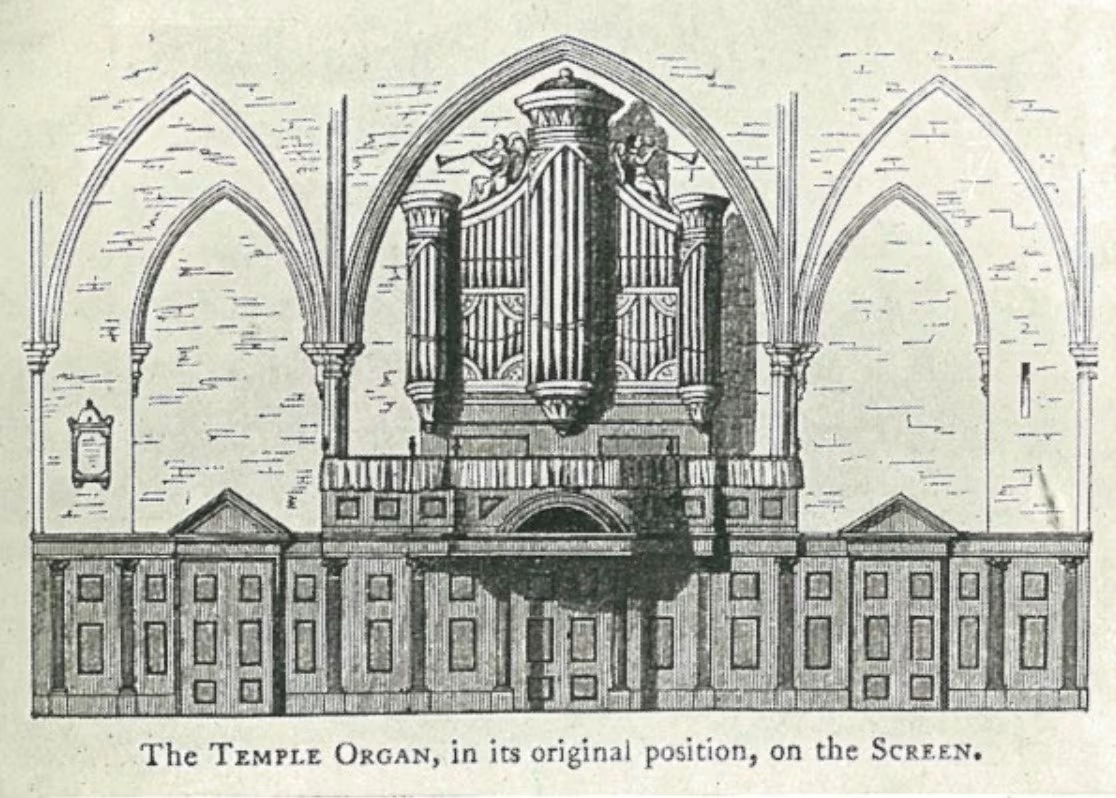
Ensemble Hesperi’s programme for ‘Celestial Music did the Gods Inspire’ celebrates the historic ‘Organ Battle’ at Temple Church in the 1680s. Following the refurbishment of the church by Christopher Wren, a dispute arose as to which of two leading organ builders of the day, Bernhard Smith and Renatus Harris, should furnish the church with a new instrument. The Benchers of Middle Temple had a strong preference for Smith’s organ, but those of Inner Temple favoured the challenger, Harris.
In a matter of months, the two men erected two organs at opposite ends of the church, and vied with each other, showcasing their instruments on alternate Sundays. Each organ maker invited the most celebrated players of the day, who astonished the crowds gathered for the ‘trials’ with their virtuosic performances. As the societies of the Inner and Middle Temples struggled to choose a winner, a fierce rivalry developed, and each builder tried to outdo the other, rumours of sabotage never far away. Finally, Smith’s organ triumphed, preferred for its volume and tonal qualities. The organ by the unsuccessful candidate, Harris, was subsequently installed in Christ Church Cathedral, Dublin, and still survives in St John's Church, Wolverhampton.
The programme features music by the two organists who demonstrated Smith’s winning instrument, John Blow, and his student Henry Purcell. The two men were leading musicians in late 17th-century London, particularly in the realm of church music. Sadly, Blow’s illustrious career is largely forgotten today, but he and Purcell monopolised the high offices at the choral establishments of the Chapel Royal, St Paul’s Cathedral and Westminster Abbey.
The programme was performed and filmed at Temple Church on 13 October 2023, supported by a grant from Continuo Foundation.
PROGRAMME
John Blow ‘The Lord is King, and hath put on glorious apparel’
Henry Purcell ‘Rejoice in the Lord alway’, Z49
Sonata in three part No. 1 in G minor, Z790
Blow ‘Lord, who shall dwell in thy tabernacle?’
Purcell ‘Celestial music did the gods inspire’, Z322
Blow Trio Sonata in A
‘And I heard a great voice’
PROGRAMME NOTES BY MARY-JANNET LEITH
Ten years Henry Purcell’s elder, John Blow was awarded a doctorate in music at the age of 28, and was in great demand as a teacher, boasting not only Purcell, but also William Croft and Jeremiah Clarke as his pupils. However, the vast majority of Blow’s output was sacred, as demanded by his church roles, and he composed over 100 anthems, many at a very young age. His verse anthem, ‘The Lord is King, and hath put on glorious apparel’, set to the text of Psalm 93, features alto, tenor, and bass verses, preceded by a joyful instrumental symphony. Purcell’s verse anthem, ‘Rejoice in the Lord’, has been known as ‘The Bell Anthem’ since the time of its composition in the mid-1680s. In 1679, Purcell had taken up the role of organist of Westminster Abbey, upon Blow’s resignation from the same, and in 1682, took up a post at the Chapel Royal. During this period, he appears to have severed his previously close connection with the theatre, instead composing largely sacred music, including two still-popular anthems, ‘My heart is inditing’ and ‘I was glad’, for the coronation of King James II. The dance-like Prelude of ‘Rejoice in the Lord’ weaves the bells’ peals through the instrumental lines, heralding a triple section for three solo voices, which is repeated by the full choir for a joyous ending. In stark contrast, Purcell’s Sonata in B minor from his Ten Sonatas in Four Parts strongly expresses the darkness of this key, and showcases a now-unfamiliar style which reflects the cosmopolitan musical tastes of late 17th-century England. Unknown upon his death, Ten Sonatas in Four Parts was one of several collections published posthumously by Purcell’s widow, Frances, who arranged for them to be printed and sold, in this case by Henry Playford of Temple Change.
Blow’s ‘Lord, who shall dwell in thy tabernacle?’, written around 1680, is the result of a period of compositional experimentation, in which he made increasing use of wind instruments, perhaps inspired by the arrival of several talented French players in London. Blow’s setting of this text of Psalm 15 is somewhat darker in mood than that of Purcell, scored for recorders in addition to strings. The opening symphony, featuring close dialogue between the winds and strings, is striking, and it is followed by several verse sections for alto, tenor, and two basses. Like many anthems of this period, the full choir enters only in the final section, and the work ends in the major key, conveying a sense of hope for those who follow God’s commandments. Purcell’s Ode, ‘Celestial music did the gods inspire’, was commissioned by the headteacher of a London school, Mr Maidwell, at whose premises the piece was first performed on 5 August 1689. Purcell may have been pushed for time in its composition, for he re-used the symphony from his 1684 coronation anthem ‘My heart is inditing’. The rest of the ode, however, is full of harmonic originality and elaborate word-painting. Rarely performed today, it is scored for SATB and strings, but features an alto solo in the central section, in which two recorders support the voice. The libretto, by an anonymous ‘pupil’, champions music as the balm to the cares and evils of the world.
Our programme ends with two pieces by Blow, the first a secular instrumental work, his only ‘Trio Sonata in A'. While Blow’s output was largely sacred in nature, he also composed for the theatre, and his masque Venus and Adonis (c. 1681) is an important landmark in the development of opera in seventeenth-century England. The short inter-connecting movements of this sonata drip with lyricism and operatic flair, reflecting Blow’s skill in writing for London’s many entertainment spaces. Our final anthem, ‘And I heard a great voice’, is a little-known, but exceptionally powerful setting of a text from the book of Revelation. The verse sections are scored for alto, tenor and two bass parts, the latter portraying the ‘thunderings’ of the mighty voice of God. The work ends with a cascade of alleluias, celebrating God’s eternal reign in heaven.
PERFORMERS
Hesperi Voices
SOPRANO: Eloise Irving, Victoria Meteyard, Amy Wood
ALTO: Amy Lyddon, Simon Ponsford, Ben Williamson
TENOR: Jacob Ewens, Sam Jenkins, Chris Lombard
BASS: Michael Hickman, Stuart O'Hara, Tom Lowen
Ensemble Hesperi
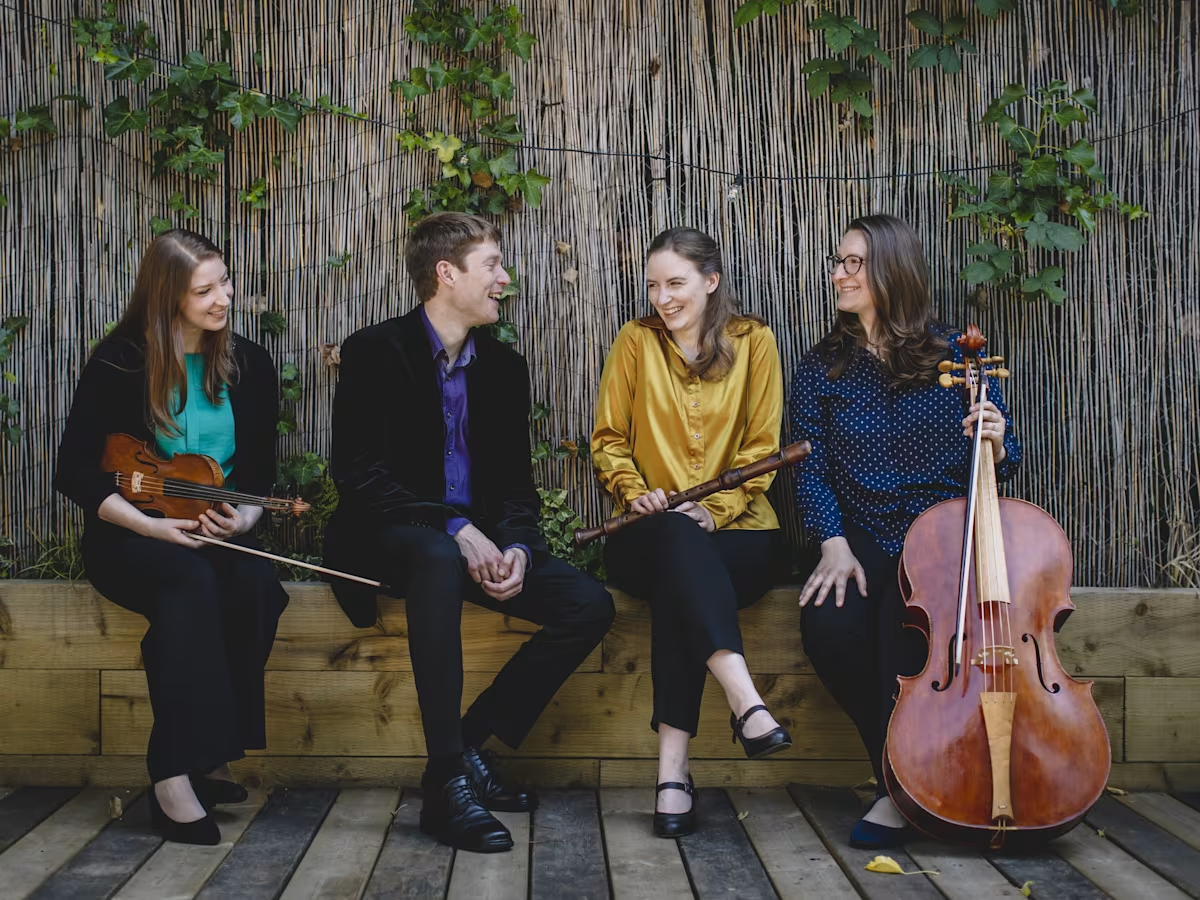
BAROQUE VIOLIN: Magdalena Loth-Hill, Maxim del Mar
BAROQUE VIOLA: Joanna Patrick
BAROQUE CELLO: Florence Petit
RECORDERS: Mary-Jannet Leith, Oonagh Lee
THEORBO: Jens Franke
DIRECTOR/HARPSICHORD/ORGAN: Thomas Allery
VIDEOGRAPHY Tom Mungall
This project was supported by a grant from Continuo Foundation
Supported by Continuo Foundation
Share this
Keep reading
In conversation: Samuel Ng
Continuo Connect catches up with Samuel Ng, cellist and gamba player with the newly formed Republic of Viols and Liturina.
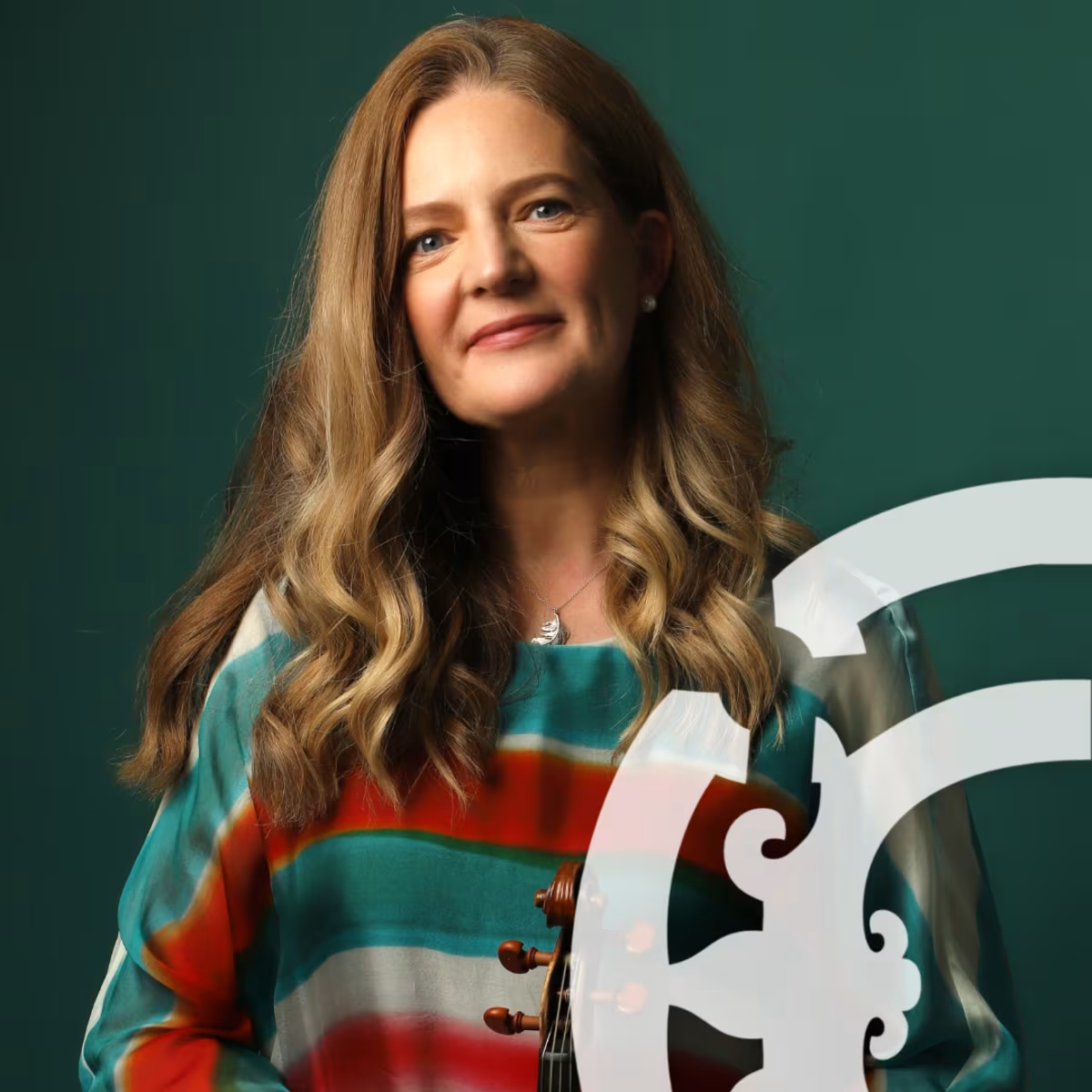
The Best of Rachel Podger
This playlist celebrates 'the unsurpassed British glory of the baroque violin' (The Times) - that is of course Rachel Podger.

Guitar Meets Square Piano: Nathaniel Mander and Declan Hickey
Continuo Connect talks to guitarist Declan Hickey and harpsichordist Nathaniel Mander about their upcoming “Dukatenkonzert” in London and the instruments they will be playing.