

Feature
Jeffrey Skidmore: Made in the Midlands
Share this

BY ASHUTOSH KHANDEKAR | FIRST PUBLISHED 07 FEB 2026
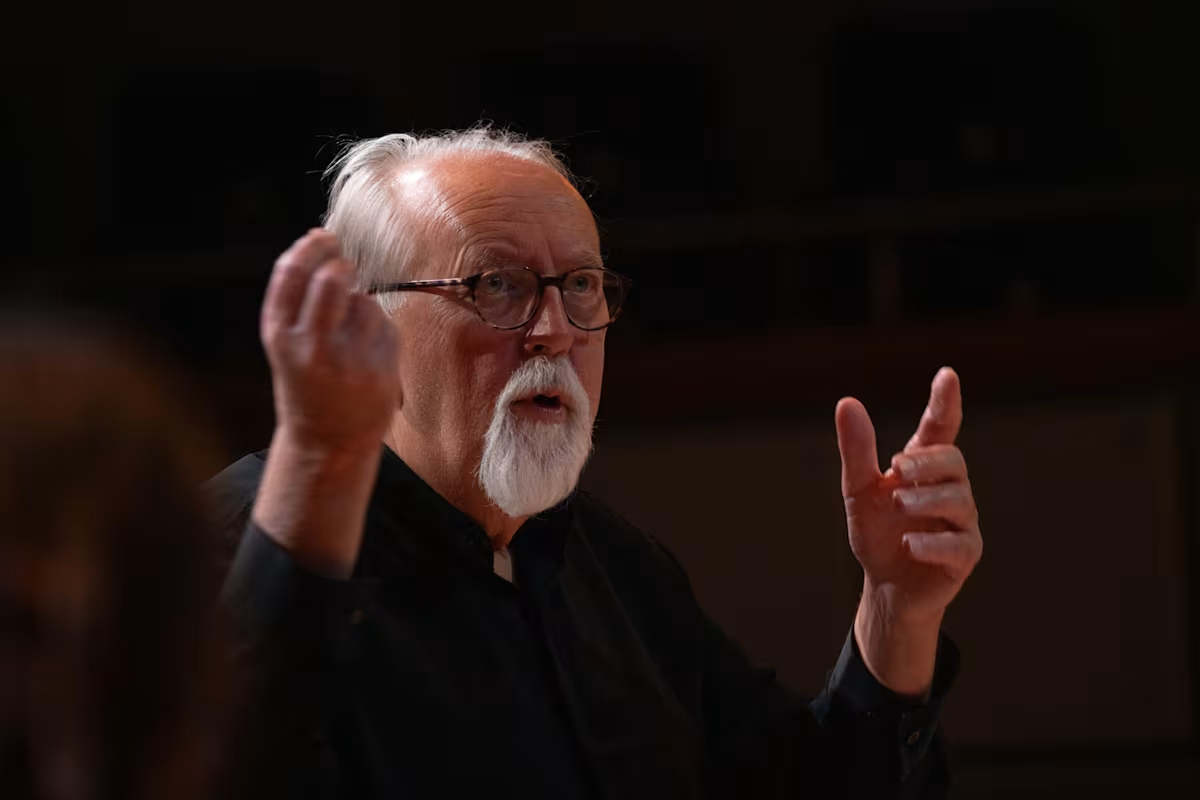
As he approaches his 75th birthday, Jeffrey Skidmore reflects on a career that has shaped musical life in Britain in distinctive ways. From founding Ex Cathedra in Birmingham to emerging as one of the UK’s leading voices in Early and French Baroque music, he is celebrated for his profound musicianship, intellectual curiosity and independent spirit.
𝄞 You can accompany your reading with a playlist curated by Jeffrey Skidmore for Continuo Connect.
Conductor, scholar and teacher, Jeffrey Skidmore has never been much interested in following musical fashion. The wry, gently maverick musical luminary founded Ex Cathedra in Birmingham in the late 1960s, with little thought of where the centre of the British music world was supposed to be. ‘People still ask me why I didn’t base myself in London – Why would I want to do that?’ he asks, genuinely puzzled. Remaining in Birmingham, he says, gave him independence. ‘I could be my own man,’ I didn’t have to fit into a London scene.’ For 20 years, he built Ex Cathedra alongside a career teaching in comprehensive schools in Birmingham. ‘There was a group of singers. There was a market. We got very good audiences in those early days.’
Over the years, Skidmore has established Ex Cathedra as one of the city’s most distinctive musical ensembles, known for its work in Early and Baroque instrumental and choral music, and inspiring loyalty among singers and audiences alike. Alongside his conducting, Skidmore has spent much of his life shaping the lives and careers of young musicians, and steadily building a repertoire driven by a compulsion to explore.
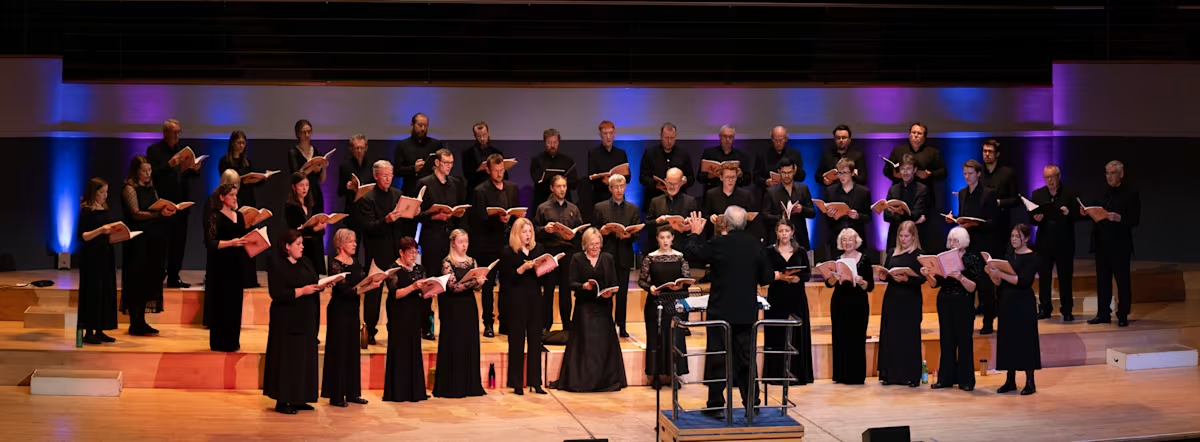
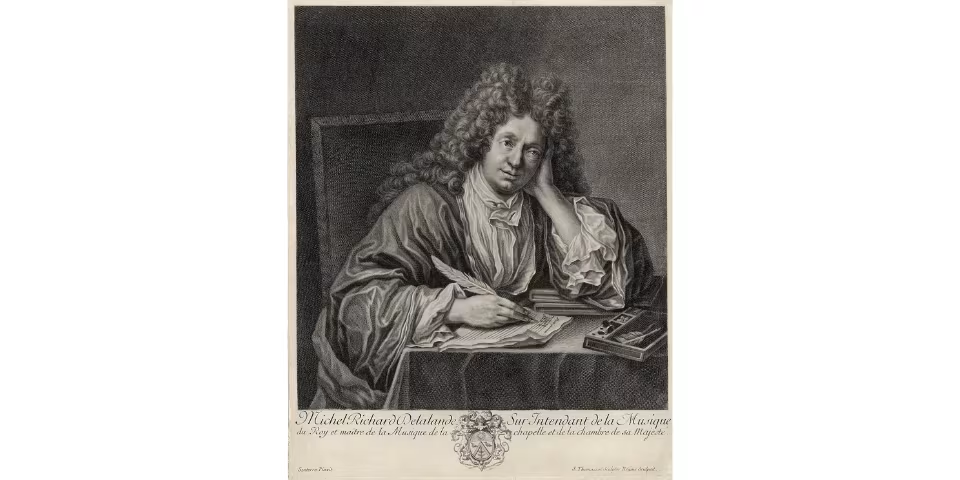
Skidmore’s current preoccupation finds him immersed in the world of French Baroque, a repertoire he regards as ‘home’. He’s preparing a programme called The Sun King’s Favourite. Marking the 300th death anniversary of Michel-Richard de Lalande (also, ‘Delalande’), the programme features sacred works written for the Chapelle Royale in Versailles. As we speak, Skidmore picks up a book he first encountered more than 60 years ago. ‘I was looking through it again to find some inspiration,’ he says.
The volume, entitled Notes et références pour servir à une histoire de Michel-Richard de Lalande, published in 1957 and edited by Norbert Dufourcq, contains scholarly writings and research on a composer who dominated sacred music at the court of Louis XIV. Skidmore was 12 when it was shown to him by a young music teacher at a Birmingham Grammar Technical School. ‘It wasn’t so much for its musical content, but because it’s a really old-fashioned book. the pages had to be cut apart with a paper knife to be read. You could see the little feathery edges. Some had never even been opened.’
At the time, Skidmore didn’t read the book. He would return to it properly only decades later. Even so, the encounter stayed with him. ‘In a strange way, it must have sparked something,’ he says. ‘I was a working-class boy from a council estate, and here was de Lalande, a French Baroque composer, turning up in my 12-year-old life. I didn’t think about it again for years – but it clearly stayed in there somewhere.’
That teacher, Walter Jennings, was fresh out of Birmingham University and proved a decisive influence: ‘He used to play us Palestrina masses in class,’ Skidmore says. ‘I was probably the only boy paying attention. He was very inspirational – and very demanding.’ Music quickly became central. Church choirs followed, then a place as a schoolboy lay clerk at Birmingham Cathedral under Roy Massey, and eventually a choral scholarship to Magdalen College, Oxford.
MICHEL-RICHARD DE LALANDE: THE SUN KING’S FAVOURITE
As Ex Cathedra rehearses its latest programme, 'The Sun King’s Favourite', Jeffrey Skidmore returns to a composer who has been quietly central to his musical life for decades.
Three hundred years after his death in 1726, Michel-Richard de Lalande remains one of the most significant – and underappreciated – figures of the French Baroque. For more than three decades, he shaped the sound of sacred music at Versailles, becoming Louis XIV’s preferred musical voice and the dominant composer of the Chapelle Royale.
For Skidmore, De Lalande stands apart from his French contemporaries. ‘I think he’s a more spiritual composer than Lully or Rameau,’ he says. ‘Despite everything we know about Louis XIV’s outwardly lavish lifestyle, he was deeply religious. The liturgy really mattered to him – and De Lalande’s music captures that.’That spiritual intensity lies at the heart of ‘The Sun King’s Favourite’. Works such as De Profundis and Cantate Domino combine ceremonial grandeur with a strain of penitential darkness that clearly spoke to the King. ‘Louis knew he was a sinner – and he didn’t want to be,’ Skidmore suggests. ‘There’s a pathos in this music that must have resonated with him.’
De Lalande’s appeal was not only emotional, but technical. ‘His counterpoint is extraordinary – on a par with Handel, not quite Bach, but close – and far more sophisticated than Lully or Rameau,’ Skidmore argues. While Rameau may surpass him harmonically, de Lalande’s ability to build layer upon layer of harmony creates an expressive density of remarkable depth.Appointed in 1683 as one of four sous-maîtres of the Chapelle Royale, de Lalande rapidly eclipsed his rivals and soon held the position alone, remaining Louis XIV’s favoured sacred composer until the end of the King’s life. ‘For Louis, it was simply: “This is the composer who writes what I want,”’ Skidmore says. ‘He clearly took pride in having discovered this genius.’
De Lalande’s musical world at Versailles was also a family one. His daughters were outstanding singers who regularly performed solos during services – a rare and striking presence of female voices in the royal liturgy. Their sound, floating down from the high galleries of the chapel, became part of the distinctive sonic identity of worship at court.
As Ex Cathedra marks the 300th anniversary of de Lalande’s death with ‘The Sun King’s Favourite’, Skidmore sees the programme as both a celebration and a corrective. ‘This music deserves to be better known,’ he says. ‘It’s profound, human, and endlessly rewarding – for performers and listeners alike.’
De Lalande De Profundis, S23 | Ex Cathedra & Jeffrey Skidmore
Oxford in the 1970s was a place of remarkable musical energy. ‘There were some great people around,’ Skidmore remembers. ‘I had a lot of discussions with Andrew Parrott, concerts with Emma Kirkby, Paul Elliott, David James. We did some really adventurous stuff – starting with Machaut and then moving on.’ His first concert as a conductor was Machaut’s Messe de Nostre Dame. ‘We knew nothing about 14th-century Latin. We just totally made it up,’ he admits, cheerfully. ‘Which, to be fair, is more or less what everyone was doing then.’
At Oxford, French Baroque wasn’t in the frame. ‘The Grands Motets need a big choir, and that came later.’ The catalyst arrived in the mid-1980s, around the time of Lully’s anniversary. ‘I wanted to do some French Baroque music,’ Skidmore says. ‘So I started looking into it. That led to Lully, then Rameau, Charpentier – and eventually Lalande.’
Charpentier Salve Regina a 3 chœurs | Ex Cathedra & Jeffrey Skidmore
His approach to the musical world of Louis XIV and Versailles unfolded gradually. ‘As always, it started with language,’ he says. ‘That’s how I get into any style.’ French Latin proved particularly revealing. ‘I knew, in theory, that French Latin existed, but I hadn’t explored it deeply. When you start researching the pronunciation and the stresses, suddenly the music makes sense. The stresses are crucial,’ he explains. ‘The musical setting of the Latin can be puzzling until you think about how the French language works. Once you speak the stresses like a French person, it all makes sense. You can still smell the garlic on the Latin. It’s definitely not Italianate.’
Skidmore’s explorations have also brought long-term collaboration with instrumentalists: Ex Cathedra has worked for many years with a consistent and distinguished group of period players. ‘For over 20 years, Micaela Comberti was our leader,’ Skidmore recalls. ‘And people like Rachel Brown and Gail Hennessy – these were the top players.’ French Baroque music initially unsettled them. ‘I guess we were all slightly scared of the unknown.’
Skidmore, together with his singers and players, developed a coherent approach to their music-making. ‘We experimented with how phrases were shaped, articulation, stresses, ornamentation… all of that,’ he says. ‘And gradually the style evolved.’ Today, French Baroque is the repertoire he feels most confident in. ‘There’s probably no style of music I understand better,’ he says. ‘I really feel at home in it.’
Rameau Castor et Pollux, Act 1: Scene 2-3 'Un tendre intérêt vous appelle' – 'Tristes apprêts' | Carolyn Sampson, Ex Cathedra & Jeffrey Skidmore
The subject of inégalité, the stretching and contracting of phrases that is such an essential characteristic of French music, brings a smile. ‘Oh, we read and read about it. We played and played. And we argued,’ he says.’ How much swing should there be? How consistently should it be applied? Eventually we realised we were all talking the same language. Now it happens instinctively!’
That emphasis on instinct balanced with academic research runs through Skidmore’s wider thinking. He has always resisted rigid rules. ‘I’m not a purist,’ he says. ‘Sometimes we do one to a part, sometimes we don’t. It depends on the music.’ French grand motets suit Ex Cathedra’s flexible forces particularly well. ‘You can have 30+ singers and still be completely authentic. And people want to sing this music. They don’t want to be left out.’
France itself has played an important role in his musical life. ‘I spent a lot of time in Paris, Versailles, Lyon,’ he says. ‘You get a real feel for the music there.’ At the same time, he is convinced that English singers bring something distinctive to French repertoire. ‘The purity of the English sound, the intelligence – it’s extraordinary,’ he says. ‘They read fast, they’re flexible, they’re quick.’
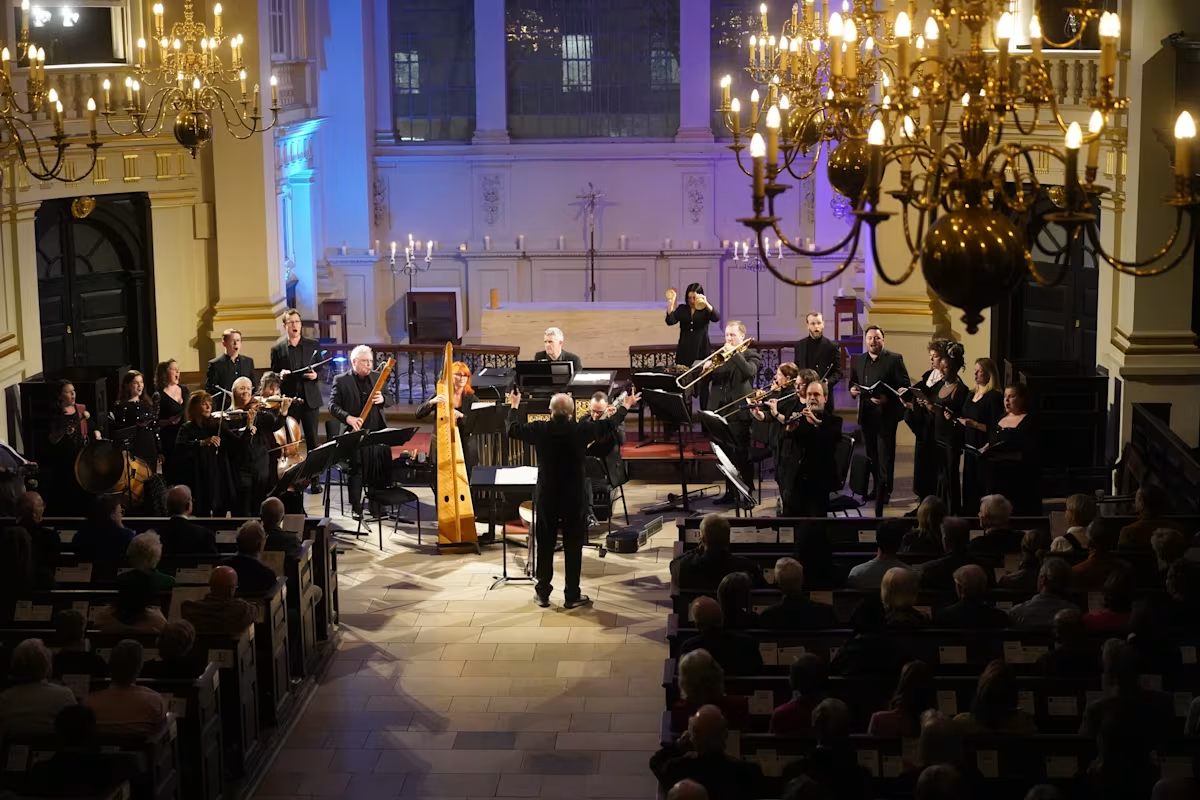
One of his former pupils in Birmingham was the tenor Paul Agnew, co-director of Les Arts Florissants. ‘I taught him A-level,’ Skidmore says. ‘And now he’s Mr French Baroque.’ Their long friendship has involved many spirited arguments about style and authenticity. ‘Can anyone do Purcell better than the English?’ Skidmore asks rhetorically. ‘No – of course they can’t. We understand it.’ For him, the richest music emerges where traditions meet. ‘Purcell is English, Italian and French all mixed together. Unless you understand all three, I don’t think you can really do it.’
The Midlands, Skidmore believes, has been unusually fertile ground for Early Music. The names trip off his tongue: David Munrow, David Wulstan (founder of Clerkes of Oxenford and Skidmore’s tutor at Oxford), Andrew Parrott, John Butt, Robert King, Lawrence Cummings… ‘Music must be in Birmingham’s air,’ he concludes, though his own role as a teacher has also been hugely influential. John Butt recently wrote to him, recalling his schooldays in the late 1970s. ‘He said, “I learned so much from playing for you”. That’s very moving!’ Skidmore says. ‘You don’t think about these things at the time – the impact on a young mind that a music teacher can have.’
As he celebrates his 75th birthday this February, I asked Skidmore whether he feels like a musical patriarch. ‘I suppose the white beard gives you some sort of status as a wise old man,’ he laughs. ‘Which, of course, isn’t true. I’m just as stupid as I ever was. In any case, I won’t stop. I’ll carry on working with students – that keeps things fresh. Meanwhile, looking back can still surprise him. ‘Sometimes I hear a recording on the radio and think, ‘Oh, that’s quite good.’ And then I realise it’s us!’
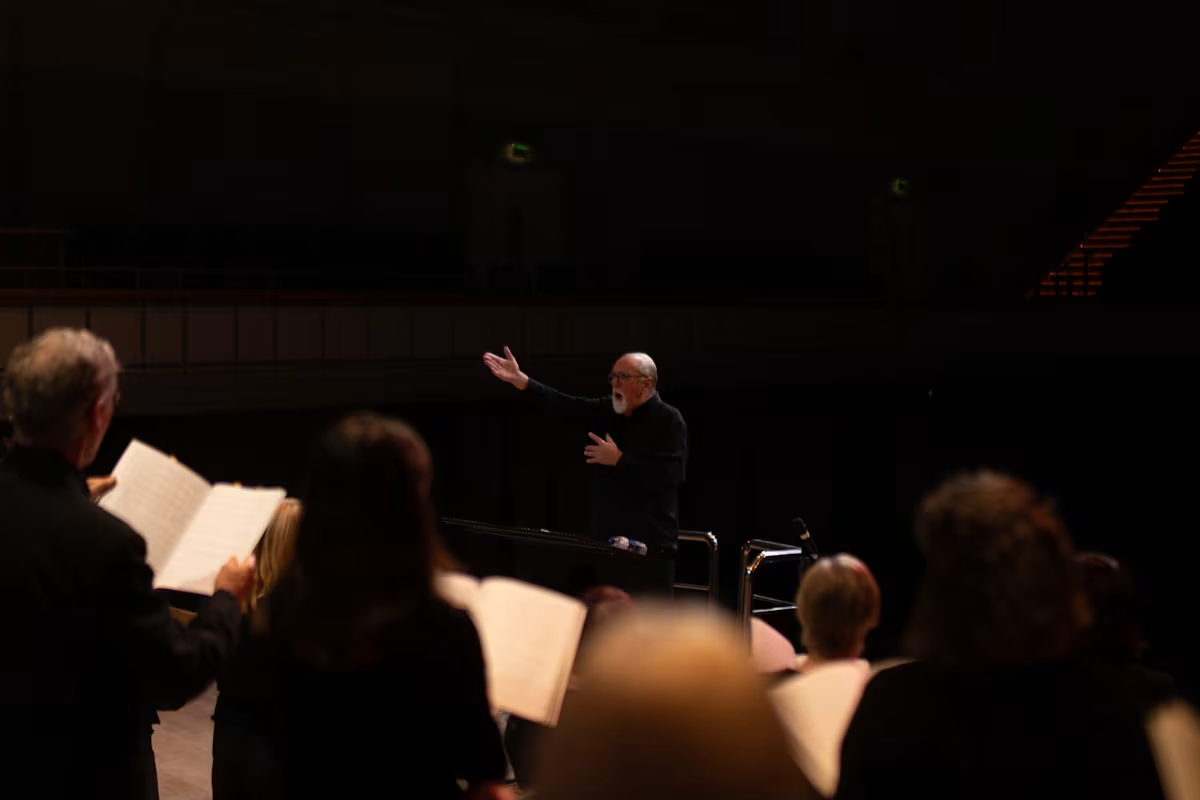
In 2027, Skidmore will step down as Artistic Director of Ex Cathedra, assuming the role of ‘Founder and Conductor Emeritus’. The search for his successor was carefully planned. ‘We started looking five or six years ago,’ Skidmore says, ‘So I’ve had time to prepare myself.’
At the end of January, the announcement was made that James Burton would take over Skidmore’s mantle, initially as Associate Artistic Director starting this spring, before becoming Ex Cathedra’s new Artistic Director in the 2027/28 season. Burton, 51, has gained plaudits for his work as the director of leading choirs and orchestras on both sides of the Atlantic, ranging from the BBC Singers to the Tanglewood Festival Chorus. His selection was the result of an inclusive search process of interviews, workshops, and rehearsals with Ex Cathedra.
‘Hearing other conductors work with the choir was strange at first,’ Skidmore admits. ‘But Ex Cathedra has to continue. We need someone with vision, who can keep people wanting to sing and play for Ex Cathedra. James struck us as a perfect fit: he has a contagious curiosity which is captivating, and a musical intelligence which allows him to take risks. This is very important for an Ex Cathedran! I am excited to see in what new directions he takes the group.’
As he prepares his de Lalande programme, revisiting a composer that first brushed past him as a 12-year-old schoolboy, there is a sense of continuity rather than closure. ‘This music still excites me,’ Skidmore says. ‘And as long as that’s true, there’s always more to do.’
Ex Cathedra performs 'The Sun King’s Favourite' in Birmingham Town Hall on 15 February 2026, featuring music by Michel-Richard de Lalande alongside that of his contemporary Arcangelo Corelli. This is one of three concerts in Ex Cathedra's 2025 - 2026 season supported by a grant from Continuo Foundation.
Share this
Keep reading
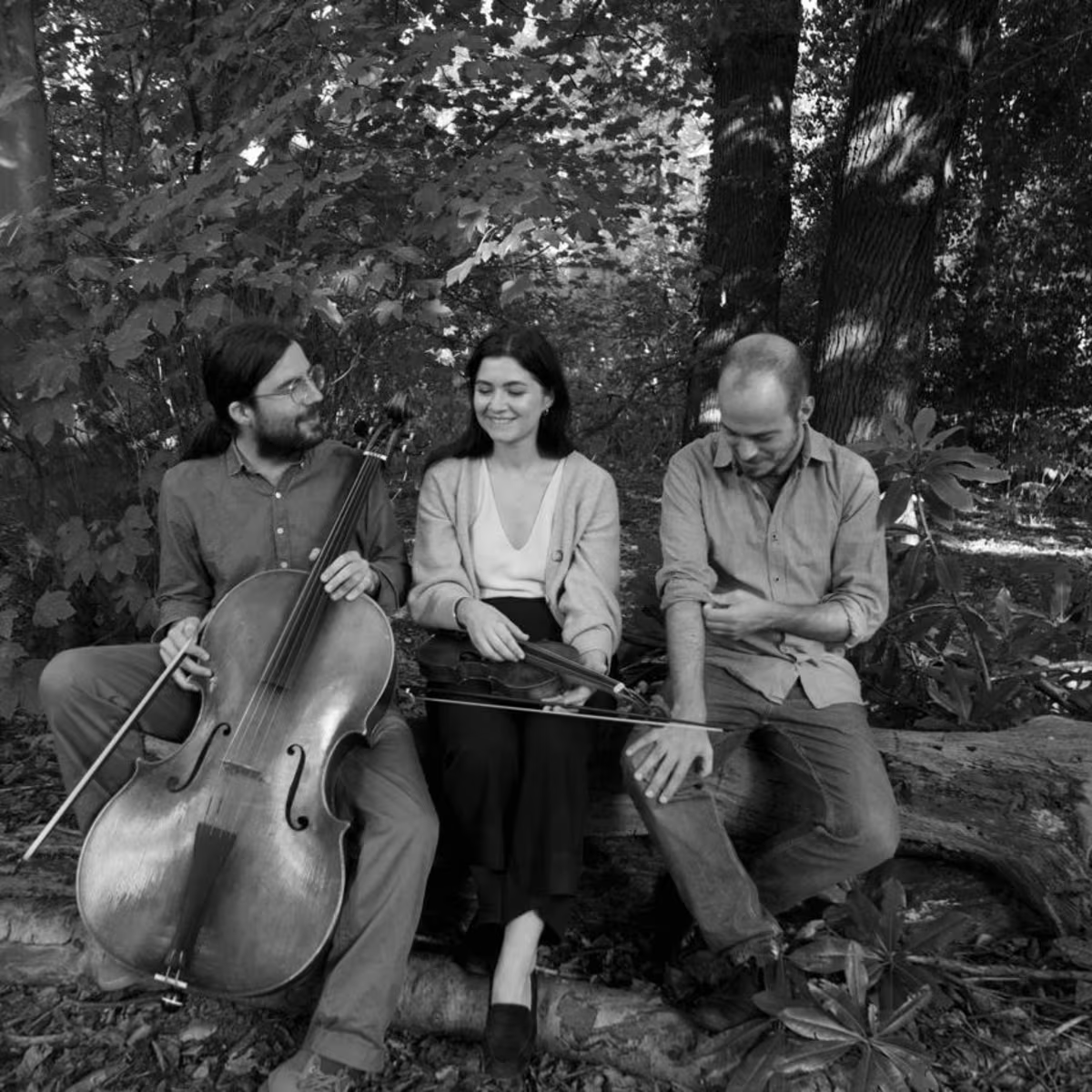
Šarovít, duende, meraki… Inside Nocturnalia’s musical language
Continuo Connect catches up with Pablo Tejedor-Gutierrez from Nocturnalia Ensemble, first-time Continuo grantees, about their upcoming season.

Sam Brown on Dowland and filtering history through a modern lens
Lutenist Sam Brown of Dowland's Foundry chats with Simon Mundy about how we interpret John Dowland, the formation of the ensemble around Emma Kirkby's kitchen table, and an exciting recording project in the pipeline.
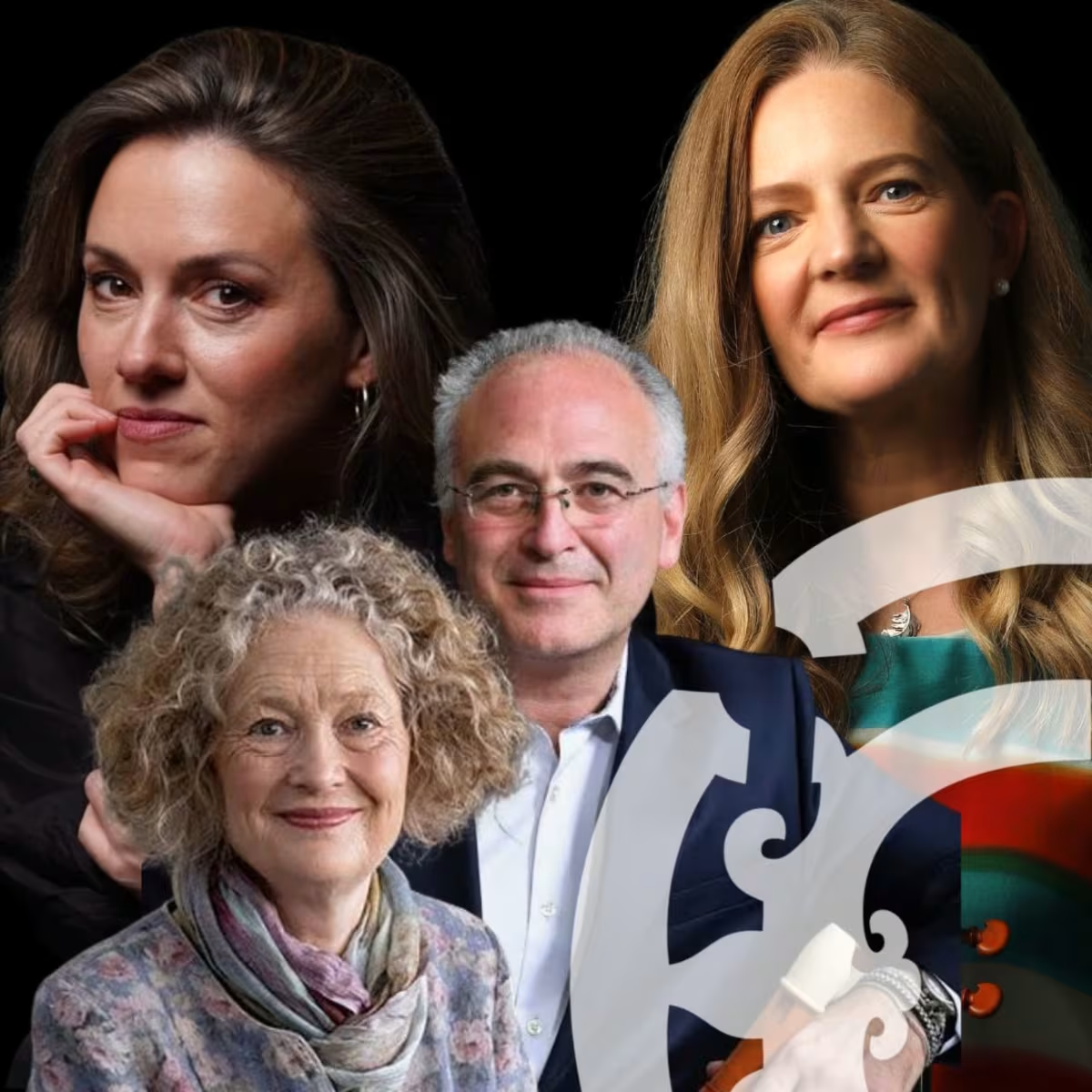
Playlist: Continuo Patrons
A playlist of tracks by Continuo Foundation Patrons Mary Bevan, Emma Kirkby, Rachel Podger and Ashley Solomon in celebration of the UN International Day of Charity.