

Feature
The North Star
Nigel North on Dowland, lutes and the quatercentenary in Norwich
Share this

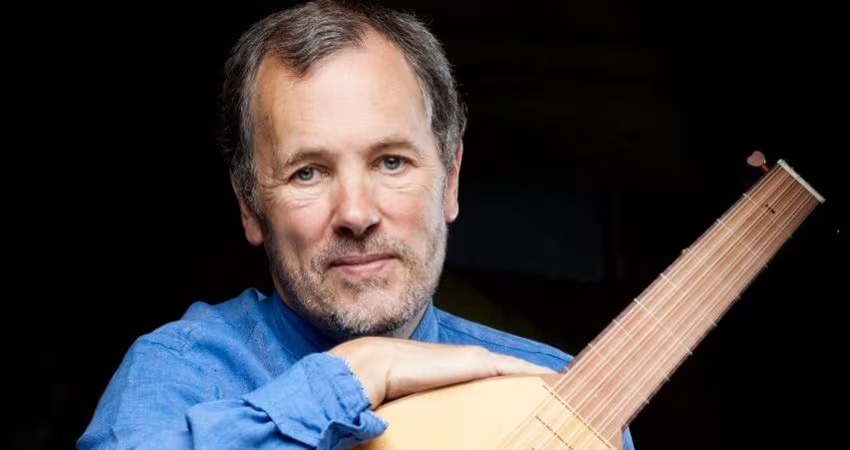
BY SIMON MUNDY | FIRST PUBLISHED 11 JULY 2026
Nigel North has been a leading voice among lutenists for half a century, his career shaped by a deep, evolving relationship with Dowland’s music. Ahead of the Dowland 400 Festival in Norwich this July – marking 400 years since the composer’s death and the Lute Society’s 70th anniversary – North spoke to Simon Mundy for Continuo Connect about Dowland's travels, his complicated relationship with the early 17th-century Jacobean court, and why melancholy is only half the story.
Norwich will be thrumming to the sound of lute strings this month at the Dowland 400 Festival when it is the centre for commemorations of the death of John Dowland in 1626. It coincides with the 70th anniversary of the Lute Society, so for the long weekend of 23–26 July, there will be a gathering, as well as concerts, lectures and masterclasses. Among the lectures, Peter Holman talks about Dowland and Thomas Simpson abroad (24 July), Peter Hauge explores Dowland’s time in Copenhagen (24 July), Joachim Held speaks about his visit to France (24 July), Michael Lowe focuses on his lutes (23 July) and Jan Burgers on the manuscript sources (23 July). Among the concerts, there is Bor Zuljan (25 July), the Chordophony Lute Quartet (26 July) and Fretwork with Elizabeth Kenny (26 Jul). The marketplace, children’s events and demonstration centre will be in the Martineau Hall on Colgate; the concerts, lectures and masterclasses in the Octagon Unitarian Chapel next door, its shape allowing for the audience to listen in the round.
John Dowland: Lachrimae Pavan, P15 | Nigel North
One of those appearing will be Nigel North, a stalwart among lutenists for half a century. Dowland, he says, means more to him now than ever. ‘After all these years, he does stand as being at the top of his field.’ And there is more to his music than the doleful songs for which he is famous. ‘It’s trendy to think he only wrote melancholic tunes. The others get overlooked, so I try to find a balance in my programme, Mirth and Melancholy, which is the opening evening concert (23 July) of the festival.
John Dowland: Mrs Winter's Jump, P55 | Nigel North
Dowland in his early years was part of Lord Hunsdon’s circle, which included other lute players, like father and son, John and Robert Johnson, whose style was very different. It seems that some Catholics were accepted and given posts at Elizabeth I’s court (like William Byrd and Thomas Tallis); others were not so favoured. John Dowland always felt that his religion told against him, unlike the Johnsons. In 1594 he went travelling to Germany, France and Italy, so that he had far more direct access to the playing traditions around Europe than most of his English contemporaries: then to Denmark. ‘His time in Germany left its mark, in Kassel, Darmstadt and Brunswick,’ North points out, ‘because his music was copied and survived there.’ For eight years, he was one of the highest-paid musicians to King Christian IV of Denmark.
John Dowland: The King of Denmark's Galliard, P40 | Nigel North
Only after he had been back in London permanently for six years was he given a post at court in 1612. This was a time when the masques of Ben Jonson were all the rage with James VI and I. Many of the composers were working on them and, like Robert Johnson, on plays with Shakespeare. North feels, ‘It seems unlikely that he had no relationship with the stage and when he got an appointment finally at the Jacobean court he stopped composing. He probably played for the masques. But he was more interested in just being a wonderful lute player, I think. He may have kept himself to himself, rather like me. We can only judge the lutenists of his time by what they wrote and published, not how they played.’
In one of the concerts at the Dowland 400 Festival, Emma-Lisa Roux accompanies herself in Dowland songs (25 July). ‘There’s no evidence of Dowland as a singer,’ North says, ‘but he was an educated man and he probably could, though most of the time it is likely that in public others sang and he accompanied.’ How the songs were performed once they were published is another story.
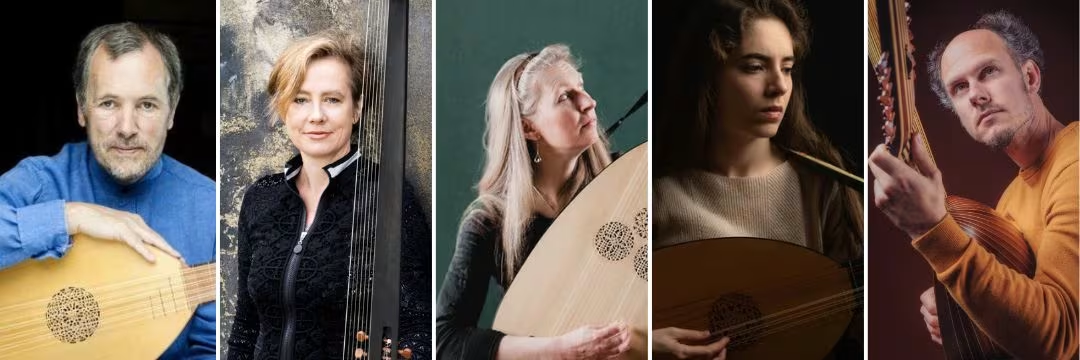
Coming back to the other anniversary being marked in Norwich, North ‘became aware of the Lute Society in the 1970s. From humble beginnings, it now has a large membership and is well-organised. We are a huge family and not just old friends; there’s a good range of young players. The development of the lute would not be as it is without the society.’ That includes lute makers, too, and there will be an exhibition and showcase of their instruments over the weekend. ‘I'm always asked which is my favourite lute,’ North grimaces slightly, ‘and the answer tends to be the one I am playing at the time. At the moment, coincidentally, it’s an eight-course lute made in Norwich by Malcolm Prior. I have lutes with six and thirteen courses and everything in between. I also have three from Lars Jonsson in Sweden and there are some fine young makers in Ghent – my wife’s hometown where I live now.
‘In what I want to play I find I'm moving back in time towards the Renaissance from the late Baroque and there is so much more of it that I want to learn and play. Many of us have worked hard over the last half century to play on the right instruments in a historical way, but there are some players, well known, who play on instruments that never existed at the time. The audiences will not necessarily notice, but there is a sense of betrayal when I see it.
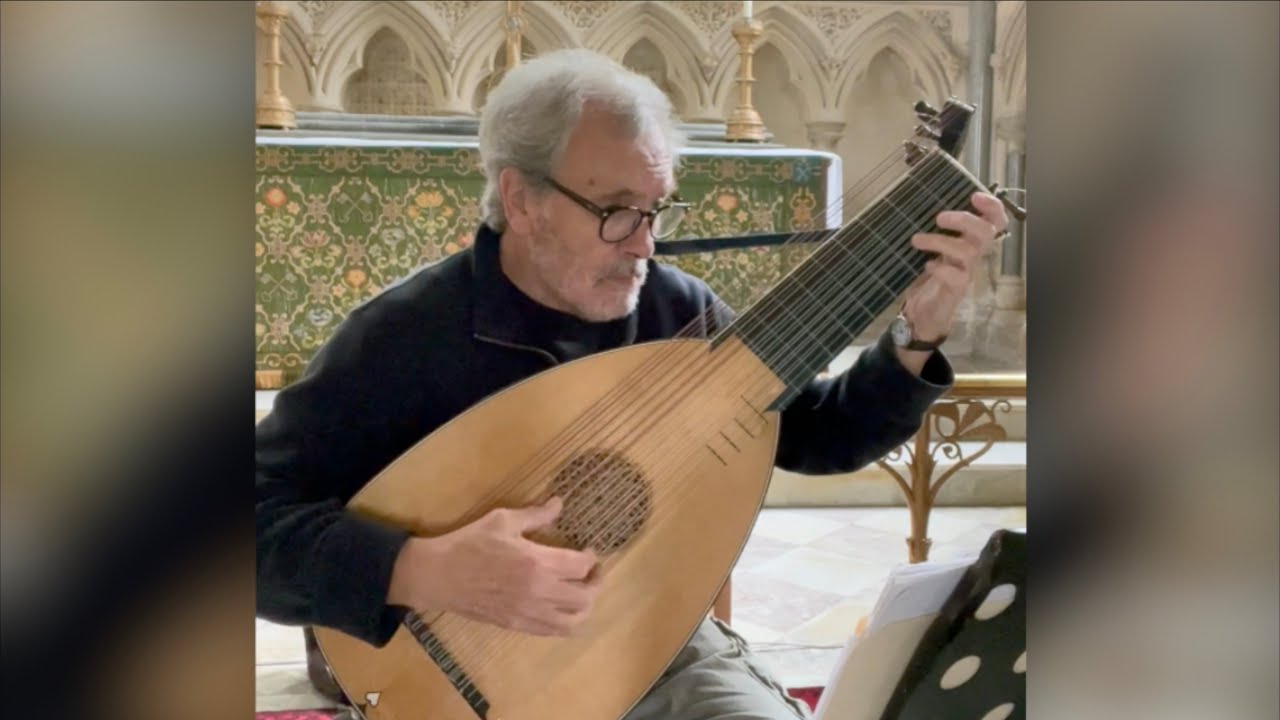 ▶
▶Nigel North performing ‘Gavotte’ in E from JS Bach’s Partita, BWV 1006a
‘The last 40 years have seen an explosion in lute teaching and now almost all Early Music groups have a good player. Good solo players have been slower to emerge, but now there is a new generation coming through. Thomas Langlois (in the festival) is a fantastic young player from Belgium.’ Talking of Dowland’s playing, but also to the joy of listening to the lute now, North refers to the poem, ‘If music and sweet poetry agree’, by Richard Barnfield, published in The Passionate Pilgrim in 1598. Of Dowland’s lute playing, he writes:
Dowland to thee is dear, whose heavenly touch
Upon the lute doth ravish human sense.
Lutenist Nigel North will be performing at the first evening concert of the Dowland 400 Festival on Thursday 23 July, and will also teach a masterclass the next morning (Friday 24 July). Visit the Dowland 400 profile page for the full festival programme.
Share this
Keep reading
Exploring the golden age of the ‘City of Dreams’
‘City of Dreams’ is an exploration of two centuries of Renaissance Florence at Brighton Early Music Festival. We spoke to Oliver Webber, founder of Monteverdi String Band, and writer Saria Steyl about how the project came together.
Tallis: ‘Spem in alium’ – a forty-part motet
A favourite among choral fanatics, Tallis' 'Spem in alium' has a fascinating history and has more recently been used in an unexpected context.

The soundtrack of imagination: David Yardley and Green Dragon Guild of London
Medieval countertenor David Yardley, Artistic Director of Green Dragon Guild of London, discusses Medieval music, Southwark’s layered history, and how imagination and meticulous research meet in performance in our latest podcast.