

Sidetracks
Monteverdi: ‘O primavera, gioventù de l’anno’
Share this


BY SIMON MUNDY | FIRST PUBLISHED 22 MAY 2026
SIDETRACKS: In this series, Continuo Connect takes the scenic route through the Early Music repertoire, exploring pivotal works and the surprising stories that travel with them.
There are few pieces of music that so succinctly conjure up the spirit of spring as this delightful madrigal. ‘O primavera gioventù de l’anno’, SV 68, was included as number nine of 15 pieces in Claudio Monteverdi’s (1567–1638) third book of madrigals, published in 1592, when he was 25. The book was hugely popular, being reprinted in Venice seven or eight times in Monteverdi’s lifetime.

It appeared the year after he moved from Cremona, where he was born and brought up as a chorister and organist at the cathedral, to Mantua. Hence the dedication to its duke, Vincenzo I Gonzaga, who was both his employer and a hugely influential patron throughout northern Italy.
🎶 Want to see more like this? Sign up to our free fortnightly e-newsletter to receive the latest Early Music news, event listings, features and more straight to your inbox.
Like many similar madrigals of the time, it is scored for five voices: two sopranos, alto, tenor and bass. This reflects the influence of the ailing senior composer at the Mantuan court, Giaches de Wert, who had published his tenth book of madrigals the year before and favoured this combination. De Wert was a controversial figure in the conservative palace of Mantua. His fairly disastrous love life had led him to spend most of his time in the more liberal atmosphere of Ferrara, ruled by the d’Este family. There he had developed an improvisatory style that Monteverdi was drawn to as he developed his own style.
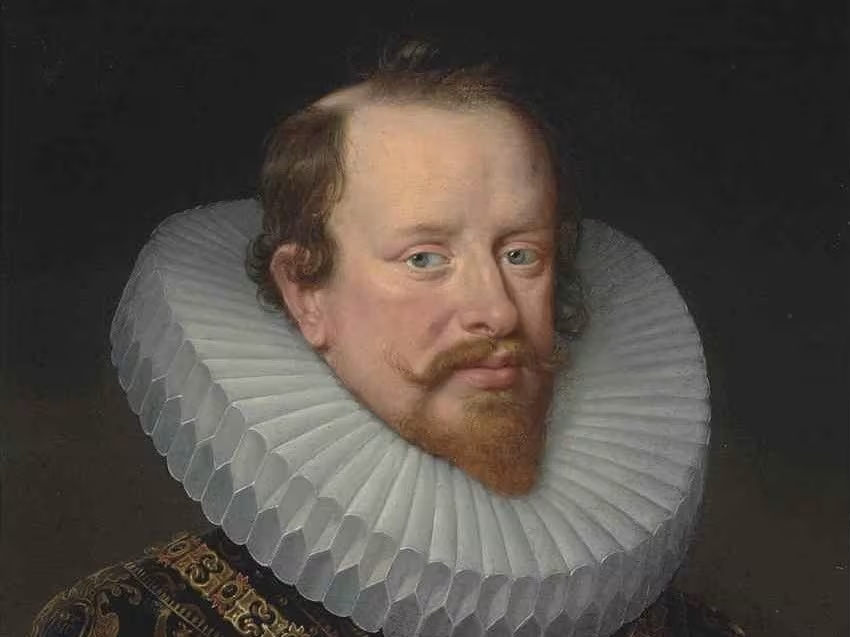
The absence of de Wert, who was suffering from malaria – hardly surprising given the swamps around both cities – left a space in Mantua's court that the young Monteverdi filled with ease. For this madrigal he turned to the words of one of de Wert's favourite poets, Giovanni Battista Guarini (1538–1612).
O primavera, gioventù de l'anno,
bella madre de’ fiori,
d’erbe novelle e di novelli amori,
tu ben, lasso, ritorni,
ma senza i cari giorni
de le speranze mie.
Tu ben sei quella
ch’eri pur dianzi, sì vezzosa e bella;
ma non son io quel che già un tempo fui,
sì caro a gli occhi altrui.
O Spring, the year’s youth,
lovely mother of flowers,
of new grass and new loves,
Alas, you return well,
but without the dear days
of my hopes.
You are fine, the same as
you were just now, so charming and beautiful;
but I am not what I once was,
so dear to the eyes of others.
🔎 Experience the beauty of Early Music for yourself – find a concert near you on our What's On page. Try searching for 'Monteverdi'!
The words, from Mirtillo’s monologue in the third act of Guarini’s pastoral tragicomedy, Il pastor fido, are conventional: the joy of spring countered at the end by the poet’s decline into middle age, but they are a perfect vehicle for Monteverdi’s music, merging that sense of improvisation with the gentle lyricism so popular in Venetian households on the cusp of the new century. He anticipates the regretful ending by setting the words ‘gioventù de l’anno’ not to the ascending phrase one might expect as Proserpina rises from Hades to reinvigorate the earth, but to a languid falling scale. After, the mood picks up as he exults in the ‘mother of flowers’. Like all good poets, Guarini implies more than one meaning, so the song is both a celebration of the season and a love song, unrequited because of impending age – not Monteverdi’s problem, then.
The British Early Music supergroup I Fagiolini performs ‘O primavera’.
Somehow the few minutes of this song stick in the memory as among the most uplifting from that era. O primavera has the clarity of the coming early Baroque, of which Monteverdi was such a pioneer, but also the clever interweaving of voices that was the hallmark of the late Renaissance. It is simply a very 'hummable' way to greet a happy season... or to flatter a potential lover.
DID YOU KNOW?
As far as court composer jobs go, Monteverdi's gig in Mantua was a tough one. Though highly regarded by the Gonzagas, he was constantly overworked, underpaid (often waiting months for his salary) and pushed to compose at impossible speed – not ideal for a perfectionist worried about ‘note-spinning’. He even had to accompany the Duke on military campaigns to Hungary – so much for the job description! Worn down by pressure and personal tragedy (losing his wife and his sister within months), Monteverdi slipped into depression and returned to Cremona in 1608. He later resumed his post, only to be dismissed in 1612 by Vincenzo’s cost-cutting heir, Francesco. But, with forward-looking works like the Vespers of 1610, Monteverdi’s star was already rising, and the door shut in Mantua opened onto his celebrated long tenure at St Mark's Basilica in Venice from 1613 to 1643.
Cover video: Les Arts Florissants live at l'amphithéâtre de la Cité de la musique, Paris, May 2012.
Share this
Keep reading

JS Bach, and a cabinet of curiosities: Jorge Jiménez
Violinist, director and composer Jorge Jiménez talks to Simon Mundy about his latest album Curiosa: Lost & Found Tunes, his new Bach weekend in Ipswich, and his freelance career balancing life in rural Essex with regular work in Spain.
Playlist: Continuo Patrons
A playlist of tracks by Continuo Foundation Patrons Mary Bevan, Emma Kirkby, Rachel Podger and Ashley Solomon in celebration of the UN International Day of Charity.

Celebrating 300 years of Academy of Ancient Music
Three hundred years after the first Academy of Ancient Music was founded, its modern namesake is preparing a season that looks far beyond commemoration.