

Spotlight
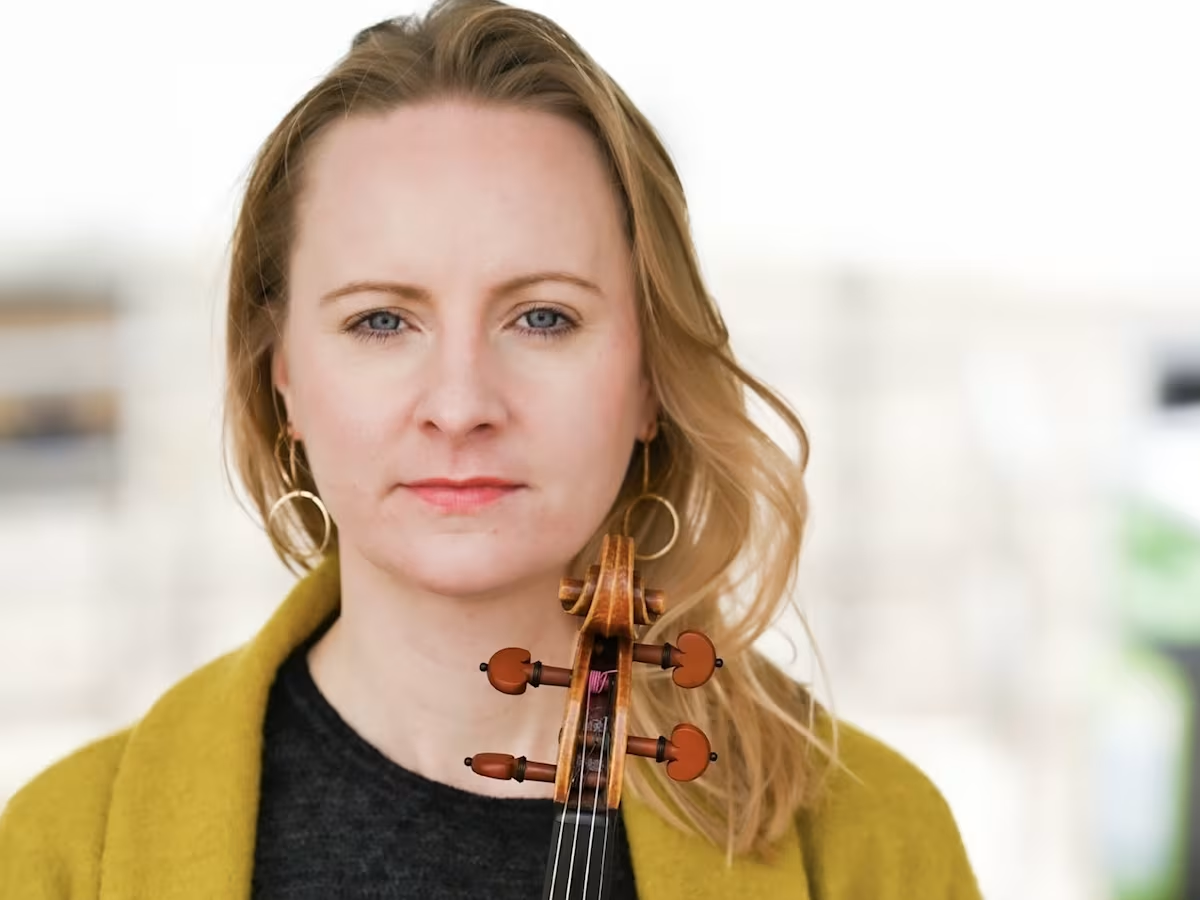
In conversation: Jane Gordon
Share this

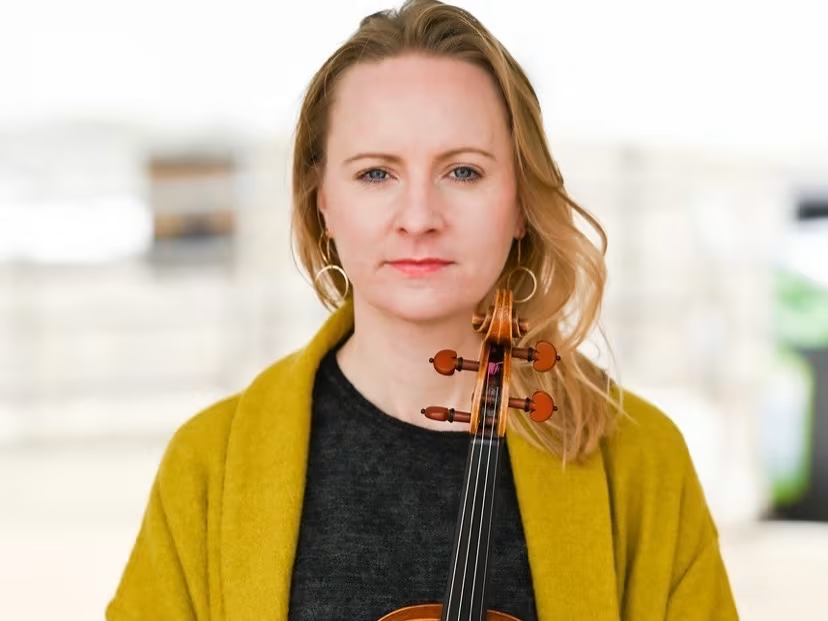
Described as playing with ‘glowing conviction’ (Financial Times) and a ‘ravishing tone and depth of timbre’ (The Independent), Jane Gordon is one of the UK's leading period instrument violinists. Her work centres on historically informed performance, encompassing orchestral leadership, directing from the violin, chamber music, concertos and solo recitals. Jane is a member of the Rautio Piano Trio and leader of La Nuova Musica, founded and directed by David Bates. She is in demand as a guest leader, having recently worked with Dunedin Consort, Arcangelo, English Baroque Soloists, Irish Baroque Orchestra and Casa da Música and is also Artistic Director of the Hastings Chamber Music Festival.
What do you love about being a musician?
I love connecting with other musicians and creating rapport in how we play and interact. There is such an amazing musical community in the UK, and it’s great to be a part of it. I spend quite a bit of time planning concerts, designing programmes and inviting players to join me. There is a real joy in that.
What made you choose the violin?
There wasn’t a particular reason – I simply asked my parents one day if I could learn the violin, and thankfully they made it happen. I’ve always loved not only the sound of the violin but also the physical sensation of creating that sound. I can remember that feeling from my earliest childhood, and it’s never really left me.
Where did you encounter the most receptive audience?
At Festivals away from major cities, both in the UK and Europe, there is often a feeling of real personal value to live concerts. I often enjoy the concerts in the most rural places off the beaten track, where you have time and space to chat with audience members.
How has Continuo Foundation impacted your day-to-day life?
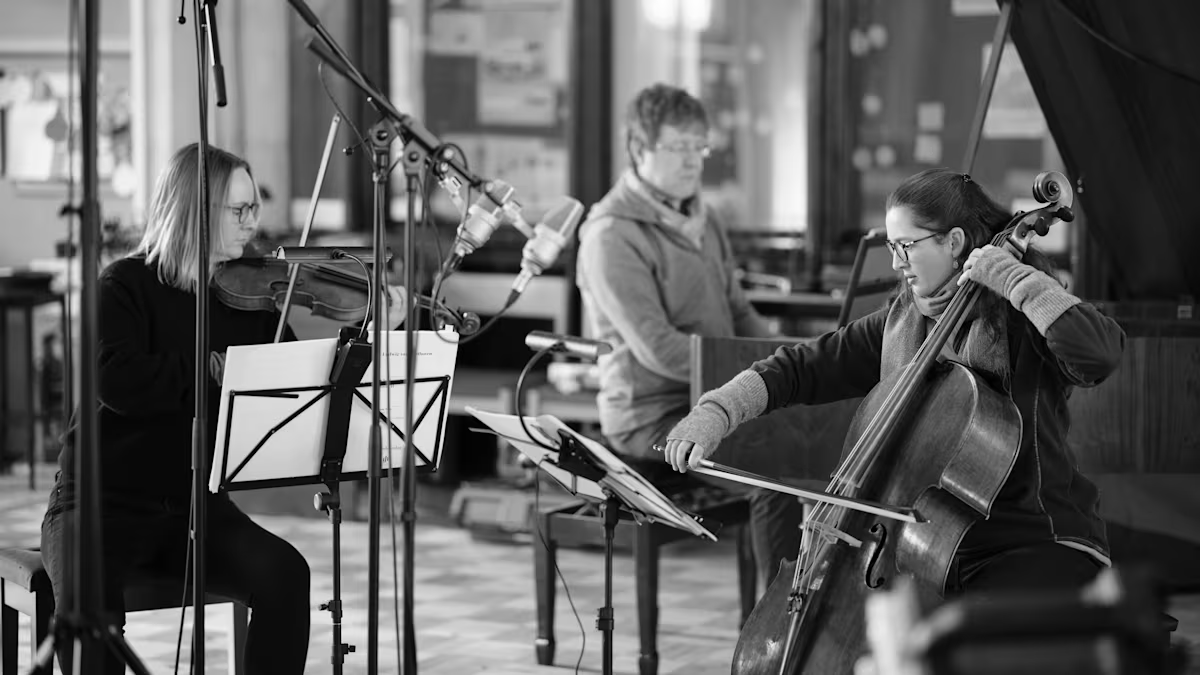
In all honesty, I’m feeling such a great sense of purpose and fulfilment as a musician right now. Having the opportunity to realise one of the most ambitious projects conceivable – recording all the Beethoven Piano Trios with fortepiano – is a dream come true. I couldn’t be happier!
What new doors have opened for you since becoming a grantee?
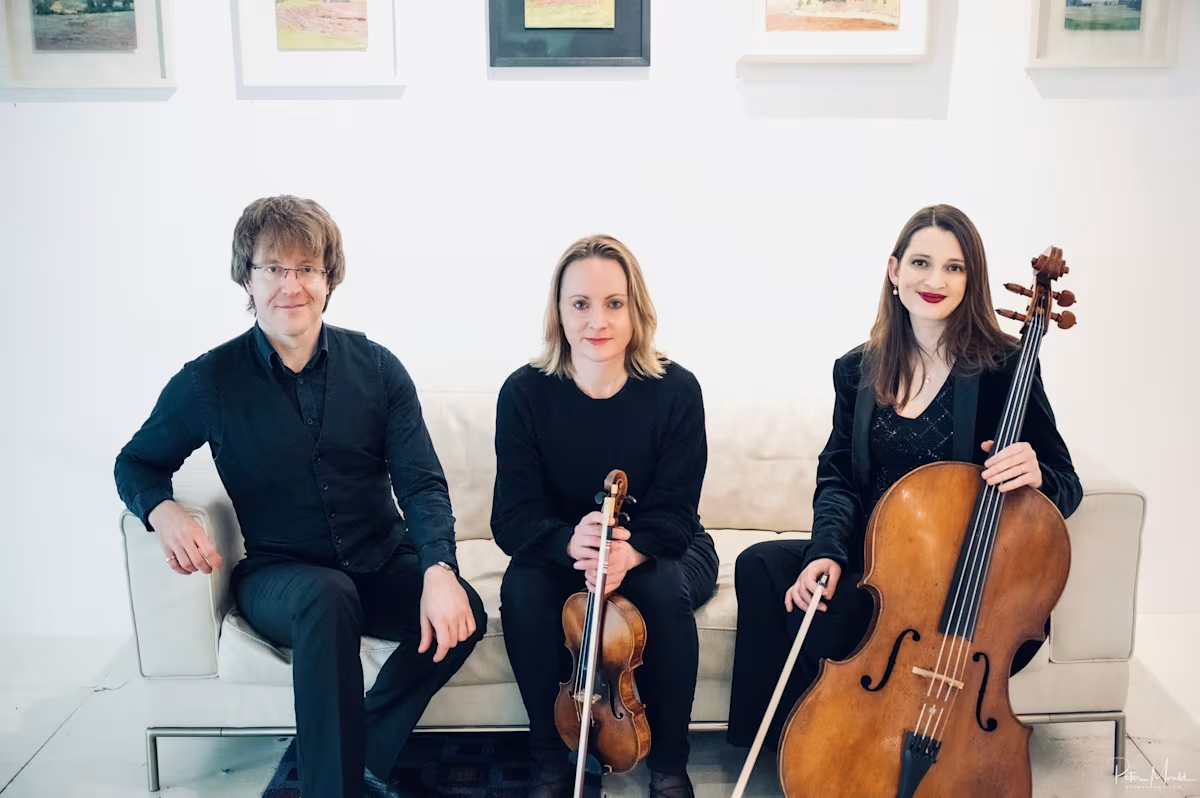
My trio’s Beethoven project simply would not have been possible without Continuo’s support. It’s monumental and has taken us five years to record the trios and explore a lot of other associated repertoire. As a result of this project, we now have many new performance opportunities, including our first concert at Wigmore Hall on fortepiano and a concert in Mannheim next year. We are also set to be part of a Beethoven Symposium in association with Oxford University.
You have a diverse portfolio of music-related skills, including public speaking and journalism. How did you get into these areas?
I’ve always enjoyed creative writing because it helps me clarify my thinking and crystallise my ideas. Public speaking has developed naturally alongside my role as an Artistic Director. I wanted to create a stronger connection between audiences and performers, so I introduced an Artists in Conversation series, where I interview musicians and invite questions from the audience. It’s really interesting seeing where the conversations lead, and the format allows both musicians and audience members to engage with the performance in a more personal and meaningful way.
How have you found Alexander Technique and a holistic approach to musical life has helped you, and can you offer any simple tips to the Continuo Connect community?
Just over a decade ago I trained as an Alexander Technique teacher, an experience that fundamentally changed my approach to playing. I began questioning how I was thinking while I played, both in performance and practice. This was a catalyst for developing a holistic approach, which gradually shifted my priorities. I also read The Inner Game of Tennis by Timothy Gallwey and became curious about the parallels between music and sports psychology. Rather than trying to control every aspect of playing, I became more interested in creating the conditions in which music could emerge naturally. Central to that was a conscious letting go of ‘trying too hard’ and instead finding a sense of ease. From that foundation, I found myself able to be more dynamic with my body language and more creative with musical ideas.
A simple exercise players can try is to explore the space between thought and action. If there is a tricky passage to practise, get ready to play, bring up the instrument, but at the very last moment, don’t play. In that space, pause and ask yourself: is there any unnecessary tension in the whole body (not just the muscles involved in playing)? Check whether you are holding your breath, whether your weight has shifted onto the front of your feet, or whether there is an almost overwhelming urge to play. Typically, we all have patterns of tension that jump into action before we’ve even played a note. The more aware we are, the greater our capacity to change. If we begin playing from a place of less tension and greater freedom, the sound will be freer and more resonant. From there, there is so much more to explore artistically.
Could you share with us any special moments in the realisation of your latest Rautio Piano Trio project?
When we finished the recording sessions for the final album of our Beethoven cycle (a project which has been supported by three grants from Continuo Foundation since 2022), I was on a high for days. It’s such a monumental project that I still can’t quite believe we’ve completed it!
There was also a very special moment while recording the Kakadu Variations. In one typically Beethovenian phrase, I felt in the ‘flow state’ or ‘in the zone’ more than ever. It was as though all the experience, preparation and musical understanding came together in a single, beautiful and incredibly simple phrase – the kind of passage that sounds completely effortless but is, in reality, very difficult to bring off.
Please tell us a bit about the Hastings Chamber Music Festival, of which you are Artistic Director.
I founded the Hastings Chamber Music Festival to create a space with complete artistic freedom and somewhere I could collaborate and connect with like-minded musicians. Like many festivals, it’s an ongoing challenge to fund and sustain, but I feel strongly about creating more opportunities for chamber music performance in the UK.
The festival brings together historical-performance ensembles and modern chamber groups, featuring both established and emerging artists. The repertoire is immensely varied, ranging from Baroque music to world premieres and new commissions. A particular focus is on imaginatively curated programmes and the artistic ideas that the musicians bring to each project.
You lead and guest-lead a number of major period-instrument orchestras. What have you learned working with such diverse groups of musicians and with a range of conductors?
I've learned the importance of being flexible and open-minded. Every orchestra has its own personality, and I genuinely enjoy discovering how each one works. The role of a leader is to understand what the conductor wants to achieve and find the best way to help communicate that to the orchestra. In that sense, a good leader is a facilitator. The conductors I've worked with in recent years have all had very different styles, and I've enjoyed adapting to each of them and trying new ideas.
I'm also passionate about creating a healthy working environment where musicians feel valued and respected. Ours is a demanding profession, and players make considerable sacrifices, particularly when touring. I believe people perform at their best when they feel supported and the group dynamic is functioning well both on and off the stage.
One of the things I love about my role as leader with La Nuova Musica is the continuity it offers. I am developing deeper musical relationships with artistic director David Bates and the orchestra's wonderful musicians. This brings a depth of understanding that only grows over time.
What’s so special about HIP/Early Music performances?
The curiosity of the musicians and willingness to try something new.
Do you have a lucky charm or ritual that you follow before important concerts?
I don't have a lucky charm or a pre-concert ritual, but I do pay a lot of attention to my mindset. I try not to rush around on the day and aim to feel as calm and focused as possible. Good sleep, good food and keeping my playing muscles in shape are all priorities.
For me, it’s really the days leading up to a concert that are sacred. The quality of the preparation has a far greater impact than anything I could do in the hour before I walk on stage.
What is it that you most dislike?
Vacuous social media!
Who is your favourite composer, and why?
At the moment, it’s Beethoven. I feel his music speaks to our shared humanity in a profound way. There is a sense of triumph through struggle that I think performers instinctively relate to. What we do is demanding and requires a lifelong commitment to growth and self-improvement. Beethoven’s music seems to acknowledge that journey, and I think that's one of the reasons it continues to give such deep satisfaction and meaning to our lives as musicians.
 ▶
▶If you could meet anyone from the past, who would it be?
Mozart’s sister, Nannerl, to see if she was more talented than her brother! Or Clara Schumann or Hildegard of Bingen or Marianna Martines…
No. 1 listening recommendation?
Brahms Piano Concertos on historical piano by Andras Schiff/OAE or the Rautio Trio’s latest Beethoven album. I have a passion for the sound of historical piano, despite being a violinist!
Rautio Piano Trio’s latest recording is out now on Resonus Classics, featuring Beethoven’s Piano Trios Op. 70 Nos 1 (‘Ghost’) & 2, plus Allegretti for Piano Trio, WoO 39 & Hess 48. Purchase the CD from Jane's online shop or listen now on your favourite streaming platform. Watch them perform live at London’s St John’s, Waterloo, in a programme including Beethoven’s ‘Archduke’ Trio in B flat on Sunday 22 November.
Share this
Keep reading
In conversation: Bolette Roed
Continuo Connect talks to the Danish recorder player Bolette Roed about her group, the Elephant House Quartet, and Copenhagen Baroque Festival.
Mary-Jannet Leith on collaborating with the Buskaid Soweto String Ensemble
In the first of a new series of Continuo Connect podcasts, Simon Mundy talks to Mary-Jannet Leith of Ensemble Hesperi about their collaboration with the Buskaid Soweto String Ensemble, and the music that once filled Scotland's country houses.
Šarovít, duende, meraki… Inside Nocturnalia’s musical language
Continuo Connect catches up with Pablo Tejedor-Gutierrez from Nocturnalia Ensemble, first-time Continuo grantees, about their upcoming season.