
Spotlight
LIFEM 2026: Interview with Eun Sol Lee
Share this

REPUBLISHED WITH PERMISSION FROM THE EARLY MUSIC SHOP | 16 OCT 2026
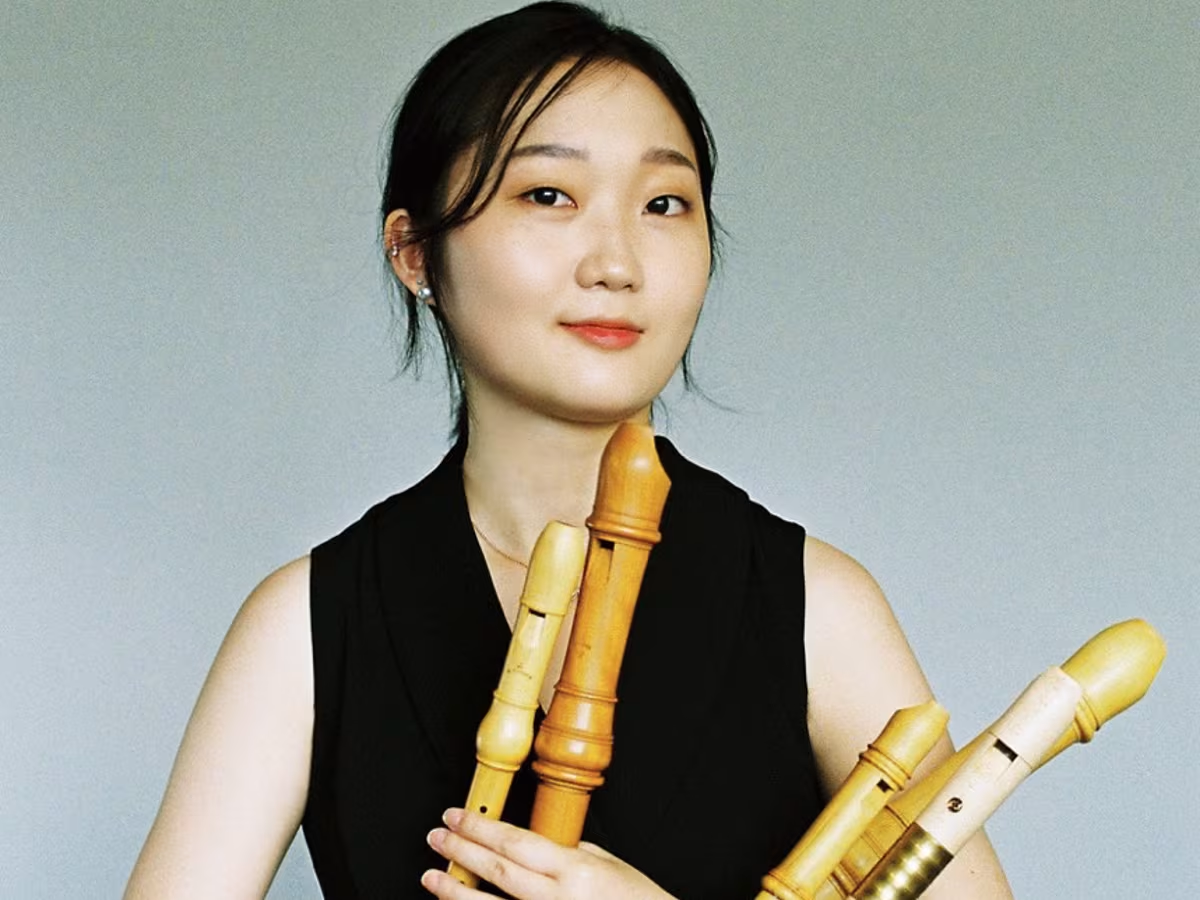
Following her first-prize performance at last year's Moeck/SRP Solo Recorder Competition, held at the London International Festival of Early Music (LIFEM) every two years, Eun Sol Lee returns to London this November for her Winner's Recital (13 Nov). The Early Music Shop caught up with Sol to find out more about her year since she won the competition and what we have to look forward to in her performance at LIFEM...
The Early Music Shop: We thoroughly enjoyed your performance at the final of the Moeck/SRP Solo Recorder Competition last year. What were your highlights of travelling to London to take part in the festival and competition?
Eun Sol Lee: First of all, London felt absolutely massive to me. It is incomparably larger than Vienna, where I currently live, so I actually got lost quite a few times.
It was my first time attending the LIFEM festival, and I was pleasantly surprised by how large the audience was for the competition. Furthermore, the atmosphere of the church concert was truly wonderful.
EMS: Your programme for your Winner’s Recital at LIFEM 2026 is entitled 'Bamsæ–Overnight'. Can you tell us a little bit about the story behind the programme and some of the music you will play?
ESL: The word 'Bamsæ' translates to 'overnight' or 'all night long' in Korean, but it can also double as a wordplay meaning 'a night bird'. Since the recorder is so often compared to a nightingale, I thought this would be a perfect, evocative theme to express through the combination of recorder, viola da gamba and lute. The recital will unfold across four distinct nocturnal themes: La nuit (Darkness), Les soupirs amoureux (Sigh of love), Le sommeil (Sleep), and Le réveil-matin (Wake-up call).
One of the greatest strengths of the recorder, in my opinion, is its limitless potential. While it does have inherent constraints in terms of volume and range, I truly believe there is almost no piece of music that cannot be interpreted or brought to life on this instrument. Because of this philosophy, the programme features a blend of original recorder repertoire and arrangements originally written for other instruments. Audiences can look forward to a diverse musical journey, including a Bach violin sonata, a traditional Korean secular vocal piece, Changbu-taryeong (Song of the ntertainer), and a recorder sonata by Louis Mercy, alongside several fresh, new works!
EMS: We love that your programmes often reference your heritage with Korean traditional music. Is the recorder used often for folk music in Korea, or are there other native flutes you could tell us about?
ESL: We don't really have a traditional Korean instrument that directly mirrors the recorder. Instead, we have wind instruments like the daegeum and the piri, which are closer in form and function to the western flute and oboe, respectively.
When I play Korean music on the recorder, I don't see it as a process of introducing or projecting my Korean identity outward. Rather, I feel it works from the outside in – it's about projecting the language and gestures of Early Music onto myself. Even though Korea doesn't have an instrument with a structure or tone similar to the recorder, there are moments when playing traditional Korean music on the recorder feels like a perfect fit. In those moments, I truly realise that music transcends backgrounds; it is, at its core, a universal medium for human connection.
EMS: Do you have any other upcoming projects or performances you’d like to share with our readers?
ESL: In July, my Vienna-based ensemble AS TIME GOES BY – A New Consort of Music released our very first album. It’s a project featuring music by Jan Pieterszoon Sweelinck and his contemporary composers, all performed on four or five recorders. Plus my LIFEM recital, of course!
EMS: Lastly, do you have any advice for our readers who might be thinking about buying a new recorder during Recorder31?
ESL: The Early Music Shop has an incredible variety of instruments! It’s fantastic that they offer so many choices, ranging from semi-handmade models to custom instruments by individual makers.
When choosing a recorder, the most critical factor I consider is how the instrument handles resistance. I always test its limits by blowing a bit harder than my usual comfortable level and applying stronger articulation than normal, just to see where it begins to lose stability. Also, always check the intonation with a tuner!
Sol’s recital features guest musicians Réka Nagy (viola da gamba) and Sophie Esterbauer (lute) and will take place on 13 Nov. Her programme explores contrasting nocturnal scenes from Couperin and Hotteterre's French Baroque to extracts of Korean traditional music. The London International Festival of Early Music (LIFEM) is one of the world's longest-running celebrations of Early Music with concerts, workshops, talks, competitions and the famous makers' exhibition. The full LIFEM programme includes concerts by Phantasm & Elizabeth Kenny, Nigel North, L'Artefice, Ensemble Inventio, Erik Bosgraaf & Baltic Baroque Orchestra and many more – including world-leading instrument makers in the LIFEM Exhibition.
Share this
Keep reading
JS Bach, and a cabinet of curiosities: Jorge Jiménez
Violinist, director and composer Jorge Jiménez talks to Simon Mundy about his latest album Curiosa: Lost & Found Tunes, his new Bach weekend in Ipswich, and his freelance career balancing life in rural Essex with regular work in Spain.
The Best of Rachel Podger
This playlist celebrates 'the unsurpassed British glory of the baroque violin' (The Times) - that is of course Rachel Podger.

Celebrating 300 years of Academy of Ancient Music
Three hundred years after the first Academy of Ancient Music was founded, its modern namesake is preparing a season that looks far beyond commemoration.