

Podcast
JS Bach, and a cabinet of curiosities: Jorge Jiménez
Share this


BY CONTINUO CONNECT | FIRST PUBLISHED 9 OCT 2026
Violinist, director and composer Jorge Jiménez talks to Simon Mundy about his latest album Curiosa: Lost & Found Tunes, his new Bach weekend in Ipswich (16-18 Oct), and his freelance career balancing life in rural Essex with regular work in Spain, where he has just completed his first summer as Artistic Director of the Música Callada festival in the villages around Burgos.
Prefer to read this interview? View an edited transcript of this podcast below.
Simon Mundy: Jorge, good to speak to you. There's an awful lot to discuss, because you lead so many groups, you are part of so many orchestras, and you have a galloping solo career as a violinist as well. Which at the moment is the most important to you?
Jorge Jiménez: I quite like having lots of strings to my bow. I'm a performer, and I love playing the violin – I will never stop playing the violin as long as I can – but I do love composing, and I do love conducting, so I try to do as much of it as possible. One of the things I love the most is being able to conduct from the violin. Then the two things come together, and I'm so happy.
SM: Before the 19th century, of course, everybody would have done that.
JJ: Absolutely. Even in the 20th century it was still done.
SM: Oh yes, very much so.
JJ: In opera theatres like La Scala in Milan, the first violin was basically the one to follow, even for the singers.
SM: I always remember that back in the 1980s it was said at the Royal Festival Hall that you could tell when there was a really bad conductor on, because nobody was watching them. They were watching the leader.
JJ: It still happens...!
SM: Let's start by talking about your new album. Who is it with? Tell me about the album itself.
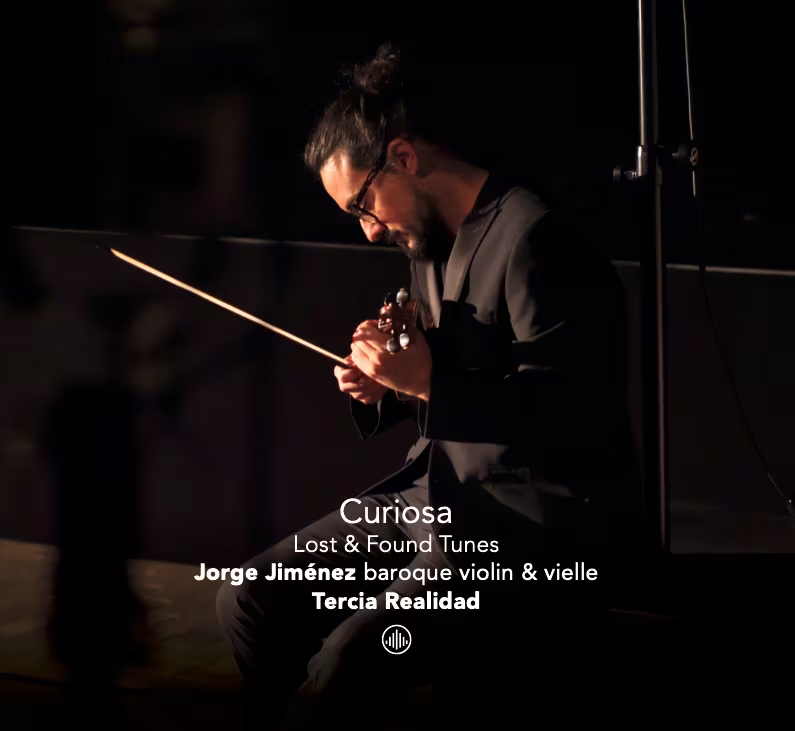
JJ: The new album is called Curiosa, and we released it a few months ago with Challenge Classics, a Dutch label. It's together with Joy Smith on harps and percussion and another percussionist who did all the castanets and the very complicated other layers that we had to add to the mix: Daniel Garay. He's Spanish, from Bilbao, and he's one of Jordi Savall's percussionists. This tradition of historical percussion is starting to extend to the UK, but there are some incredible players in Spain at the moment.
SM: And what's the repertoire?
JJ: Curiosa is basically a cabinet of curiosities, and it's music I've been collecting for years and years. I've been playing the baroque violin for about 25 years, and every time I work with a different ensemble, if I find a nice tune, I keep it in my pocket. At some point I had so many tunes that I wanted to record, but none of them fitted the albums I'd recorded before. So I decided, why not? It's like a pantry: you have different shelves, so why not put them together on a CD and see what happens? We recorded it here in Essex, in the studio of a colleague of mine, and it was a lot of fun, I have to say, doing the transcriptions of pieces I've been playing with so many different groups and in so many different formations. Then I got Joy to play with me, and then I got Danny to play, and we ended up having a lot of fun recording it.
SM: You talk about it being a box of curiosities. What is the most curious piece, and what's the range – very early to very late? Are there compositions of your own in it?
JJ: My own arrangements, yes. I think the earliest is my version of the Lamento di Tristano, which until not long ago was considered the first surviving written piece, though it's not – there are earlier ones. I play that on the Medieval vielle. I've got a very lovely five-string instrument that has so much range, more than the violin in a way, and it's a very gutsy sound. So that's the earliest. We also do a French tourdion, a drinking song, on the vielle and the Medieval harp. And then it goes all the way to Bach, where I play one of the suites for lute, which I've arranged for violin, because I just think they're such incredible music. And we know that Bach didn't play the lute, so he may have meant it for a violin. You never know!
SM: I always think Bach just composed the music and then wondered who could play it – basically that was everybody in his ensemble, so he let them get on with it. And I still think that works. It's almost impossible to pick an instrument, put a piece of Bach to it and have it not sound good.
JJ: Absolutely. I've been arranging different pieces by Bach for violin for a while now. The Goldberg Variations was the first mad idea I had, and I've now performed it, I don't know how many times, all over the place, and it's still going. It's one of those programmes I still do five or six or ten times a year, because it works so well. You wouldn't expect it to work on the violin, but it does.
SM: One always thinks of Sitkovetsky's wonderful version for string trio.
JJ: Yes, it works. Or any of the organ fugues played on an accordion – it sounds fantastic. It's like cooking: good ingredients always work, don't they?
SM: You've been thinking about your Anglo-Spanishness, if you like, because there you are living in Essex, but you are fundamentally someone from Catalonia, from Barcelona. Do you feel there's a rope between the two, pulling you back and forth?
JJ: Yes, of course. My parents still live in Barcelona, and I like to visit them a lot. But I also work a lot with Spanish ensembles, which means that almost every month I'm lucky enough to go to Madrid or Oviedo or Barcelona for concerts and rehearsals. I still have a great group of friends and colleagues there, so I don't feel like I ever completely left. It feels strange that when everyone goes back home in Madrid, I just take a flight back to London, but I've got used to it.
SM: Which are the main Spanish ensembles you work with?
JJ: I'm the leader of a group called Forma Antiqva, which is three brothers – you may know them. They've come to London a few times for the BBC series at St Luke's. They're the Zapico brothers: there are two lute players, one on baroque guitar and one on theorbo, and they're twins. Then there's an older brother who plays the harpsichord, and they are the core of the group. I've been leading the strings there for – gosh – 20 years now. It's a great team, and it's been working for a long time.
SM: On the other side of the question, which are the British ensembles you work with most?
JJ: I've played with pretty much everyone here: Academy of Ancient Music, English Baroque Soloists, The King's Consort – you name it, I've probably worked with them. I think that's the nature of being a freelance Early Music player in England: there's a pool of players who end up playing with almost everyone. Of course, in England there is a core of players in each ensemble, and they tend to work for only one or two ensembles, so you don't see them in others. But then there's another pool of players like me, whom you'll see in many different groups – 'Oh, Jorge is there.' It works quite differently in Spain. I used to work with Al Ayre Español and Eduardo López Banzo, one of the iconic Early Music ensembles. He was the one who started playing Spanish Baroque in a more flamenco way, so to speak, with lots of castanets and lots of percussion. There was that school, and then there was the Savall school. Because I was playing with Eduardo López Banzo, I wasn't playing with Jordi Savall – that's how things were. Now it's a different generation altogether. I'm an oldie now!
SM: Do you play with Jordi these days?
JJ: No, I don't. He actually happens to be family – he's the uncle of my brother's wife – and we've met many times, but I don't play the baroque violin for him.
SM: I was meant to be going to his festival this summer, but the heat was just too much.
JJ: Lots of festivals are going to start shifting to the autumn because of the heat; that's how it's looking at the moment.
SM: It makes a lot of sense.
JJ: Barcelona is unbearable in the summer. I wouldn't recommend it.
SM: Let's go back to what you're doing over the next few months, apart from the Curiosa album – very much with your own ensembles, rather than ensembles you happen to be playing with. What have you got planned?
JJ: The closest thing, and I'm very excited about this, is the new Ipswich Bach Weekend. I found this beautiful 1699 building in Ipswich. It's not difficult to find an old building in Ipswich, but this one is incredible: it's the Unitarian Meeting House. I don't know if you know Ipswich, but I'd been into Ipswich so many times and never seen it, because it's hidden behind a very modern building, in the backyard of other tiny houses. It's a meeting house, not a church, but it looks like one of those Dutch churches you see, wooden and with balconies. It's absolutely gorgeous and so well preserved, and they're incredibly keen on Early Music and on bringing this kind of repertoire there. So I'm going to be playing the complete Sonatas and Partitas over two days, on the Friday (16 Oct) and the Sunday (18 Oct). Then on the Saturday (17 Oct), Joy Smith, who is on Curiosa as well, will be doing a storytelling night, telling stories around Bach and his time while playing the harp. It's fabulous – you can't stop listening to her. She's been telling me stories for years anyway! So that's the plan. It's in two weeks, from 16 to 18 October, and I can't really imagine a better place to hear this kind of music. The acoustics are pristine, and people are absolutely loving it. We've done a few concerts there already, and that's what made us think of something bigger. I'm hoping this is going to be the start of something heftier and more regular in Ipswich, which doesn't seem to have much Early Music – almost none.
SM: And tell me a little about further ahead.
JJ: I'll have to look at my diary now! Since this past summer, I've been the Artistic Director of a festival near Burgos in Spain called Música Callada, after the cycle by Frederic Mompou. This was my first summer programming it, but we also have an Advent series of three concerts. I'm working on that, and it's looking very exciting, because we found a 'Sibyl' chant from a church very near, from that region, which we literally discovered a year ago. So that's one of the concerts. Then there's a beautiful concert of Telemann with La Guirlande, which is a Spanish-Swiss group. And Raquel Andueza – maybe you've heard of her, she's quite a renowned Spanish soprano. She's coming to give a recital with a theorbo player. So this is occupying my admin at the moment.
SM: Burgos is a gorgeous place to have an Early Music festival.
JJ: Yes. The festival isn't in the city; it's in seven towns around it, and they're all on the Camino de Santiago, as are all the churches where the concerts take place. Because the towns are tiny, you wouldn't imagine the incredible wealth of heritage they have. You kick a stone and a beautiful Romanesque church appears.
SM: I'm sure the vineyards are better than they are in Ipswich, but the two of them...
JJ: Well, apparently the Shotley Peninsula has some very beautiful wine coming up. I think climate change has only one upside: the wine in England is going to be good.
SM: There we go. Jorge Jiménez, thank you so much, and good luck with all these projects. They sound fascinating, and I love the umbilical cord between Spain and Essex.
JJ: Thank you.
Ipswich Bach Weekend takes place from 16-18 October. Read more about the festival here and learn about Jorge's Curiosa album in our recording feature.
Share this
Keep reading

The soundtrack of imagination: David Yardley and Green Dragon Guild of London
Medieval countertenor David Yardley, Artistic Director of Green Dragon Guild of London, discusses Medieval music, Southwark’s layered history, and how imagination and meticulous research meet in performance in our latest podcast.
The Best of Rachel Podger
This playlist celebrates 'the unsurpassed British glory of the baroque violin' (The Times) - that is of course Rachel Podger.

Guitar Meets Square Piano: Nathaniel Mander and Declan Hickey
Continuo Connect talks to guitarist Declan Hickey and harpsichordist Nathaniel Mander about their upcoming “Dukatenkonzert” in London and the instruments they will be playing.