
Feature
Handel’s Messiah – the Salisbury connection
Share this

BY NIGEL WYATT | FIRST PUBLISHED 16 SEP 2026
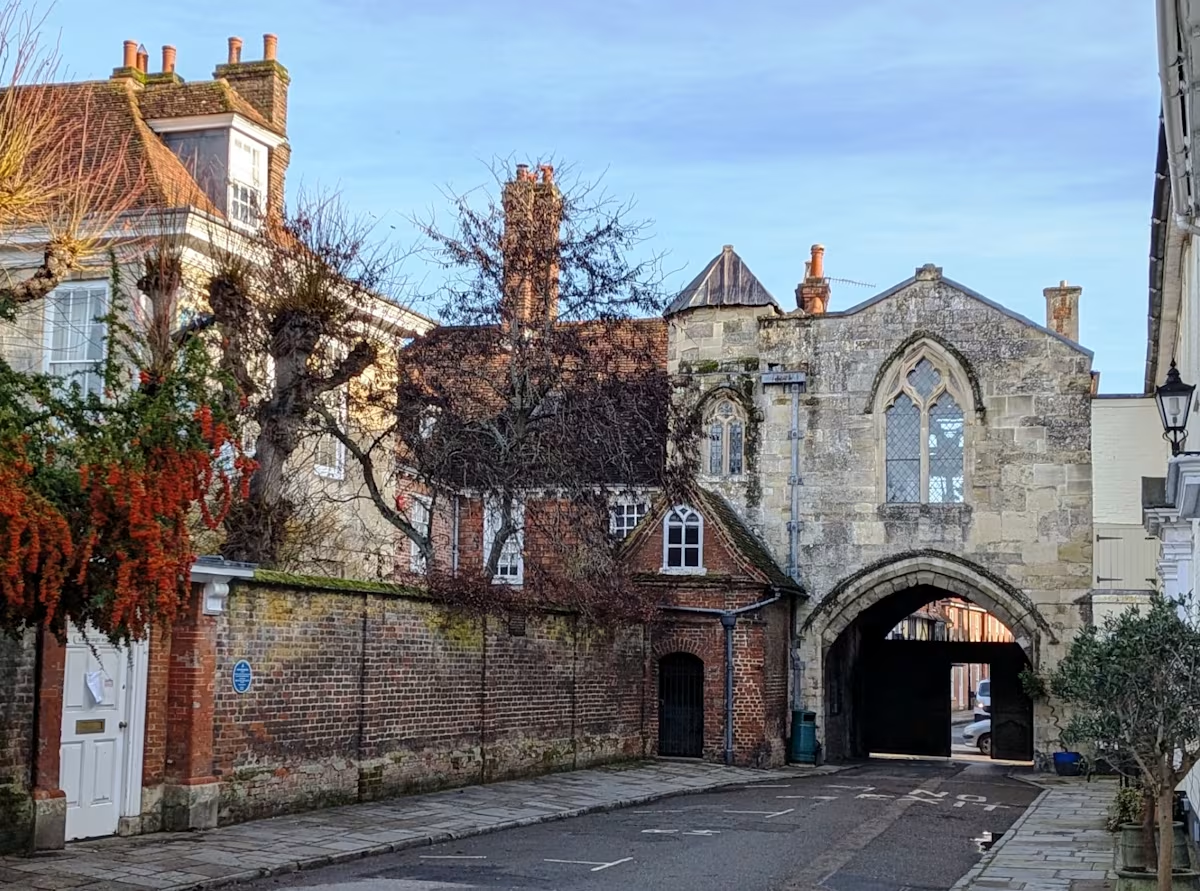
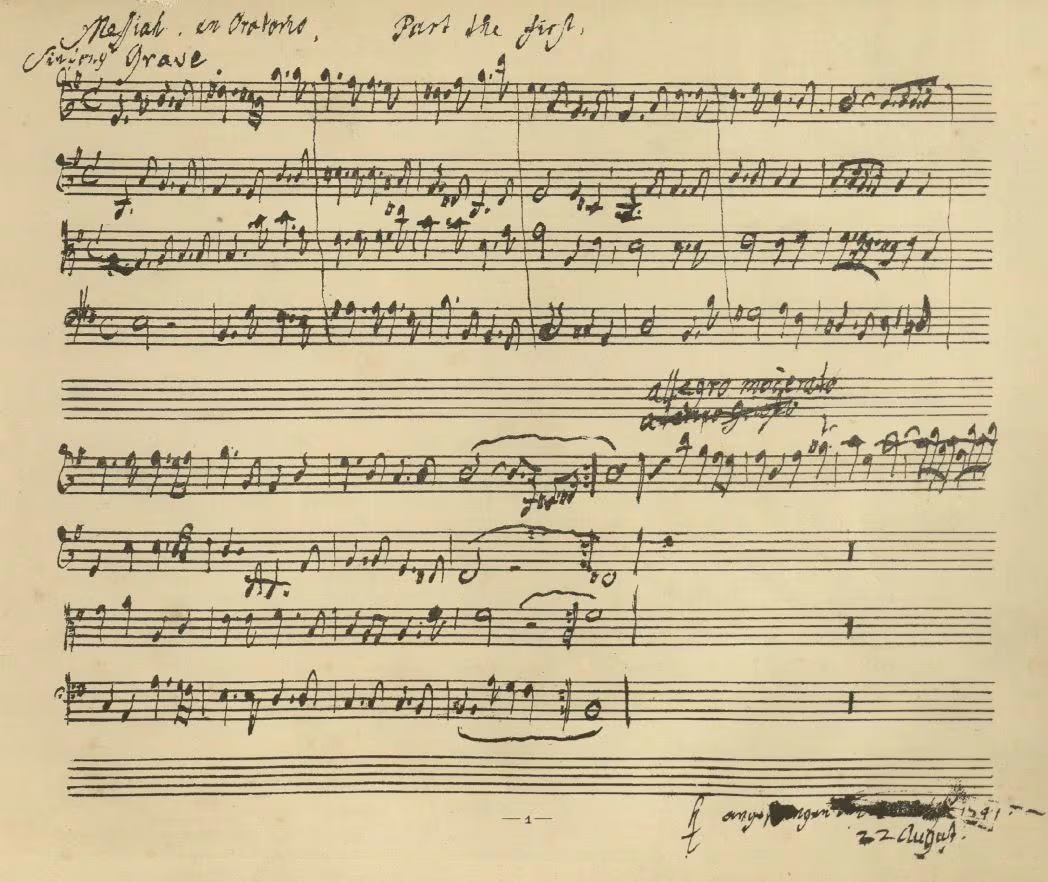
There is an oddly persistent local story that a performance of Messiah was given in the chapel room over St Anne’s Gate when Handel stayed in Salisbury in 1739 with his friend James Harris of Malmesbury House in the close. We know that Handel composed Messiah between 22 August and 14 September 1741, so a quick look at these dates shows that this story is obviously not true – but its very persistence reveals a fascinating relationship between Handel’s Messiah and Salisbury.
The special nature of the relationship between Salisbury and Messiah relies on two important facts, firstly that the earliest performance in Salisbury was one of the first outside London. The advertisement for this first performance of Messiah in Salisbury described it as ‘a new sacred oratorio’:
St. Cecilia’s Festival will be celebrated at Salisbury on Thursday and Friday the 4th and 5th of next October.
There will be a Te Deum, and two Anthems of Mr. Handel’s each day in the Cathedral Church, and Vocal and Instrumental Musick at the New Assemb’y Room. The first Night the Messiah; the second Night the Allegro and Penseroso, both by Mr. Handel. There will be a ball each Night for the Ladies, and several Performers from Oxford and Bath. At the same Time the New Organ will be opened at the Assembly Room.
The Messiah a New Sacred ORATORIO
Being the first Night’s performance;
AND
MILTON’S Allegro and Penseroso, with a Song for St. CECILIA’S DAY by DRYDEN,
Being the second Night Performance,
Will both be published the first Day of the Festival
And sold at the Printing-Office, and at the Door of the Assembly Room (Price Six Pence each)
Salisbury and Winchester Journal, 24 September 1750
On 1 May 1750, Handel conducted his first charity performance of Messiah at the Chapel of the Foundling Hospital in London. The performance in Salisbury in October 1750 was then followed by performances elsewhere - Bath (1755), Three Choirs Festival (1757) and Bristol (1758). Other musical cities such Birmingham and Coventry followed from 1759 onwards. The first printed edition appeared in 1767, printed in London.
Secondly Messiah became so popular in Salisbury that an analysis of the adverts of 18th century concerts in the city mentions performances of Messiah 21 times (equalled only by Zadok the Priest). In 1768 an extra day was added to the annual festivals making them three day events to accommodate a performance of Messiah on the middle day. Interestingly, these performances were linked to a local fundraising campaign in aid of the new Salisbury Infirmary. Following Handel’s example, since then Messiah performances have frequently been connected to a charitable purpose. The Salisbury performances took place in the Assembly Rooms, the Cathedral and, in 1777, in St Thomas’s Church while the Cathedral was closed for renovations.
Now in its second year, the modern Salisbury Musick Festival takes its inspiration from the three-day festivals in 18th century Salisbury. So it seemed a natural choice to include a gala performance of Handel’s Messiah this year – the most frequently performed large scale work of the 18th century festivals.
The journal kept by local composer John Marsh gives an interesting insight into local performances. In 1778, he elected to play the timpani so he could sneak round and see the star performers sing their arias:
The following morning I went with Miss Nicholls & Mr Purity to the Messiah at the Cathedral … in w'ch I beat the kettle drums, for the 1st time upon this occasion, which post I in future agreed to take at the annual Music Meetings, by way of compromise on being excused from taking a fiddle or bass, which would employ me the whole time & prevent me hearing any of the chief singers or performers to advantage, whereas the drums being only used in a few of the grand chorusses I could go down & hear the rest of the performance to advantage & yet be of nearly as much service as if I played a violin or bass all the time. - 16 September 1778, (Robins, Brian (ed) (2011). The John Marsh Journals: The Life and Times of a Gentleman Composer (1752-1528), Vol. 1 Pendragon Press; Revised edition)
The star performer in 1778 was the castrato Venanzio Rauzzini, one of the foremost singers in London after his move from Italy in 1774 and for whom Mozart composed the motet Exultate jubilate.
The soloists in 2026 include Charlotte La Thrope soprano, Sarah Denbee alto, Hugo Hymas tenor, William Drakett bass. These performers will join The Farrant Singers and Salisbury Baroque, Salisbury's own period instrument orchestra for local players and colleagues from further afield.
The second edition of the three-day Salisbury Musick Festival will take place from 2 - 4 October 2026 and will include concerts, talks, a guided walk and workshops for children and adults. The festival will conclude with a performance of Handel’s Messiah on Sunday 4 October at 6.00 pm in St Thomas’s Church, Salisbury. Full details of all the events including those by local musicians, many of which are free to attend, can be found on the festival's Continuo Connect profile page.
Share this
Keep reading
Šarovít, duende, meraki… Inside Nocturnalia’s musical language
Continuo Connect catches up with Pablo Tejedor-Gutierrez from Nocturnalia Ensemble, first-time Continuo grantees, about their upcoming season.

Sam Brown on Dowland and filtering history through a modern lens
Lutenist Sam Brown of Dowland's Foundry chats with Simon Mundy about how we interpret John Dowland, the formation of the ensemble around Emma Kirkby's kitchen table, and an exciting recording project in the pipeline.
Playlist: Birds in Early Music
A playlist that explores how birds and birdsong inspired composers from Rameau and Couperin to Handel and Haydn and beyond.