

Review
Bucharest in full score: Enescu Festival 2025
A report from Romania’s biennial musical extravaganza
Share this

BY SIMON MUNDY | FIRST PUBLISHED 27 DEC 2025
Established in 1958, just three years after the death of its namesake composer, the George Enescu International Festival is a big beast, with quite possibly the biggest programme of orchestral concerts squeezed into one month of any classical festival in the world. From late August to nearly the end of September, there are three and often up to six concerts per day, spread across four main venues in the centre of Bucharest, with additional smaller groups of concerts held in more than 20 cities across Romania from Arad, Constanța and Cluj-Napoca to Iași, Sibiu and Timișoara.
In 2025, for its 27th edition, the festival also expanded into neighbouring Moldova with a performance in its capital, Chișinău. Most of them are broadcast on Radio Romania, and most are also either televised or streamed. Cleverly, it is held every other year, meaning the enormous burden of hosting so many orchestras from all over Europe does not overstrain the audience, the small organising team, or the Ministry of Culture’s budget.
The festival invites reporters from abroad to cover a five-day slice of the events and, bearing in mind the focus of Continuo Connect, I picked a period between 5 and 9 September, when there were at least a few Early Music concerts amid the deluge of modern orchestral ones. This was the first time I had attended the festival since the hiatus of the COVID years, and Bucharest has changed in that time. Several of the open-air restaurants close to the main concert halls, the Athenaeum and the Cultural Palace, are now vacant spaces, but smaller indoor ones have opened, and the old town, 15 minutes’ walk away, has become something of a commercialised tourist hot spot.

The festival takes place, though, in the grandest part of the city, roughly a square bounded by the National Gallery, the Athenaeum (the beautiful circular hall opened, like Amsterdam’s Concertgebouw, in 1888) and the Athénée Palace, the art deco hotel that became a setting for Olivia Manning's novels, A Balkan Trilogy, as a place for intrigue and wartime spies.
Enescu holds a central place in Romania’s musical consciousness in the same way that Vaughan Williams does in England or Khachaturian in Armenia, and the festival ensures a good sprinkling of his music is included in every edition. The other focus this year was the 50th anniversary of Shostakovich’s death. Romania feels very vulnerable because of its proximity to Russia’s continuing war against Ukraine. It is a frontline state that has had enough of dictators, and Bucharest audiences responded to Shostakovich’s darkest music, like the exhausting Eighth Symphony (performed superbly by the Hesse Radio Frankfurt Symphony Orchestra under Alain Altinoglu, preceded by Julian Rachlin playing the Sibelius Violin Concerto) with rapt and emotional attention.

Immediately before that, in the elegant hall of the University of Music, a brilliant young trio from the Academia Lumières d’Europe (Sabina Silaghi, violin; Heddi Raz-Shahar, cello; and Gabriel Berrebi, piano) gave a heart-wrenching performance of Shostakovich’s Second Piano Trio, written in the same ghastly year, 1944.
The Early Music movement is still finding its footing in Romania, and the festival continues to play an important role in introducing international standards and perspectives to local audiences. Last time I visited, in 2019, groups like Europa Galante and the Orchestra of the Age of Enlightenment (OAE) were drawing full houses, even to the late night slots in the Athenaeum, starting at 10.30pm and finishing after midnight. The OAE were there on 11 September, just after I left, with choreographer Kim Brandstrup’s Breaking Bach programme, devised as part of the orchestra’s extraordinary partnership with students at the Acland Burghley comprehensive school in Tufnell Park.

I did attend another Early-Music-and-dance performance two nights earlier at the Ion Caramitru Stage of the National Theatre, given by the Malandain Ballet Biarritz with the Orchestra of the Royal Opera of Versailles, combining The Four Seasons by both Vivaldi and Giovanni Guido. Thierry Malandain’s choreography found particularly vivid expression in the Guido movements, where smaller groupings and brighter costumes allowed greater visual variety, while the Vivaldi, danced by the full company in black against predominantly turquoise lighting, adopted a more restrained palette.
Given the physicality of the choreography and the size of the forces on stage, amplification seemed clearly a pragmatic choice, though it unavoidably altered the overall acoustic character of the otherwise engaging performance directed by violinist Andrés Gabetta – brother of cellist Sol who had played the Lalo Concerto fabulously in the Athenaeum with the Basel Chamber Orchestra the previous Saturday.

Sol's concert had been followed by the first of two by Ottavio Dantone’s period group, Accademia Bizantina. I had high hopes for this: a programme of Neapolitan music, heavy with Pergolesi. The powerful bass Omar Montanari obliged and lit up the night, while soprano Valeria La Grotta’s stylistic poise and accuracy offered a more restrained contrast, and the instrumental ensemble favoured refinement and control over exuberance.

The night before, Accademia Bizantina was joined by the 25-strong Purcell Choir (entirely Hungarian, despite the name) for a work seldom performed today, inviting audiences to explore an intriguingly obscure facet of the Baroque repertoire: Il trionfo della Fama (‘The Triumph of Fame’), an allegorical one-act opera by the Florentine-born Habsburg-court composer, Francesco Conti, written for the coronation of Charles VI (the father of his more famous daughter, Maria Theresia), who was crowned King of Bohemia in 1723. Having served its purpose at the time, the work has understandably become a rare curiosity today, unlike Conti's Don Chisciotte in Sienna Morena, one of his sixteen operas, that continues to capture attention after its modern revival in Buxton and Innsbruck.

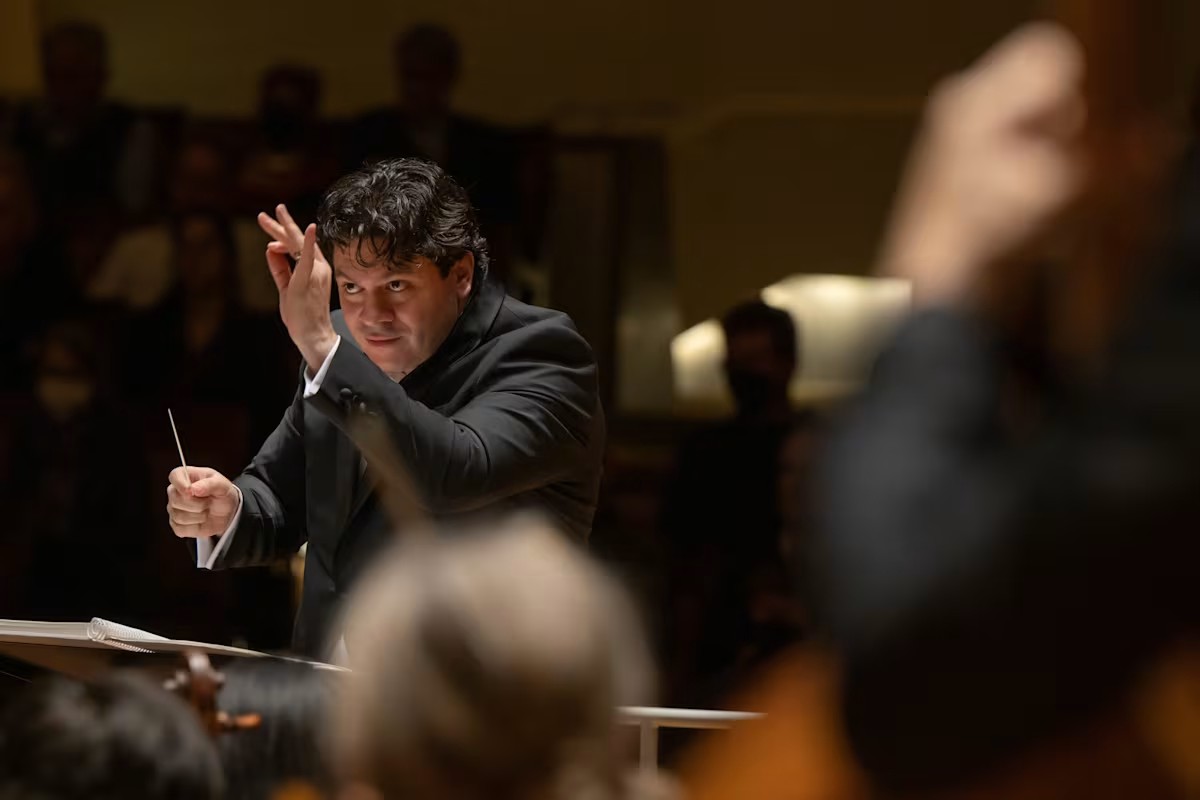
While Romania is still in the process of nurturing its own cohort of Early Music practitioners, there is clearly an educated public taste for the genre in Bucharest, no less enthusiastic than for the mainstream orchestras. The audiences for the Early Music programme were encouragingly full, and I hope the new artistic team, led by conductor Cristian Măcelaru, will feel that the festival has room for a far larger and more varied programme of period performances in the next edition in 2027.
Share this
Keep reading
Playlist: Continuo Patrons
A playlist of tracks by Continuo Foundation Patrons Mary Bevan, Emma Kirkby, Rachel Podger and Ashley Solomon in celebration of the UN International Day of Charity.

The soundtrack of imagination: David Yardley and Green Dragon Guild of London
Medieval countertenor David Yardley, Artistic Director of Green Dragon Guild of London, discusses Medieval music, Southwark’s layered history, and how imagination and meticulous research meet in performance in our latest podcast.

Celebrating 300 years of Academy of Ancient Music
Three hundred years after the first Academy of Ancient Music was founded, its modern namesake is preparing a season that looks far beyond commemoration.