
Feature
David Munrow, Britain’s own Pied Piper
Inspiration for a new concert series
Share this

BY SIMON MUNDY | FIRST PUBLISHED 16 MAY 2026
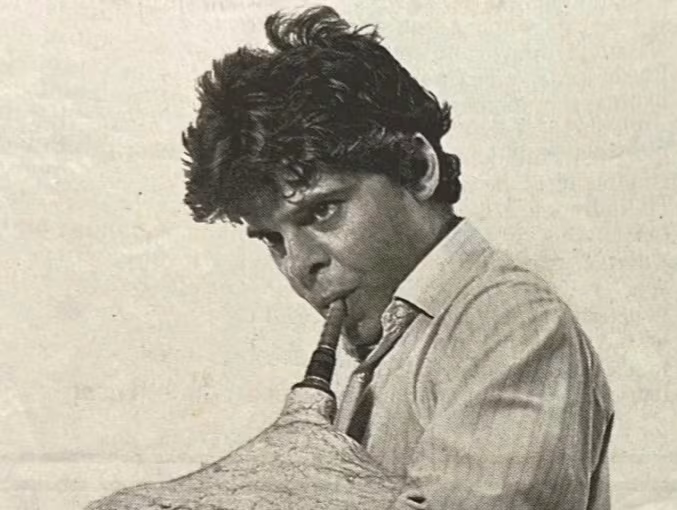
A virtuoso performer, multi-instrumentalist, broadcaster and co-founder of the Early Music Consort of London, David Munrow truly transformed Early Music into a vibrant art form. This summer, the ensemble Fiori Musicali honours his influence through a series of Continuo-supported concerts inspired by his life, eclectic repertoire and passion for musical discovery.
50 years ago, on 15 May 1976, the death of David Munrow, who sadly took his own life during a period of depression, shocked the music world profoundly. He was just 33 years old.
Munrow was the man who had pulled the Early Music movement out of academia. He played a ridiculously large array of instruments, many of them gathered on travels through South America, and presented a radio show called Pied Piper that mixed genres of music, from mediaeval to prog rock. He had made the sound of Early Music authentic in film scores and had formed the Early Music Consort of London with Christopher Hogwood. He was a pioneer, not just of playing styles, but of teaching that every musical tradition has value and quality.
Francesco Landini: ‘Ecco la primavera’ | Early Music Consort of London, David Munrow
An archive of scores, scripts, recordings and other publications spanning Munrow’s short but deeply impactful career is now housed in the Royal Academy of Music. The year after he died, his recording of Anthony Holbourne’s The Fairie Round was launched as part of the Voyager mission to Saturn and beyond. It has now passed the solar system and is heading through interstellar space, over 20 billion kilometres from the sun.
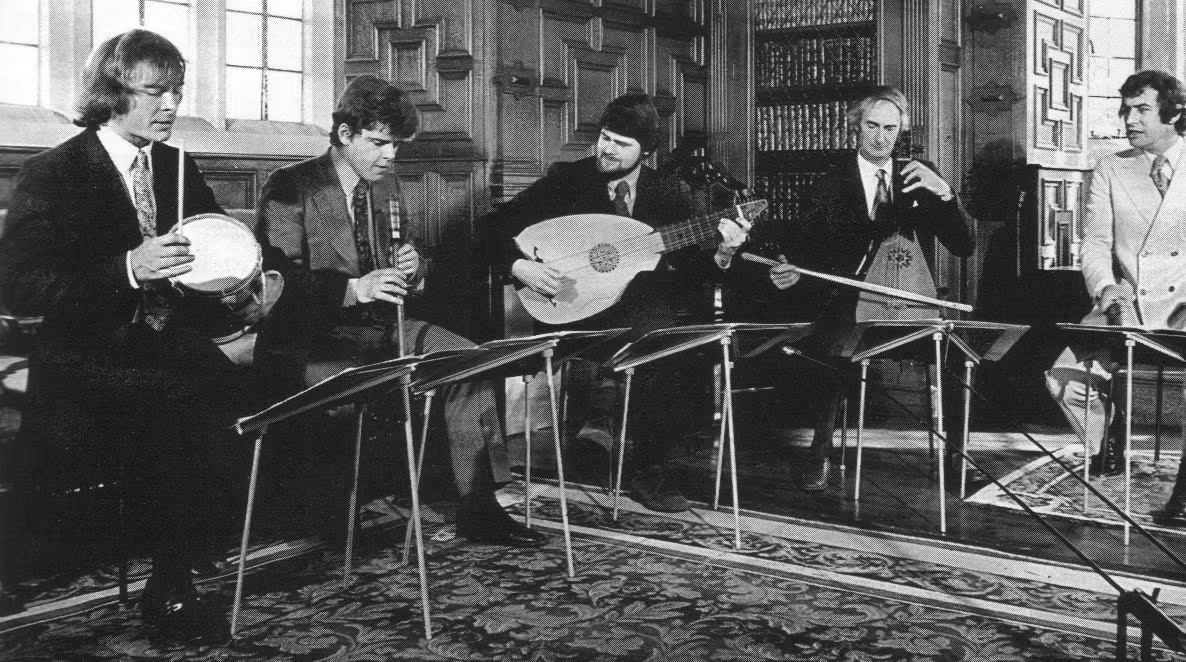
Back on Earth and in very rural settings, the ensemble Fiori Musicali will perform four programmes across the middle of England this summer, commemorating Munrow’s life. Formed in 1983 by its director Penelope Rapson, the influence of Munrow lingers strongly. Rapson told me, ‘I never met him, but I was very aware of his death. I had gone to his concerts in the 1970s when I was in the Schola Cantorum of Oxford, recording Tippett with Nicholas Cleobury. Munrow made Early Music interesting. He brought it alive, and it was never precious. He could mix and match his Medieval with his Renaissance (and even with Rock) – and apparently he played 42 different instruments.’
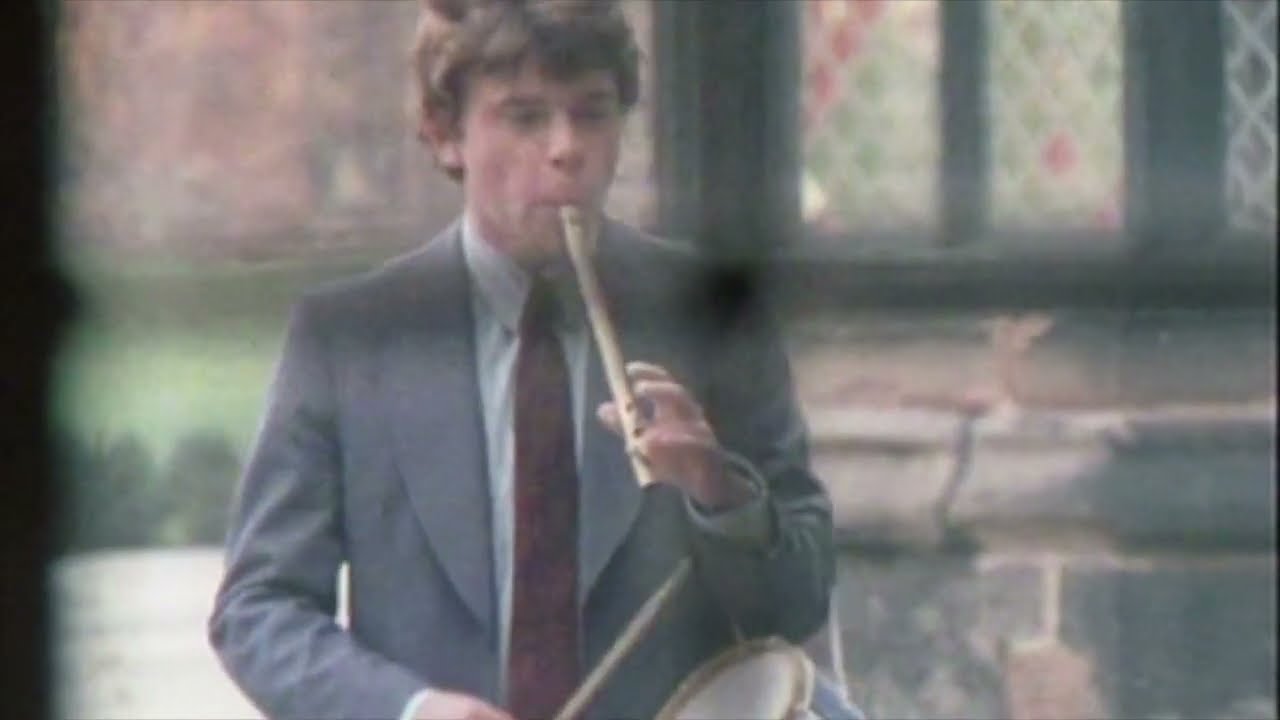 ▶
▶David Munrow playing pipe and tabor in his TV series, Early Musical Instruments, broadcast in 1976
She has designed each concert to look at a different aspect of Munrow’s music-making, built around the legend of the Pied Piper of Hamelin, ‘with the odd dulcian knocking around’. The first programme, Piping Down the Valleys Wild (11 June), ‘is inspired by the church of St Lawrence at Broughton, near Milton Keynes, which has fine 15th-century wall paintings and a chained copy of a book by Erasmus. We’ll include some of Praetorius’s Dances from Terpsichore, which were rather a signature tune for Munrow. The church is looked after by the Churches Conservation Trust, which cares for buildings all over the country. It's really important to use these places with their wonderful acoustics.'
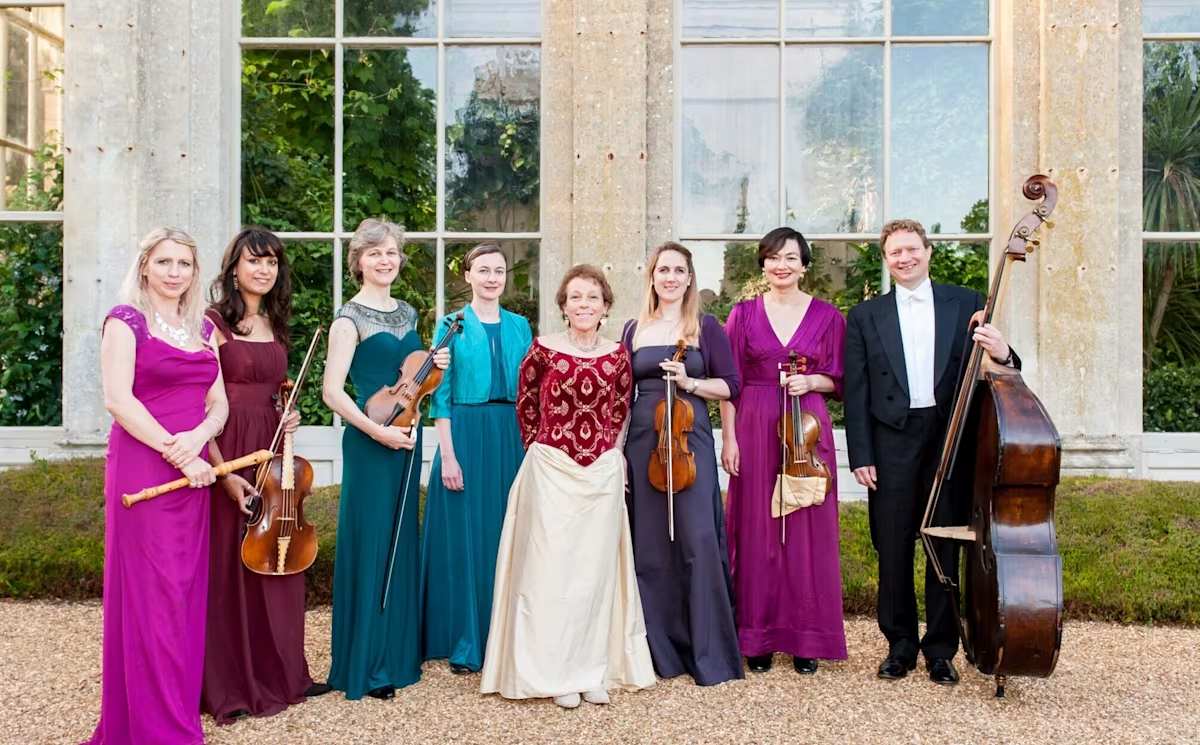
The second concert adds the Fiori Musicali Choir to the instruments. It will be in the church at Wolfhampcote (28 June), near Daventry in Warwickshire, much admired by John Betjeman and John Piper. ‘This is a church that has been left behind by time,’ says Rapson. ‘It’s in the middle of nowhere, surrounded by fields and cattle. It is our Glastonbury. There’s no electricity and no church furnishings, a completely bare shell with just a couple of 14th-century pews. But it will shortly be getting a new stained-glass window, specially designed by the celebrated Thomas Denny, that will even feature our choir (just very small at the top of the window)!
‘For this concert I’m going back to Dufay, his Missa Se la face ay pale. We’ve never performed his music, despite knowing it since university. It’s pretty challenging – full of complex rhythms – but we are greatly looking forward to it. We have a select group of voices and players for this, as, like Munrow, we will be adding a variety of instruments, including slide trumpet, cittern and dulcian.’
Guillaume Dufay: ‘Kyrie’ from Missa Se la face ay pale | Early Music Consort of London, David Munrow
The third programme is Venetian music, which will take place in the large church of St Mary the Virgin & All Saints at Fotheringhay (16 August) – an iconic former monastery home to monuments to the Duke and Duchess of York – that was partially demolished in the Reformation. ‘This is our regular summer concert there,’ Rapson says. ‘It is quite a reflective concert, musing on the passing of earthly glory (Sic transit gloria mundi) – Munrow’s early death and the collapse of the Venetian Republic after centuries of prosperity, linked to plague brought by ships’ rats – that connects with the 1284 Pied Piper story.
‘Venice, like Hamelin, was a commercial city that went from success to destruction. There’s a plaque on a house in Hamelin saying that on 26 June 1284, the feast day of St John and St Paul, 136 children were led out of the town by the piper and disappeared into the forests forever. There’s speculation that they may have been suffering from “St Vitus’ Dance”. This concert gives a nod to Munrow’s disc, Monteverdi’s Contemporaries, and we will be playing a lot of Andrea Gabrieli – with multiple choirs, up to sixteen parts spread around the church.’
The final concert of the series is in Potterspury, just to the northwest of Milton Keynes (4 October). ‘I’ve called the programme La Pastorella, and here we’ve tried to pick up on the idea of Munrow the bucolic flautist, so this is a concert of chamber concertos where woodwind instruments come to the fore. And, to link to the town of Hamelin’s connection to St Vitus, we also include Schickhardt’s version of La Folia.’
David Munrow performing Schickhardt’s Variations on ‘La Folia’
Fiori Musicali are not confined to the rural centre of England. ‘We’ve toured abroad (Prague, Budapest, Paris, Madrid, etc., also with James Bowman and Grace Davidson). Like many other groups, though, we find it harder to tour these days – it’s a different world, less certain. The Arts depends on support – they always have! It all comes down to pounds, shillings and pence (in old money).
‘In these days of economic uncertainty, Continuo Foundation is a godsend. Its support enables us to bring some of today’s finest specialist Early Music performers to places outside the great metropolises – rural communities that otherwise would be seriously underserved. We are so grateful – it means we can bring great music to people who otherwise would have little opportunity to hear it – live music, not streamed. Music is a force for good – it brings us all alive, and doesn’t use up too many natural resources!’
Supported by a grant from Continuo Foundation, Fiori Musicali’s four-part concert series starts 11 June in Broughton with further concerts in Wolfhampcote, Fotheringay and Potterspury.
Share this
Keep reading
Hugh Cutting: a countertenor in counterpoint
Countertenor Hugh Cutting talks to Continuo Connect about the physical joy of singing, Bach’s gifts to the countertenor and his determination to make music from the past speak to the present.
Tallis: ‘Spem in alium’ – a forty-part motet
A favourite among choral fanatics, Tallis' 'Spem in alium' has a fascinating history and has more recently been used in an unexpected context.
Playlist: Continuo Patrons
A playlist of tracks by Continuo Foundation Patrons Mary Bevan, Emma Kirkby, Rachel Podger and Ashley Solomon in celebration of the UN International Day of Charity.