

Podcast
Mary-Jannet Leith on collaborating with the Buskaid Soweto String Ensemble
Share this


BY CONTINUO CONNECT | FIRST PUBLISHED 04 AUG 2026
In the first of a new series of podcast interviews, broadcaster and Continuo Connect Writer-in-Residence Simon Mundy talks to recorder player and researcher Dr Mary-Jannet Leith of Ensemble Hesperi ahead of their collaboration with the Buskaid Soweto String Ensemble in concerts in Bath (18 August) and London (20 August). This project is supported by a grant from Continuo Foundation.
Prefer to read this interview? View an edited transcript of this podcast below.
Simon Mundy: The thing I always want to ask of an ensemble is how you came by your name. How did you arrive at Hesperi?
Mary-Jannet Leith: It was quite a strange one, really, and it was a long time ago – we've been working together since 2018, but the name came even before that. 'Hesperi' means 'evening stars' in Latin, and I think it was just something we felt gave a sense of something special but also linked it to being on stage: the whole variety of the night sky. Sometimes one thinks that if you had to choose a name now, you might reach for something less distant in time, but it works for us, for sure.
It's a lovely name, and one thinks of Jordi Savall's Hespèrion XXI as well – and 'seren' in Welsh, of course. So who are the evening stars? Tell me about yourselves.
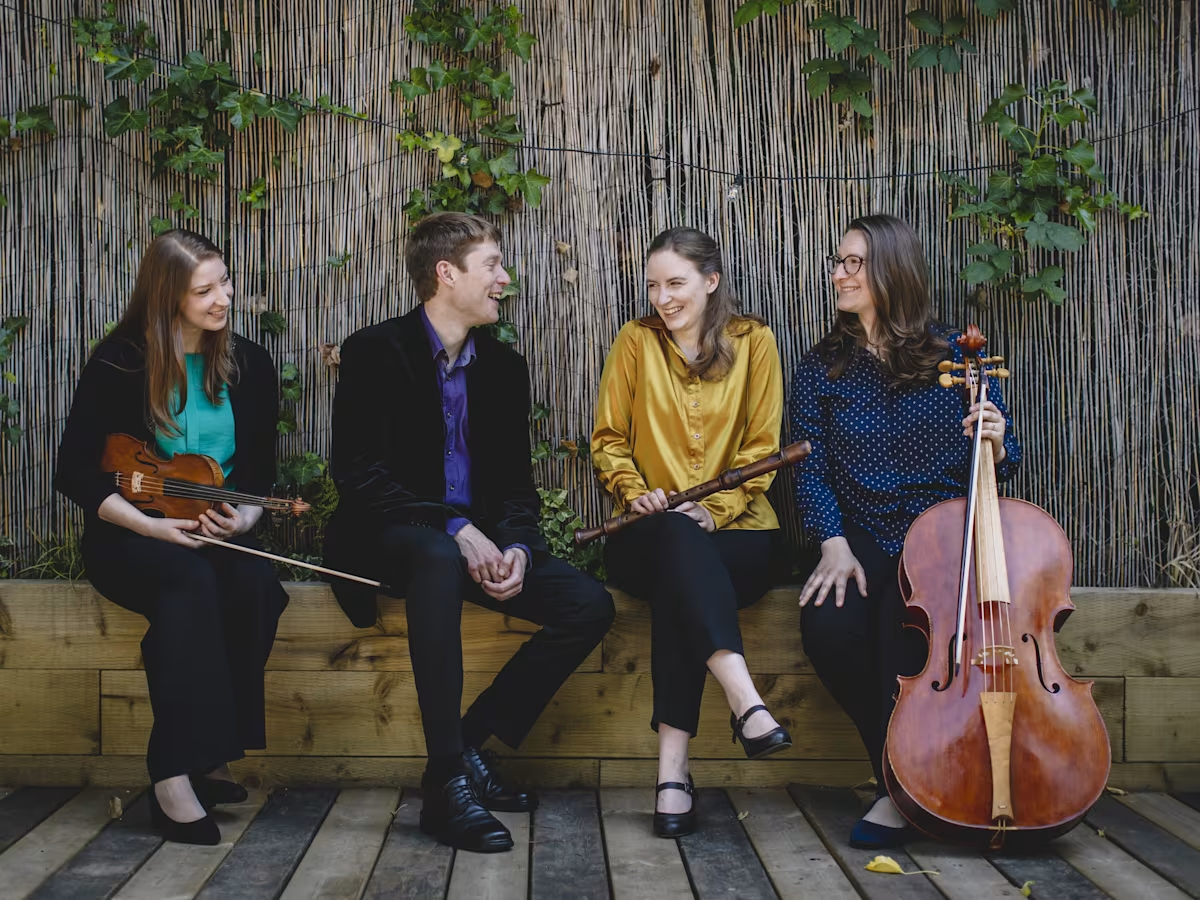
There's myself on recorder, Magdalena Loth-Hill on violin, Florence Petit our baroque cellist and Thomas Allery on harpsichord.
And what's the musical focus? Baroque or Renaissance?
It's largely Baroque, though not exclusively. More recently we've been doing a lot of expanded projects, bringing in more musicians, and for those we've gone quite a bit later – a little early Classical. It's possible for us to go earlier as well, with the recorder focus. The next thing is to acquire a viola da gamba so that Florence can do some earlier repertoire too.
I think we started off with a Baroque focus because that was our instrumentation, and that's where we were. It made sense. But we want to try anything, really, that makes sense to us.
You say you're the recorder player. Do you play all varieties, or is there one you specialise in?
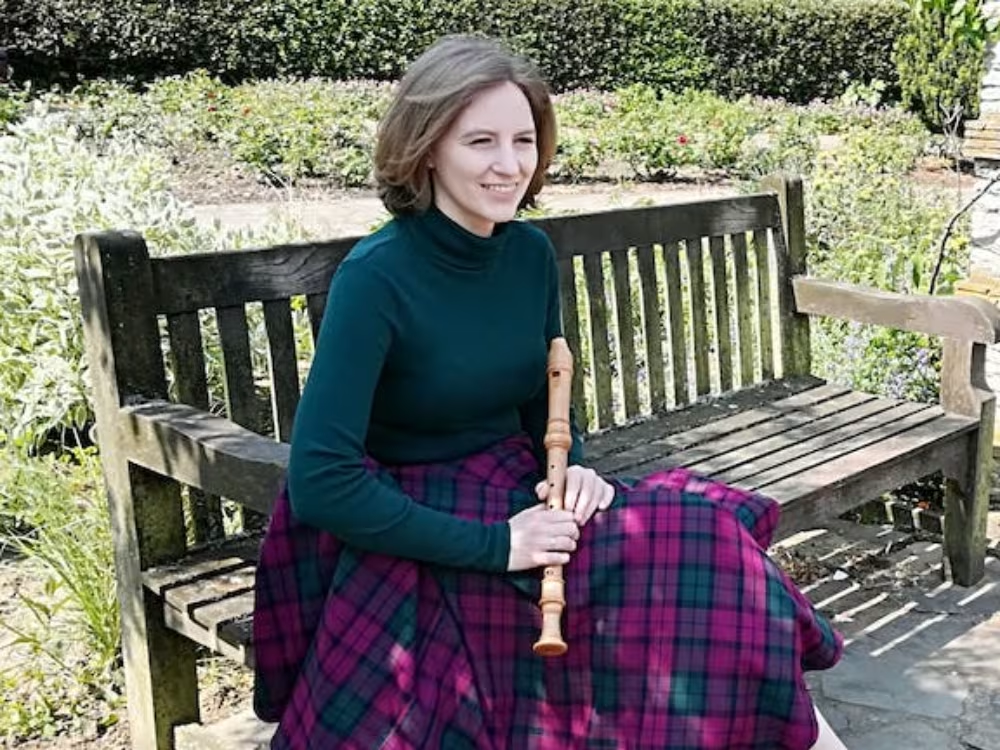
Not particularly, no – any and all recorders. I've got a fair collection here with me. I end up using the Baroque ones most often, as I think most people do, but I do have some beautiful Renaissance instruments as well. And if I'm playing in a recorder consort, I'd use nice consort instruments, which are always very beautiful when you manage to get them in tune with each other.
Do you lay them out on a table next to you in concert, rather like a drummer with his sticks?
Exactly, yes. I've got a little cushion that I try to place relatively near me. Occasionally I'll change instrument during a piece or even a movement, so it's a quick change.
Tell me about the music you're doing at the moment and what you'll be taking on tour over the next few months.
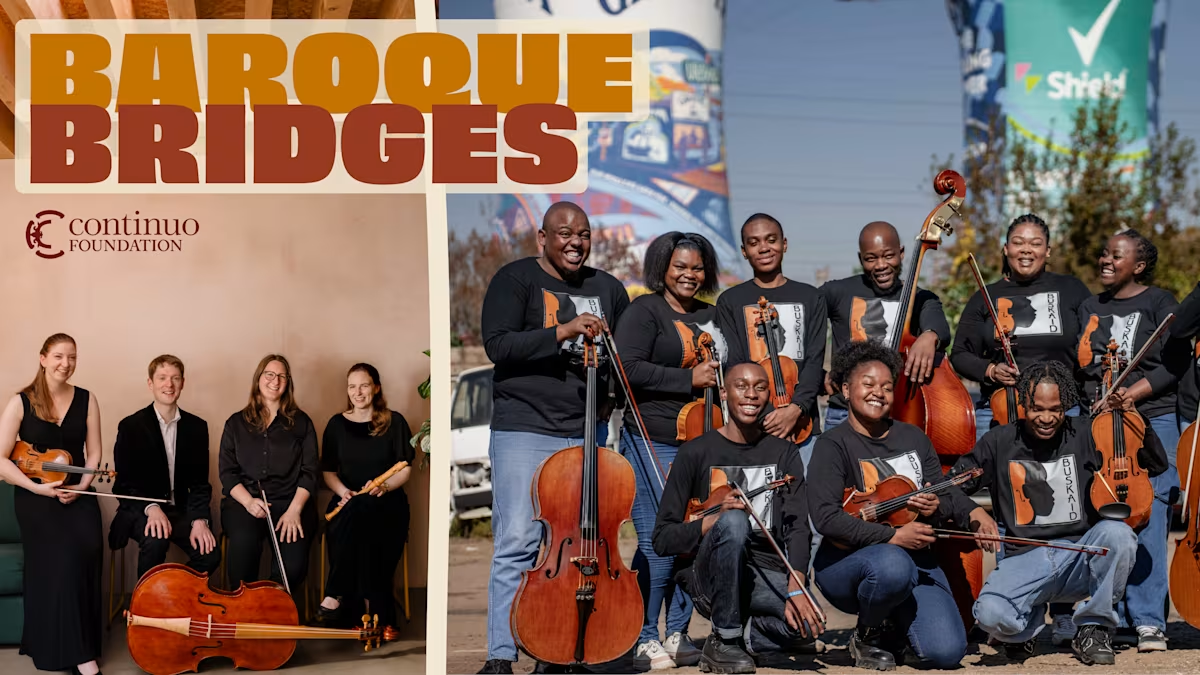
We have a really exciting project with Buskaid, a South African musical charity based in Diepkloof in Soweto, Johannesburg. It's been going nearly 30 years now. It's a music school where disadvantaged children learn stringed instruments – there are about 85 students there at the moment. It's an amazing thing, founded by Rosemary Nalden, who was a viola player in the UK before she moved out to be permanently based in South Africa.
I became quite involved with Buskaid as an administrator. When I was starting off in my performance career, I did a fair amount of arts administration as well, and I was actually the UK fundraising branch of Buskaid, administrating everything to do with that for about 10 years. I've just finished that, and right at the end of it, the ensemble was suddenly going to be able to come over to the UK – so I thought this was a wonderful opportunity for a joint project with some members of the Buskaid Soweto String Ensemble, which is essentially the flagship ensemble of the school.
Ten members of the ensemble are coming across in August, and we're doing two combined concerts with the same programme. The music is a lovely balance: some Baroque favourites, some Bach, a Telemann recorder suite which I particularly love and haven't been able to perform for a while, and some Bologne and Sancho, so a really good mix of composers. Then at the end Buskaid will perform some kwela, some township music. It should be quite energetic, and it's something we've never done before, so it's been great to be able to put this together with the support of the Continuo Foundation as well.
It's extraordinary to me that you couldn't think of two more culturally diverse places than Telemann's Europe and Soweto. What do they make of Baroque music? It must seem very strange.
Well, in a sense it is obviously not something they hear around them naturally. But what Rosemary has always found is that when she recruits the children very young, there are always waiting lists for the music school. They don't exclusively play Baroque music – it's mostly Western classical – but Baroque seems to be the students' favourite, particularly Rameau and Purcell, so we're playing some of that as well.
It seems to appeal to the style of playing that Rosemary has instigated at the school. She uses something called the Essential String Method by Sheila Nelson, and it's all about freedom of movement and free-flowing expression, which is very similar to the historically informed performance style. So we feel that in many ways the musical styles we're both going for as ensembles are very similar, despite the chasm of geographical distance between us.
South Africa does have a long classical tradition, but most of Africa doesn't. You've only got to go up to Malawi, Zimbabwe and Zambia, and you lose that sense of connection with Western culture altogether.
Absolutely, and it's really interesting, because it's definitely not limited to non-Western places – it's increasingly difficult to sell classical music at all. One of the difficulties they find is that there's no longer a classical radio station in Johannesburg, so whereas it used to be very easy to spread the word about their concerts, it's now more difficult. They've been doing a lot of work on their online visibility, so they've got a great YouTube channel now where you can explore all of their concerts. They give a big concert every year at the Linder Auditorium in Johannesburg, and they tour as well – though, as you can imagine, that's been harder since the pandemic. It's become very expensive.
So the reason they're coming to the UK, apart from performing with us, is also to teach at the ESTA Summer School. It's a really interesting opportunity, both in terms of them sharing their teaching methods and us learning from them and giving them the chance to perform alongside us. I think it's going to be very good in terms of educational development for both sides.
The European String Teachers Association?
That's right, exactly. That was the first reason they decided to come over. But of course, once you're over – and they haven't actually been to the UK since 2014 – you've got to plan a tour.
Tell me a little more about Buskaid itself. Is it about busking? Clearly not, and yet...
Buskaid now refers to the music school and the charity. But the reason for the name was that, from the very beginning, the initial effort was a busk – a London-wide busk. It was mainly what we would call historically informed performers doing that busking at most of the railway stations in London, which of course is difficult to organise these days but back in 1992 was a bit more straightforward.
Rosemary and many of her colleagues busked at the stations, I think on a particular day, in order to raise money for a string project which was already established in Soweto but was struggling. That was the idea to begin with, simply to raise money. Then Rosemary decided to go there herself to see what it was like, how it could be helped and, obviously, to hand over the money that had been raised. I think she really got the bug, ended up getting more involved and then started her own project. So it grew from something very small and has blossomed into something very impressive.
A sort of flash mob on the road, then?
Yes, an Early Music flash mob. There were some wonderful photos of Early Music instruments at all the London stations, all that time ago.
Setting the Buskaid connection aside, tell me what Ensemble Hesperi is doing over the next few months.
Following this collaboration we're working on a new programme. Our violinist Magdalena has been away for a few months – she's had a baby, which is wonderful news. We've been working with several violinists over that time, but she returns in September, just in time to get this new programme up and running.
It's going to be another Scottish programme. One of our USPs as an ensemble is Scottish 18th-century music, and that's my specialism in terms of research. I completed a PhD a couple of years ago on Scottish music in 18th-century London, so I'm really interested in the musicians who moved from Scotland and made careers for themselves in London, publishing and doing various things.
In a way, you're one of them yourself, aren't you?
Well, in this century, yes. It mirrors my own story: I'm from Aberdeen, and I've ended up down in London doing what I do now.
Our first programme was called Full of the Highland Humours, back in 2019. We did a great Arts Council-funded tour of it, and it went down very well. We've done several other programmes since, but people always ask whether we can do the Scottish one, so we think now is the time for another.
I'm collaborating with a couple of people and with Scottish historic houses and castles, many of which have fantastic musical archives. Some great research has already been done on a few of them, and others are much less explored. The plan is to build a programme around that theme: what would it have been like to go over to a castle in the evening in the 18th century, and what music would you have heard? Of course that encompasses not just Scottish traditional music, as we'd say, but the latest Corelli and Handel and everything else that was popular at the time.
It's really more of a big flexible concept, which means we can adjust programmes very easily to different venues – hopefully to several houses and to any venue with a history within that. Some in Scotland, others elsewhere, but with a Scottish connection running through.
Some of those splendid castle libraries are places where you can still find a few manuscripts. I remember going with some Early Music singers to Longleat, the Marquess of Bath's place, and the old Marquess – two Marquesses ago, in fact – opened what he said was the door to the music library, and it was actually a fridge for the gin!
Yes, I can imagine that. For my PhD I was constantly in private archives as well as larger repositories, and sometimes you come across something that didn't mean much to anyone else, but to you it's amazing.
A couple of weeks ago we headed up to Boughton House to look at the Montagu Collection there. We're hoping to give a concert at Boughton and also at Dalkeith Palace, using some of the manuscript volumes from that collection, which are really interesting. A lot of them belonged to women, so you get a sense of their lives, what they were collecting and what they enjoyed playing in the domestic sphere. And there are some really unusual things.
We're hoping to feed a lot of that into our programmes for these places and to vary our time period as well, because some historic houses have a harpsichord and others a square piano – in fact, many have square pianos. So we can adjust, use different musicians, expand and make new programmes that are flexible, based on the research for each place. Which is always really fun.
That sounds an enormous amount of fun. I wish you well with all of it, and perhaps I might even get to the odd castle to have a listen. Thank you very much indeed.
Thank you, Simon.
Share this
Keep reading
Playlist: Continuo Patrons
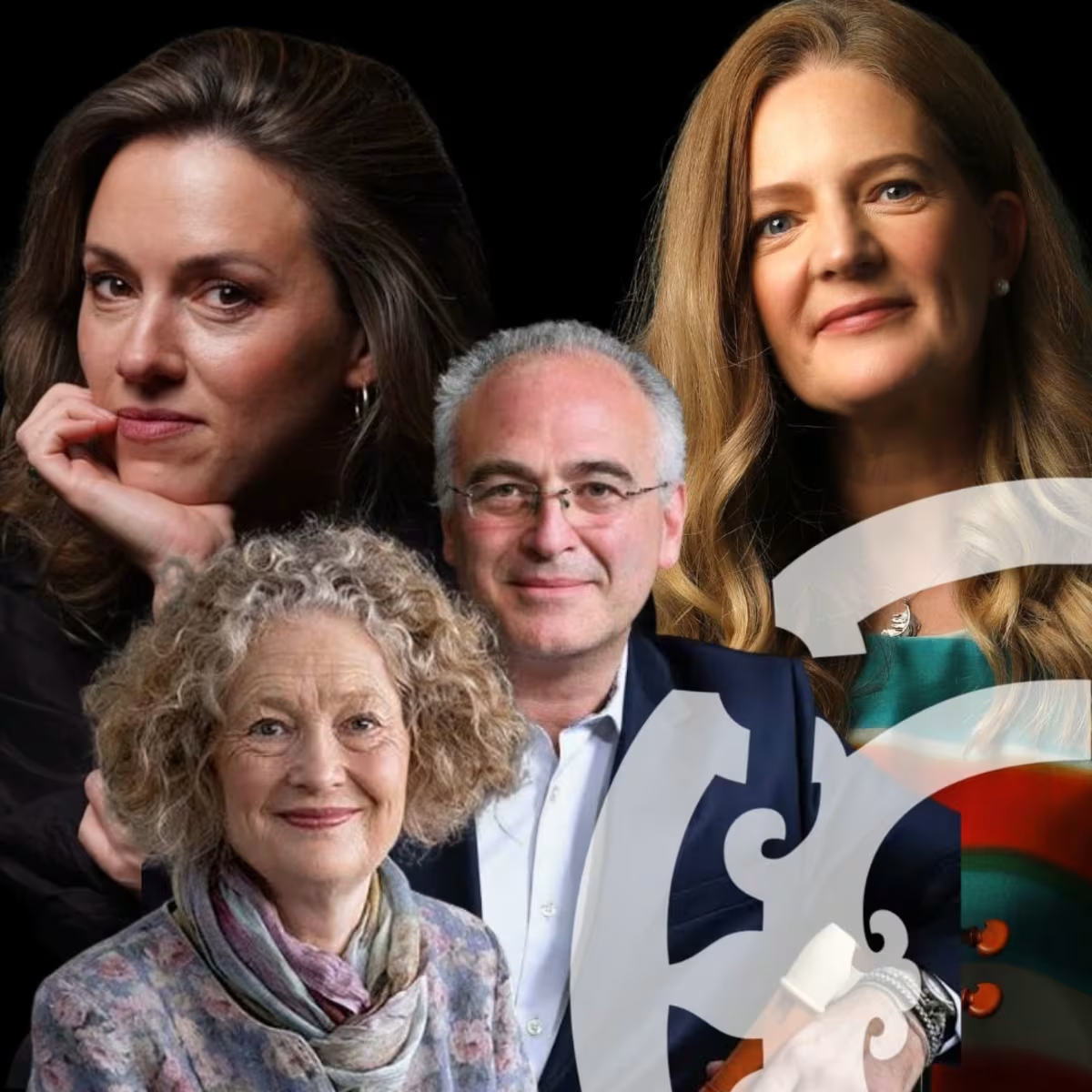
A playlist of tracks by Continuo Foundation Patrons Mary Bevan, Emma Kirkby, Rachel Podger and Ashley Solomon in celebration of the UN International Day of Charity.
Jordi Savall & Le Concert des Nations | Le concert spirituel
Jordi Savall and his orchestra Le Concert des Nations held this special 'Concert spirituel' during the 2010 Festival Musique et Histoire in Fontfroide Abbey, in Narbonne, France.
Spiritato: music out of boundless curiosity
Continuo Connect catches up with Will Russell and Kinga Ujszászi, founding members of the ensemble Spiritato.