

Feature
Margaret of Austria: Her story through music
Unearthing the music of a Renaissance stateswoman and great patron of the arts
Share this

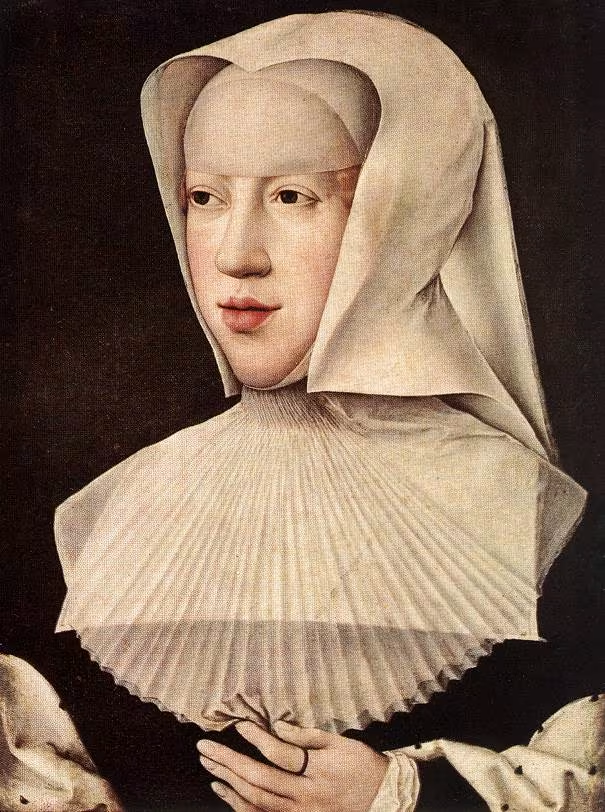
BY DAVID HATCHER | FIRST PUBLISHED 16 AUG 2026
‘Epitaph for a Green Lover’ from the Linarol Consort of Viols and soprano Héloïse Bernard celebrates the remarkable life of Margaret of Austria (1480–1530), one of the 16th century’s greatest patrons of the arts. Margaret’s world is brought to life through her musical library, featuring works by some of the greatest composers of the period and several texts written by Margaret herself. In this article, Linarol Consort’s founder and artistic director David Hatcher explores the manuscripts, music, and legacy behind the album, tracing Margaret's journey from a bargaining chip in European diplomacy to one of the most formidable arts patrons and power-brokers of her age.
The audio clips can be heard as ‘excerpts’ in Spotify’s preview mode. To hear them in full, please remain logged in to your Spotify account.
QUEEN OF FRANCE
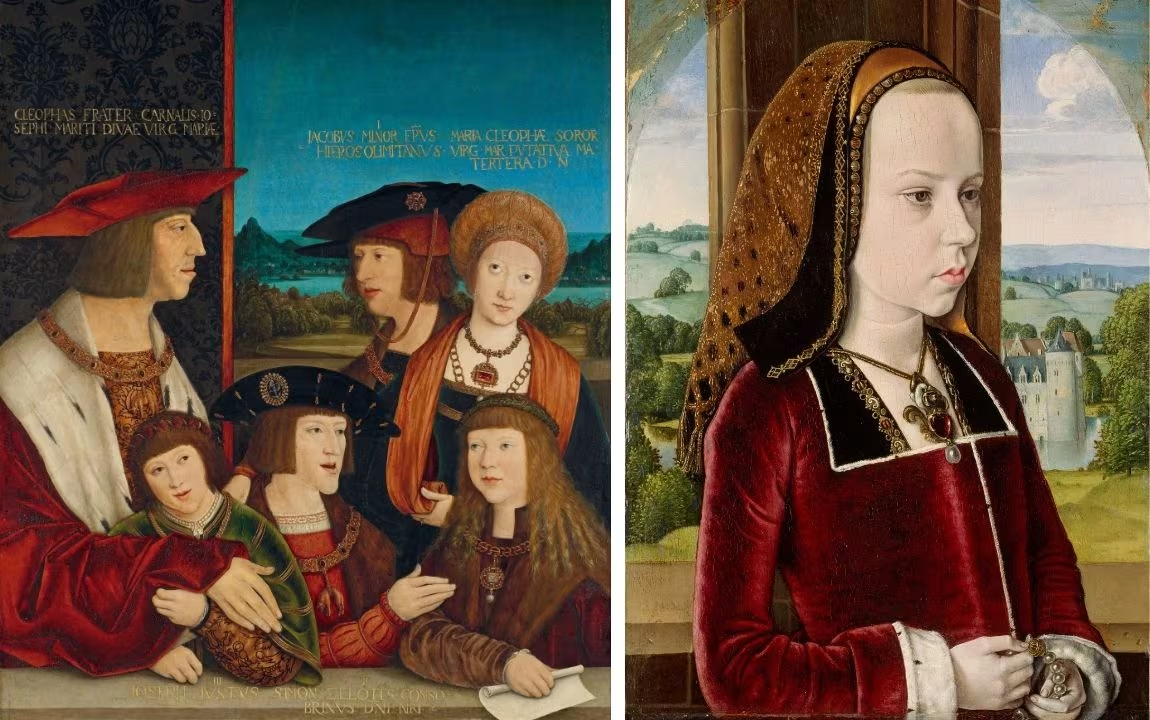
In an age when the daughters of Europe’s rulers were little more than bargaining tools to create strategic alliances through marriage, few were so valuable and yet so independently-minded as Margaret of Austria. Born in 1480 to Mary of Burgundy and Maximilian I, Holy Roman Emperor, she led a life of significance and resilience.
Under the terms of the Treaty of Arras (1482), agreed by Maximilian I and Louis XI of France when Margaret was two, she was betrothed to the Dauphin of France, Charles, twelve years her senior. Later that year, Louis died and the Dauphin succeed to the throne as Charles VIII, ‘The Affable’. Margaret, having been sent to be brought up in the French court, was from then treated as the next ‘Queen of France’. For the following eight years, the child was to develop what seemed to be a genuine affection for her future husband. But in 1491, as soon as the regency period ended, Charles’s greed for territorial acquisition led him not only to annul the betrothal, but also to have the Pope annul Maximilian I’s marriage-by-proxy to his second wife, Anne of Brittany, so that Charles could marry Anne himself in order that the French crown could encompass the wealthy Duchy of Brittany. This slight on Maximilian led to war, with Margaret remaining captive in France until she was restored to her family in 1493, when she was given into the care of her brother, Philip the Fair, Duke of Burgundy. Thus it was that Margaret’s first experience of marriage was not a happy one and the seed of enmity toward France that it sowed was to grow throughout her life.
Antoine Brumel: Tous les regretz, the opening track of Linarol Consort’s album, Epitaph for a Green Lover
The earlier of Margaret’s two surviving chansonniers (B-Br MS 11239), copied in Savoy c. 1500, is a beautiful manuscript, with exquisite French-style illuminations in the borders, painted initials and the Savoy coat of arms. The later and larger volume (B-Br MS 228) is an elaborately illuminated book in the Ghent-Bruges style with colourful miniatures and borders, dating from between 1516 and 1523.
The first chansonnier contains pieces by many of the most famous composers of the day, featuring some poignant reminders of the end of Margaret's time in France as in these despairing lines of Bruhier’s Vray Dieu qui me confortera:
Dear God, who shall comfort me,
When by a false villain I am held,
Locked in this room alone?
Antoine Bruhier: Vray Dieu qui me confortera
Margaret’s chansonniers also offer examples of what have become known as ‘regrets chansons’. The compositional tradition of ‘regrets-chansons’ began with Tous les regretz by Pierre de la Rue, setting a text by the court poet Octavien de Saint-Gelais, which was written after the annulment of Margaret’s betrothal to Charles. Several other composers added to the genre, including Hayne van Ghizeghem, Alexander Agricola and Loyset Compere. The first setting which opens our album is by Antoine Brumel, choirmaster at Notre-Dame, and then at Ferrara under Alfonso I d’Este. Josquin des Prez also made a contribution to the genre with four chansons. His ‘chanson nouvel’, Plus nulz regretz, was recorded as having been performed in Mechelen on the announcement of the Treaty of Calais on 1 January 1508 through which Margaret's nephew, Archduke Charles (the future Emperor Charles V), was betrothed to Mary Tudor of England.
Josquin des Prez: Plus nulz regretz
PRINCESS OF SPAIN
Charles VIII’s ambition and expansionist policies led to the surrounding states of Europe forming a grand alliance. Marriages were arranged accordingly, and Margaret, together with her brother, were to be married to John and Joanna of Castile, the children of Ferdinand II and Isabella I. A fleet set sail from Spain carrying Joanna to Flanders, arriving in 1496 and she was married to Philip the Fair at Lille shortly afterwards. Later on, Margaret arrived in Spain via Santander and was married to John, Prince of Asturias, at Burgos Cathedral on Palm Sunday, 3 April 1497.
With the splendour and influence of the court of Ferdinand and Isabella at its zenith, negotiations for peace progressing and Margaret expecting her first child, all seemed well at last. But that was about to change again. On his way to the celebrations of his sister Isabella’s marriage to the King of Portugal in 1497, the 19-year-old John fell mortally ill. Fearing for her unborn child, Margaret’s physicians had prevented her from seeing John. When, on 4 October, she was finally allowed to enter and kiss her husband, it was too late and she found him cold to her lips. Shortly afterwards, on 8 December, her premature daughter was stillborn. The following year, the Queen of Portugal died aged 27, her young son following her to the grave two years later. These untimely deaths left Joanna, Margaret’s sister-in-law, the sole heir of the combined kingdoms of Aragon and Castile.
DUCHESS OF SAVOY
Despite the warm affection from Ferdinand and Isabella, Margaret chose to return to Austria in 1499, where she stayed at her father’s court, learning the details of Germanic governance – meanwhile receiving marriage proposals from the Kings of Poland, Scotland, England and from Henry, Prince of Wales, later Henry VIII. All of these she resisted, finally agreeing to a match with Philibert II, ‘The Handsome’, Duke of Savoy.
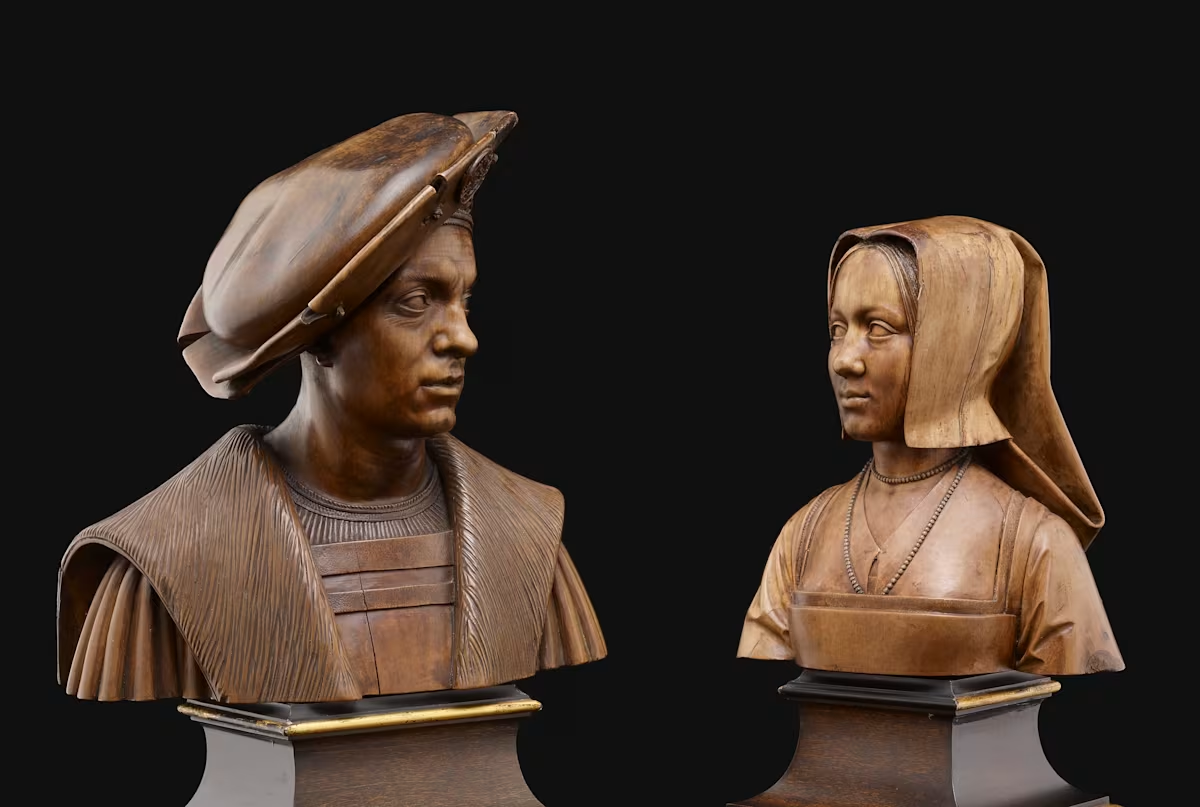
Margaret was married by proxy at Dôle in Franche-Comté on 28 November 1501. From there, the company proceeded to Romain-Motier, home of Pont d’Ain castle near Bourg some two miles from Geneva, where Philibert and Margaret first met and celebrated their marriage proper. After an extensive tour of the duchy, the couple returned to Bourg in 1503, where Margaret spent what were probably the happiest years of her life.
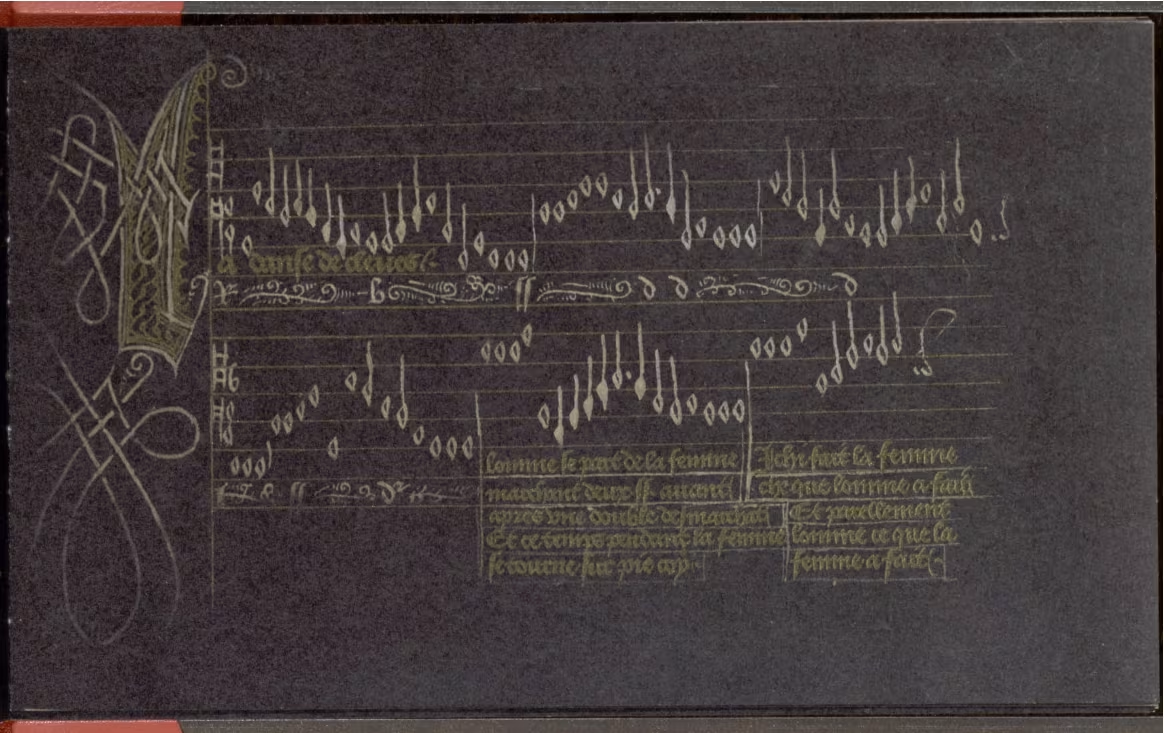
Comprising 58 dances, the exquisite collection, Basses Danses of Margaret of Austria (B-Br MS 9085) - dated between c. 1475 and 1501, the year she became Duchess of Savoy – includes L'Esperance de Bourbon and La Danse de Cleves.
In 1504, Philibert, a keen huntsman, was suddenly taken ill after a strenuous chase in the field. After days of fever, he died on 10 September, aged 24. Philibert’s sudden death left Margaret grief-stricken. She reluctantly buried her husband, keeping his embalmed heart with her. Her court poet and historian, Jean Lemaire de Belges, named her ‘Dame de dueil’ (‘Lady of Mourning’). Margaret continued to reside at Bourg for another two years, but lived a secluded life, writing prose and verse describing the depths of her grief. It was during this period of intense mourning that Margaret also adopted the motto: ‘Fortune. Infortune. Fort. Une’, which has been interpreted as ‘Fortune and Misfortune strengthens a woman’. The large-scale, three-verse chanson Me fauldra il, set by an anonymous composer, is Margaret’s heartbreaking cry to God asking for strength and patience:
Must I always languish thus?
Must I finally die thus?
Will no one recognise my suffering?
It is too much to endure,
Since it has been thus
since my childhood
REGENT OF THE NETHERLANDS
In 1506, Margaret’s brother Philip and his wife Joanna set sail on 7 January 1506 for Spain. Isabella I had died and Joanna needed to claim her inheritance. The ‘Great Storm’ of that winter forced them to land in England, where they were hosted by Henry VII until their fleet was repaired during the next three months. Henry used this period to extract three treaties from them: the first was one of alliance with Burgundy, the second a treaty of marriage between him and Margaret (Henry having been a widower since 1503), and the third was one of commerce so disadvantageous to Flemish interests that it was known in the Netherlands as the Malus intercursus. Maximilian wrote to Henry from Vienna that ‘he had heard with great joy’ of the marriage arrangement, but Margaret’s reaction was not so enthusiastic and she stubbornly refused the match, writing to her Emperor-father ‘although I am an obedient daughter, I will never agree to so unreasonable a marriage’. And she never did.
When the royal trio finally arrived in Spain in April, Philip the Fair, aged 28, died suddenly in Burgos, leaving behind six children and a grieving wife whose mental state gradually deteriorated. Again in mourning, for the funeral of her brother, Margaret composed the epitaph, ‘Doleo super te, frater mi Philippe, Rex optime. Doleo super te’ (‘I grieve for three, brother Philip’), inspired by a text from the Old Testament, Samuel 1, David’s Song for Saul and Jonathan, which was set to music by Pierre de la Rue, Margaret’s favourite composer.
Pierre de la Rue: Doleo super te, frater mi Ionathan
The death of Philip in Spain and Joanna’s subsequent incarceration left the infant Charles, then six years of age, the inheritor of the Habsburg Netherlands. Philip’s short reign was a period of relative peace and prosperity, but his death revived old rivalries in this highly fragmented multilingual duchy. The ruler would need immense diplomatic skill in order to create a sense of national unity. Margaret was soon identified as the most appropriate and capable Regent to rule these disparate and sometimes troublesome, wealthy provinces during Charles’ minority. Her mother tongue was French and her Flemish was good, but above all, she had learnt the subtle and nuanced diplomacy that allowed her to flourish as an independent woman wielding considerable power in a man’s world.
During her time as Regent, and despite her habitual melancholy, we can see from contemporary accounts that Margaret maintained a court at Malines worthy of her exalted rank. She also took a keen interest in contemporary arts and was a discerning patron of music and fine art.
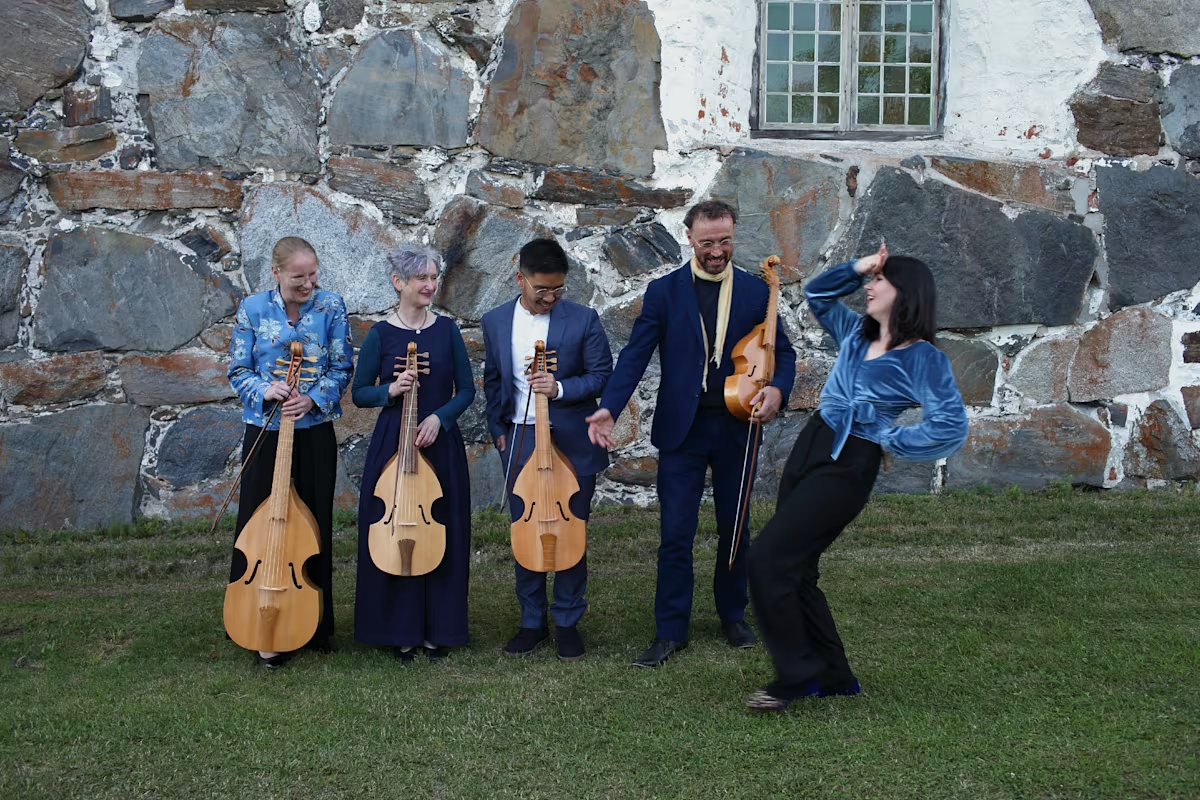
The title of our album comes from one remarkable epic poem, written by Margaret’s court poet Jean Lemaire in 1505, which takes the voice of a green parrot inherited by Margaret on the death of her mother. She became very attached to the bird, which apparently had a large vocabulary. During a visit to her father in Germany, the parrot, left behind in Flanders, died. In Lemaire’s poem, Les Épîtres de l’amant vert, the green lover laments his mistress’ absence, contemplating suicide. Finally, the pitiless bird calls to his mistress from his tomb. It is this last verse that Pierre de la Rue sets in the remarkable chanson, Soubz ce tumbel:
Within this tomb, which is a harsh locked cell,
Lies the green lover, the very worthy slave…
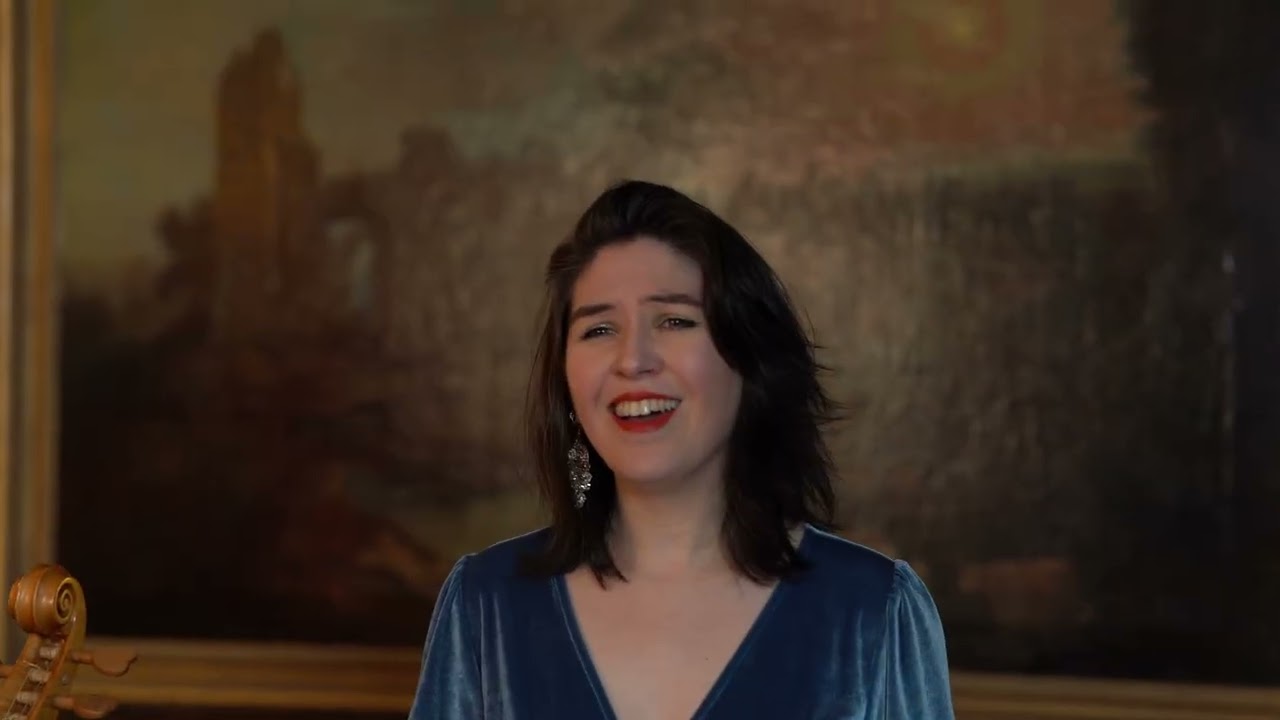 ▶
▶Pierre de la Rue: Soubz ce tumbel
FINAL YEARS
In 1515 Charles came of age. It seems that his assumption of power was granted by decree of Maximilian I, without prior consultation with Margaret, and there is evidence from court records and correspondence that she found the transition a difficult one. However, when Charles took possession of his extended realms, he found that he was needed in Spain more than in the Netherlands, and by 1518 he had begun to return considerable power into Margaret’s hands, which extended her political influence for several more years.
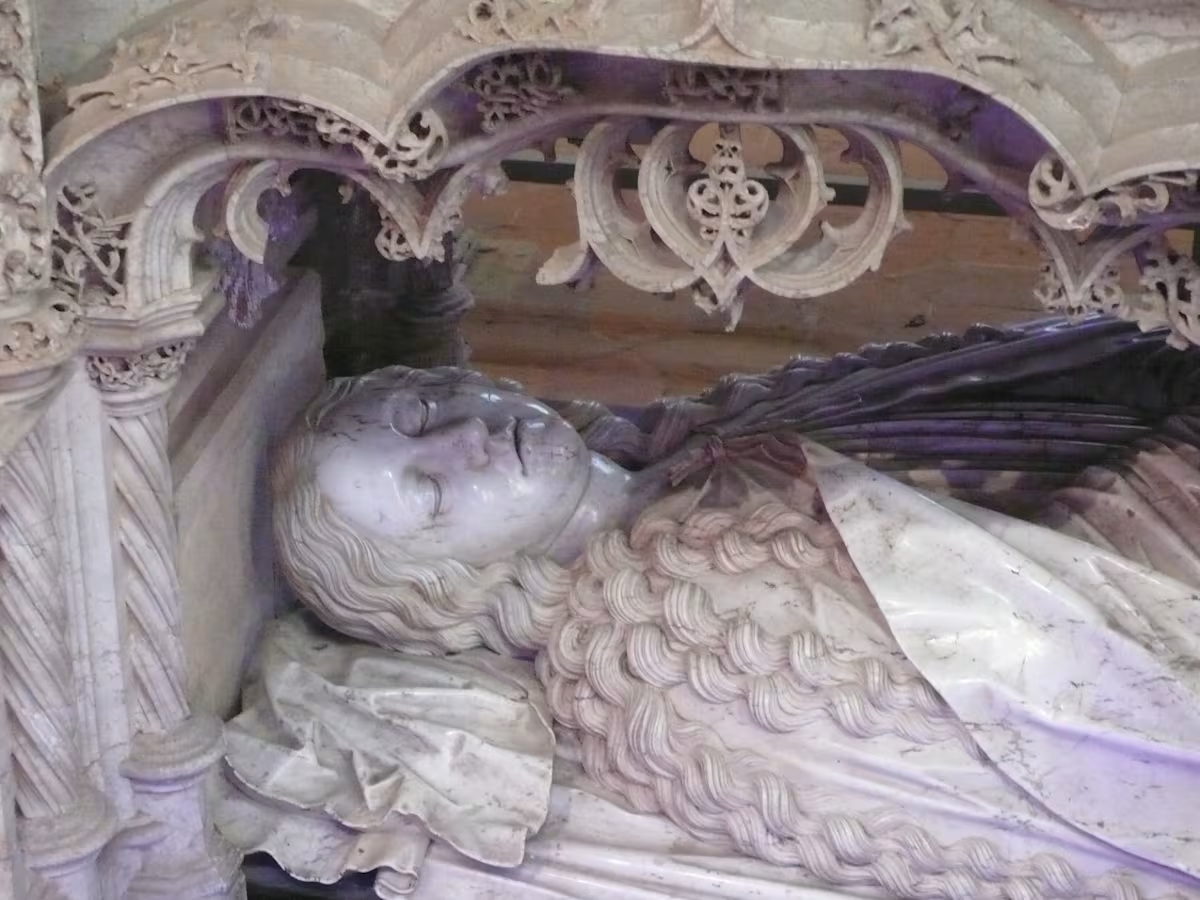
Margaret’s death in 1530 came as prematurely as the losses she had endured throughout her life. Little is clear concerning the details of her final days, but a monk's written account claims that it was down to a freak accident in which a shard of a broken drinking glass, lodged unnoticed in her slipper, caused a wound that turned gangrenous, leaving the amputation of her foot as the only option. On 30 November, after a week spent putting her worldly affairs in order, she asked the doctors to proceed. In an attempt to spare her the immense pain, in the early hours of 1 December, they administered such a large dose of opium that she died of the overdose without undergoing any surgery. She was laid to rest next to her beloved Philibert in the church at Brou.
Margaret left behind a remarkable legacy. As we hope is demonstrated by the album, the pieces in her personal music collection offer us a tantalising insight into the life of one of the most remarkable and influential women in history.
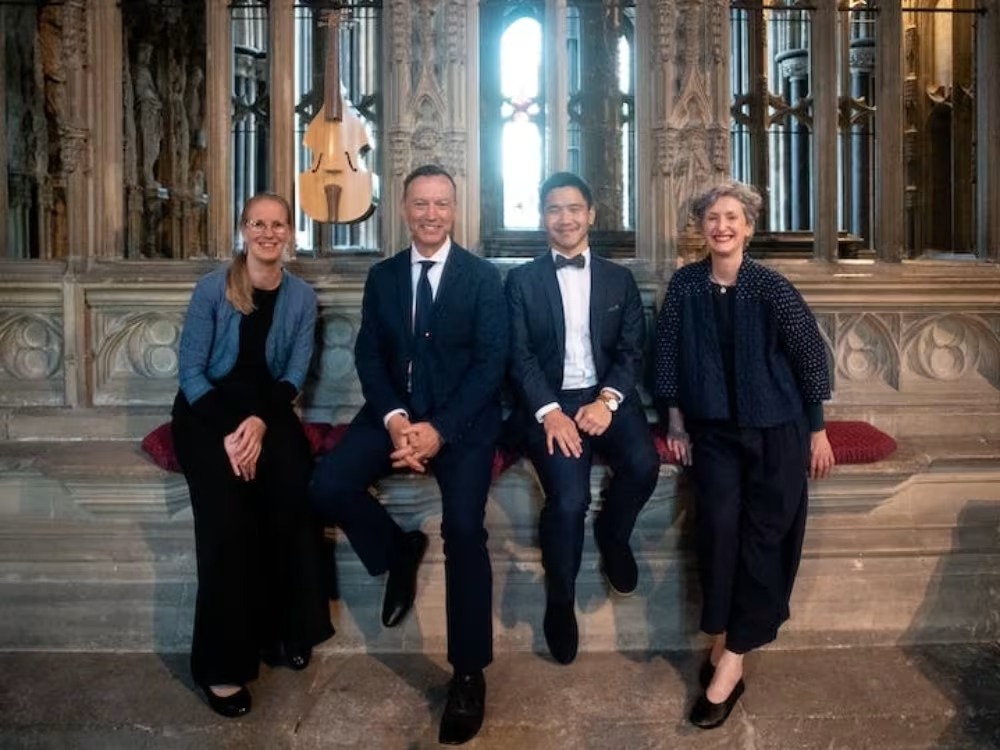
The Linarol Consort of Viols and soprano Héloïse Bernard will be touring this programme in September and October. The recording and concert tour were supported by grants from Continuo Foundation. To find out more about the album and to buy a copy, see the recording profile; for tour dates, visit the Linarol Consort’s Continuo Connect profile.
Share this
Keep reading

Guitar Meets Square Piano: Nathaniel Mander and Declan Hickey
Continuo Connect talks to guitarist Declan Hickey and harpsichordist Nathaniel Mander about their upcoming “Dukatenkonzert” in London and the instruments they will be playing.

The soundtrack of imagination: David Yardley and Green Dragon Guild of London
Medieval countertenor David Yardley, Artistic Director of Green Dragon Guild of London, discusses Medieval music, Southwark’s layered history, and how imagination and meticulous research meet in performance in our latest podcast.
Playlist: Continuo Patrons
A playlist of tracks by Continuo Foundation Patrons Mary Bevan, Emma Kirkby, Rachel Podger and Ashley Solomon in celebration of the UN International Day of Charity.