

Feature
In her musical element: Anne Sofie von Otter
Share this


BY ASHUTOSH KHANDEKAR | FIRST PUBLISHED 13 MAR 2026
𝄞 Why not accompany your reading with our Anne Sofie von Otter playlist, ‘From Ariodante to ABBA’?
For more than four decades, Swedish mezzo-soprano Anne Sofie von Otter has been a commanding presence on stage at the world’s leading opera houses and concert halls, admired for her incomparable repertorial range and stylistic versatility. She has built a career defined by curiosity and inspiring collaborations with many of the leading conductors and directors of our time, leading to an impressive catalogue of albums and performances, including her iconic recording of Ariodante. In this exclusive interview for Continuo Connect, she reflects on her career and discusses her current run as Cornelia in Handel’s ‘Giulio Cesare in Egitto’ at Zurich Opera House, part of the inaugural Zürich Barock festival running from 20 to 29 March 2026.
The role of Cornelia isn’t written to dazzle. She is the moral centre of Giulio Cesare in Egitto, and Handel’s writing for her is restrained and dignified. How do you ensure she holds the audience’s attention in an opera dominated by more flamboyant personalities?
There is no ensuring, really – I just do my best, and leave the dazzling to the others. I don't mind not being the big focus of attention in our Giulio Cesare; I've been there and done that.
Having said that, as I am part of the story, I hope and think the audience can’t avoid looking and listening when I sing and act my role. Any performance, anywhere, needs the ebb and flow of different characters, and I happen to be the one without dazzling notes in this piece.

You first sang the role of Cornelia in Salzburg in 2012 in a modern staging by the directing duo of Leiser and Caurier. It was provocative and visually extreme. At this stage in your career, does a radical staging genuinely change your understanding of Cornelia, or does your interpretation remain fundamentally your own? And, as a performer, how different does Davide Livermore’s production in Zurich feel?
For a singer, it is natural to follow the musical impulses that the composer gives us: the harmonies, the rhythms, the moods. In fact, for most of us it is impossible to ignore. The director can sometimes wish to go in a different direction, which can be a bit of a struggle, but it can open interesting doors.
In this co-production with Opéra de Monte-Carlo, directed by Davide Livermore, we are aboard a ship on the Nile, a bit like an Agatha Christie murder mystery. Davide wants us all to be suspects and heroes in this show, and having seen the show on video, it makes enough sense to me, and is actually very entertaining.
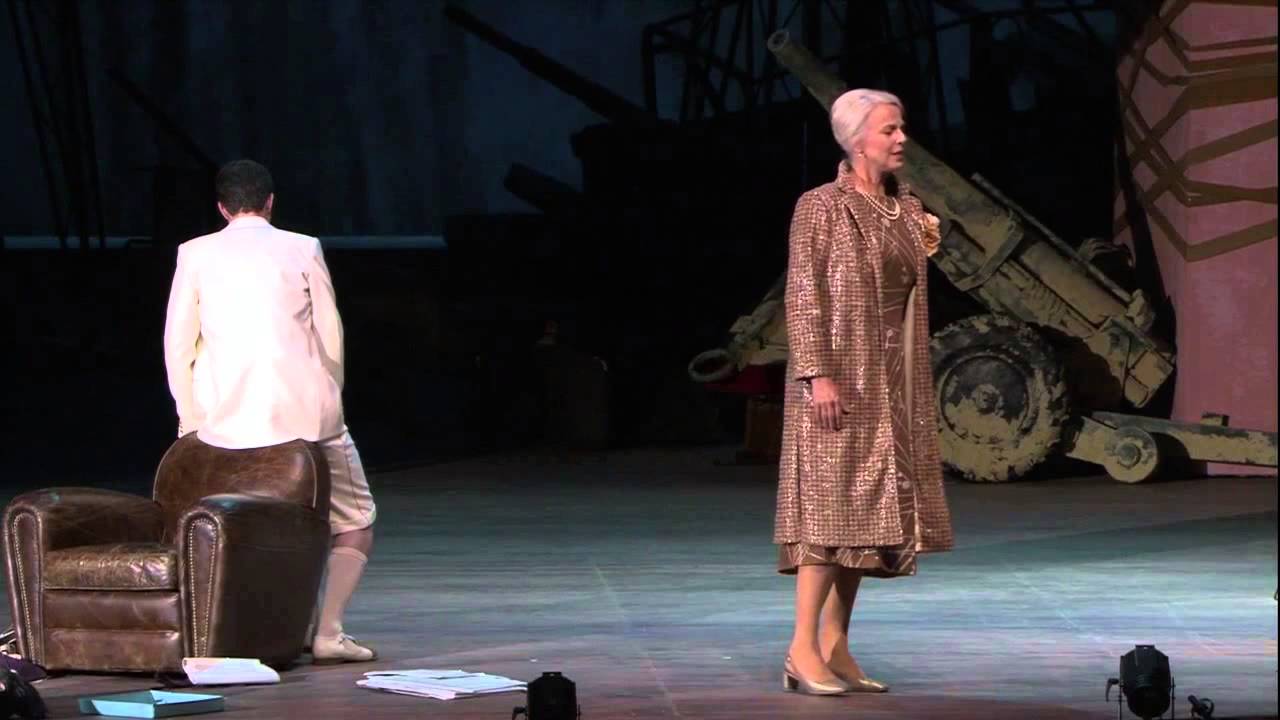 ▶
▶Anne Sofie von Otter as Cornelia in ‘Priva son d'ogni conforto’, from Salzburg Whitsun Festival’s 2012 production of Giulio Cesare in Egitto
The Zurich run reunites you with Cecilia Bartoli (singing Cleopatra). She specifically chose you as Cornelia for her inaugural season as Artistic Director of the Salzburg Whitsun Festival 2012. What is it in your artistry that makes Cornelia such a natural fit for you?
I wouldn’t say Cornelia is a natural fit for me vocally; I am a lyric mezzo, and Cornelia is written for a lower voice than mine. But I guess my physical type – how I look and act – fits Cornelia quite well. With the low voice range, I do as best I can, adding a bit of chest voice here and there. In my younger days, Sesto (Cornelia’s son) was the role I sang, and I have also recorded on a very beautiful live-recording with Marc Minkowski.
Anne Sofie von Otter sings Sesto’s aria, ‘Svegliatevi nel core’
Returning to the role in Zurich 14 years on, has your reading of Cornelia changed – vocally, psychologically, or both?
14 years... Well, we are all 14 years older than we were in 2012, so changes in voice and body are natural. But I have never been the kind to arrive on the first day of rehearsals with a strong idea of how my character should be read or played. That is the job of the director; the whole point of different productions is that they are different.
I go with the flow, mostly, and find it interesting to hear what the director reads into the story. But I do have a very strong musical instinct, and the composer’s shaping of the piece is likely to be with me all the way.
Anne Sofie von Otter sings Sesto’s da capo aria, ‘La giustizia ha già sull’arco’ from Handel’s Giulio Cesare in Egitto
The da capo aria often freezes a single effect in its opening section, yet demands reinvention on its return. How do you prevent Handel’s formal symmetry from becoming emotionally static?
This is also a job for the director – and the conductor, of course – to figure out what to do in the da capo. If the music requires variations, then I have them ready when we start. A da capo aria naturally requires imagination from us performers, but normally the staging will be inventive as well.
We have a truly wonderful and inventive conductor here in Zurich, Gianluca Capuano. He makes sure the music never goes static and boring – the da capo arias are varied in different ways, both from the singers and the orchestra, which is something I have never experienced before. Gianluca is a marvel – never has Handel felt so dynamic and fresh!
Handel seems to write Cornelia and Cleopatra almost as musical opposites. How does that tension play out in performance? Do you think Cornelia suffers from being rather too good and upright?
No, she doesn’t – not in this show! Davide Livermore has made Cornelia into a very proud, hot-blooded and hot-headed lady from Rome. She actually repeats several times in the piece that she is a ‘Romana!’ and that the vile men who are attracted by her should know their place.
When you sing Handel, do you feel you are working within a very distinct musical and dramatic world? How much difference does singing with period instruments make to the tone and colour that you use in your voice compared to singing with a modern-instrument ensemble?
I have always sung Baroque music in more or less the same way, whether with symphony orchestras or Baroque bands, with Georg Solti or Marc Minkowski, Claudio Abbado or John Eliot Gardiner. I find that the vocal writing demands a certain way of phrasing in Baroque music. By that, I mean using the voice with great awareness in terms of vibrato, phrasing and even pitching – understanding that the vocal line is a part of the general colour palette together with the instruments of the orchestra.
However, that idea is so much easier to fulfil – and sounds much nicer – with period instruments in my view. Compare modern and Baroque wind instruments; for example, the Baroque oboe... In a Handel aria, in my view, the modern instrument cannot compare to such a wonderful sound produced by the Baroque oboe.
Anne Sofie von Otter sings ‘The Winner takes it all’, featured in her ABBA album
Your career has spanned an astonishing range of styles and musical periods, from Bach and Handel to 19th-century song, from Romantic opera and Weimar cabaret to contemporary music and ABBA. What is it about your approach to the voice that allows you to encompass such a wide range of repertoire – especially in a world that likes to pigeonhole its artists?
I think the pigeonholing is less strict these days. Many of us sing all kinds of music, from Mozart to contemporary music – to American standards, for instance. In my case, I use my voice differently for a pop song or a French chanson compared to when singing classical repertoire. I try to use more of the natural voice – the one we were born with: less volume, lower range, fewer overtones. The microphone does a lot of the work – it's what they are built to do.
Some singers have incorporated the classical way of using the voice so fully that they can’t access the unschooled voice anymore. That can sound a bit unidiomatic in a folk-song or a jazz standard. It’s about taking a step or two, or three, back from the full voice to a lighter approach, and the lower range is really important, too.
What continues to draw you back to the Baroque repertoire?
The simple answer is that it is so wonderful, so rich and so varied! There is so much to choose from: French, German, Italian, Spanish... Very often it has wonderful harmonies that go straight to your heart, and rhythmically it is often very enticing too.
Anne Sofie von Otter sings Arnalta’s lullaby, ‘Oblivion soave’ from Monteverdi’s L’incoronazione di Poppea
Handel tended to write roles for specific singers. Which characters would you secretly hope he’d choose with you in mind?
I'm happy just the way things have worked out in my career, the roles I have sung. Ariodante was a bullseye, vocally right up my alley when I did it. It couldn’t have been more perfect at the time. I feel very fulfilled when it comes to all the Baroque music I have sung – and have had the good fortune to record – with so many wonderful collaborators.
Anne Sofie von Otter sings ‘Dopo notte, atra e funesta’, from Handel’s Ariodante
Anne Sofie von Otter will appear as Cornelia in Zurich Opera’s production of Handel’s Giulio Cesare in Egitto until 28 March 2026. Visit the Opernhaus Zürich website for full details.
Share this
Keep reading
Handel’s Messiah – the Salisbury connection
There is an oddly persistent local story that a performance of Messiah was given in the chapel room over St Anne’s Gate when Handel stayed in Salisbury in 1739 with his friend James Harris of Malmesbury House in the close.
Singing from within: Paul McCreesh on Gabrieli Roar
Conductor and Artistic Director Paul McCreesh talks to Simon Mundy about Gabrieli Roar – the youth choral project that puts thousands of young singers on stage alongside professional period-instrument musicians.
LIFEM 2026: Interview with Eun Sol Lee
The Early Music Shop caught up with Sol to find out more about her year since she won the competition, and what we have to look forward to in her performance at LIFEM this year...