

Feature
Elisabetta da Gambarini: A musical force of nature in Georgian London
Share this

FIRST PUBLISHED 26 FEB 2026
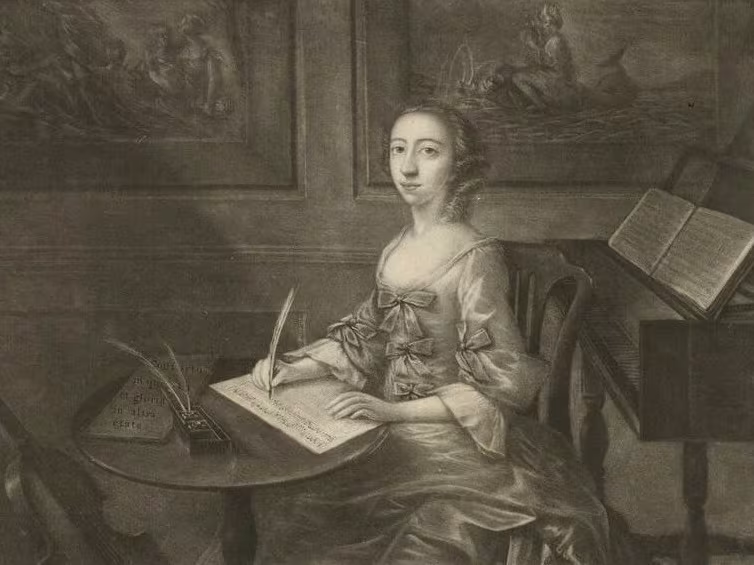
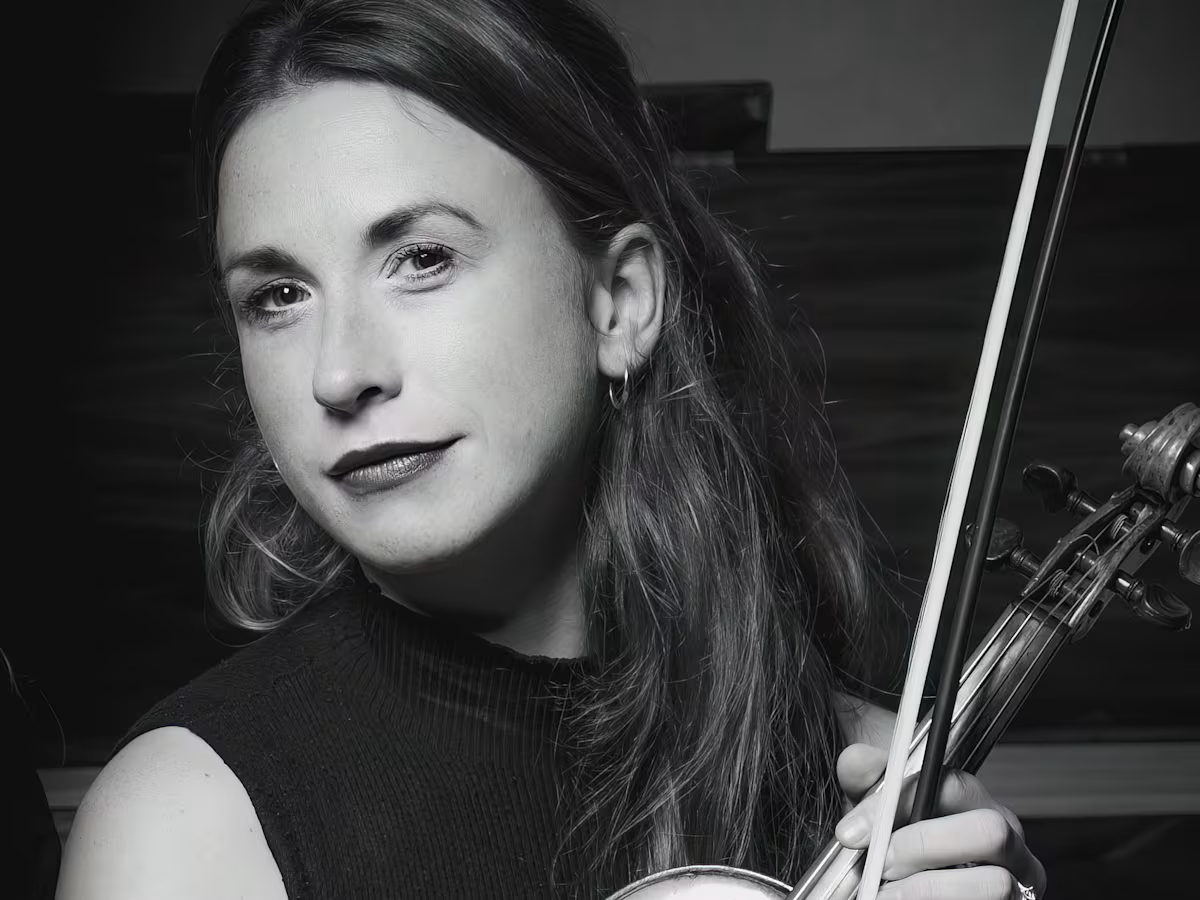
Ahead of the Academy of Ancient Music programme juxtaposing the works of Elisabetta da Gambarini (1731–1765) with those of her contemporaries, including Handel and Geminiani, violinist, curator, and musicologist Rachel Stroud explores the English impresaria’s remarkable career in Georgian London and reflects on her approach to reconstructing and orchestrating Gambarini’s music for modern audiences.
How would you introduce Elisabetta da Gambarini to audiences who don’t know her well or haven’t heard of her at all?
Elizabetta da Gambarini was a musical force of nature! Born into Italian nobility in Middlesex, she was not only the first woman in England to publish keyboard music, but she was also likely the first woman to play the organ in public. She sang title roles for Handel and was clearly an accomplished composer and performer. But perhaps most importantly of all, she was a brilliant businesswoman who used all of her skills to her advantage – ultimately ensuring that her name and music survives today.
How did you first encounter Gambarini’s music, and what made you want to pursue her work more deeply?
I first encountered her music while researching a programme that I directed with Norwich Baroque (generously funded by the Continuo Foundation) called ‘Enchanting Norwich’, which was inspired by the re-opening of the city’s iconic Assembly House in 1756. I wanted to capture the buzz and chatter that must have filled the walls, so looked to records of all of the musical events – from gossip to publications – that happened that year. The centre piece of the programme was Francesco Geminiani’s The Enchanted Forest. I was intrigued to learn that an important part of the publication history of this work involved a certain Elisabetta da Gambarini to whom Geminiani personally loaned a set of parts for a benefit concert. In every programme I curate, I always include at least one work by a female composer or a person of colour – and this was the perfect fit! I was absolutely thrilled when the Academy of Ancient Music approached me about orchestrating Gambarini’s music, giving me the opportunity to delve even further into her sonic and social world.
Unusual in Georgian London, Gambarini was known for holding impressively diverse multiple occupations and professions. How do you think it shaped her music in a scene dominated by Handel?
Impressive diversity is an excellent way to describe Gambarini’s music! After all, the possibility for making a name (and an income!) for oneself in London as a freelance musician was what attracted many foreign musicians, like Handel and Geminiani, to the capital. As her publications show, Gambarini knew how to position herself in a saturated market. The choice of title for her Op. 2 publication, Lessons for the Harpsichord Intermix’d with Italian and English Songs, is very shrewd: it allowed her to appeal to the prestige of her Italian musical heritage, while also cultivating the tastes of the British aristocracy. Many important members of the nobility and even royalty, as well as musicians like Handel, appear in her list of subscribers. It’s likely that she was one of the first women to perform on the organ in public, and her ability to compose, sing and play were all part of the novelty that attracted listeners to her well-publicised benefit concerts.
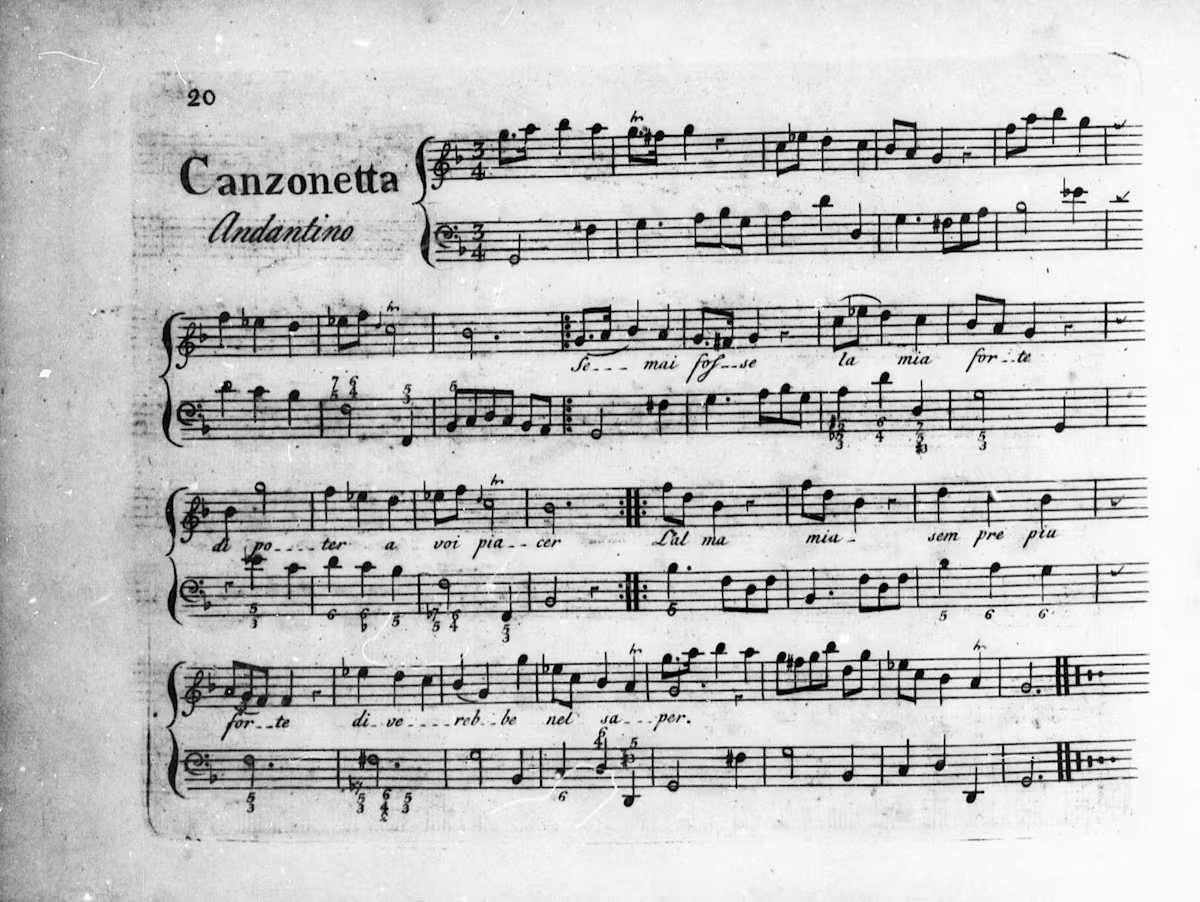
How would you describe Gambarini’s musical voice, particularly her position between late Baroque and emerging Classical styles?
Gambarini was a product of her time, and like all composers, looked to the world around her for inspiration. Her Lessons for the Harpsichord appeal to a very specific market of amateur music-making; but it also does what a lot of keyboard music of the time does. It brings the world of public music-making, the opera and the theatre, into the privacy and intimacy of the salon. Throughout her opuses, we encounter peals of bells from a carillon, heart-felt folk songs from Italy, raucous hunting calls, military marches and elegant dances. The music acts as a portal to the outside world, conjuring with delicious immediacy the sounds, sensations and musical styles of the court, the theatre and even the streets. It was also essential that Gambarini’s music cultivated the latest fashions and aesthetic trends, and so it is unsurprising that there is a distinctly galant aspect to her writing, with its buoyant rhythmical charm, melodic appeal and vivid uses of topics.
What was the guiding idea behind placing Gambarini’s music alongside Handel, Geminiani and Tessarini?
My idea was to loosely re-create the programme of two benefit concerts that she gave in London and Bath in 1747, for which we have surviving adverts:
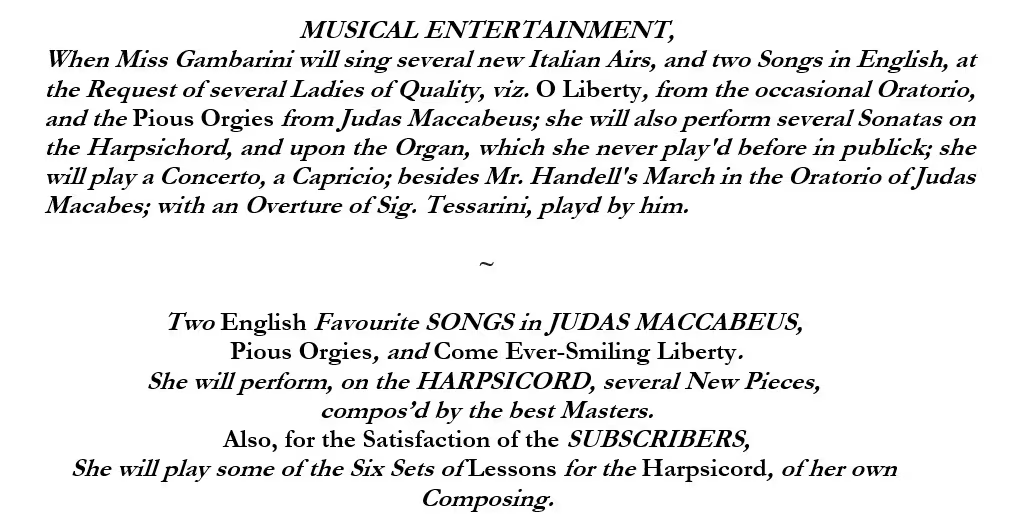
It seemed entirely fitting to place her music alongside the music – including music by Tessarini that he personally directed himself – that would have sounded in those same rooms in London and Bath all those years ago.
 ▶
▶Tessarini: Overture in D from La Stravaganza for strings and basso continuo, Op. 4: I. Allegro assai | Xenia Löffler, Georg Kallweit & Akademie für Alte Musik Berlin
For this project, you completed and orchestrated material from Gambarini’s oeuvre. Can you describe your approach?
The very first thing I did was to explore surviving source material relating to Gambarini, from first editions to concert advertisements, in the British Library. Leo Duarte, the brilliant instigator of the project, and I spent a very enjoyable afternoon there together last May! A first edition of her Op. 1 is also held in the Pendlebury Library at the Music Faculty in Cambridge, so I also spent some time with that source. I’m a huge believer in the importance of seeing and touching physical objects – they tell you so much more than the digital recreations we get on IMSLP.
I then got to know her music at the piano. Playing through all of her Op. 1 and Op. 2 really highlighted how rich with topic allusion Gambarini’s music is. Her writing employs lots of textural variety, such as moments when the bass line drops out or sudden leaps in tessitura, to conjure all sorts of musical effects – lots of which already imply a sort of orchestration.
Gambarini’s imagination at the keyboard was, of course, not limited by the technological limitations of orchestral instruments, and it was very important to me that my writing was idiomatic. So, while the second movement of Sonata II evokes hunting horns, some of the notes don’t fit into the harmonic series and I had to be imaginative with how to maintain the character without the instruments themselves. There are several moments when the oboes imitate hunting horns in this movement!
From a technical perspective, it is quite a challenge to write additional parts for a texture that is so cleverly conceived in two parts – it creates all sorts of difficulties for the counterpoint. My setting of the first movement of Sonata II evokes the buoyant quaver motion in the symphonic writing of one of her contemporaries, William Boyce, but writing a melodically-satisfying second violin part that also obeyed all of the rules of counterpoint and part-writing was extremely difficult! I discovered that Geminiani had made keyboard arrangements of his own concerti grossi, which are full of chromaticism and voluptuous harmony, so this was a very useful place to look for tricks and tips – a kind of ‘backward’ approach to composition.
Finally, it’s important to mention that my approach was collaborative and iterative. I shared material with colleagues and asked for advice about the idioms of their instruments. In particular, I was very fortunate to have the support of my duo partner, Andrew Arthur, a brilliant teacher of harmony and counterpoint at Cambridge, who was always willing to exchange ideas and proofread my work!
In projects like this, how do you negotiate the boundary between historical evidence and creative imagination?
Funnily enough, I didn’t find it a tricky boundary to negotiate as I actually always look to historical evidence to inspire my creative imagination! I’m intrigued by the wider contexts in which art is produced: what aesthetic and political debates were going on at the time, what were the latest fashions, what was going on in the worlds of technology, science and innovation? Contemporary debates around the ideas of natural landscapes (think Capability Brown) versus strictly manicured gardens, awe at the naivety and raw beauty of nature, inspired my setting of Gambarini’s Behold and Listen. It features a rising fifth motive (D-A) on the word ‘behold’ – as though she is encouraging us to listen to the resonances of the universe – and so I created an introduction, delivered ad libitum, featuring a bird-like dialogue between traverso and solo violin over a drone on a open D in the bass.
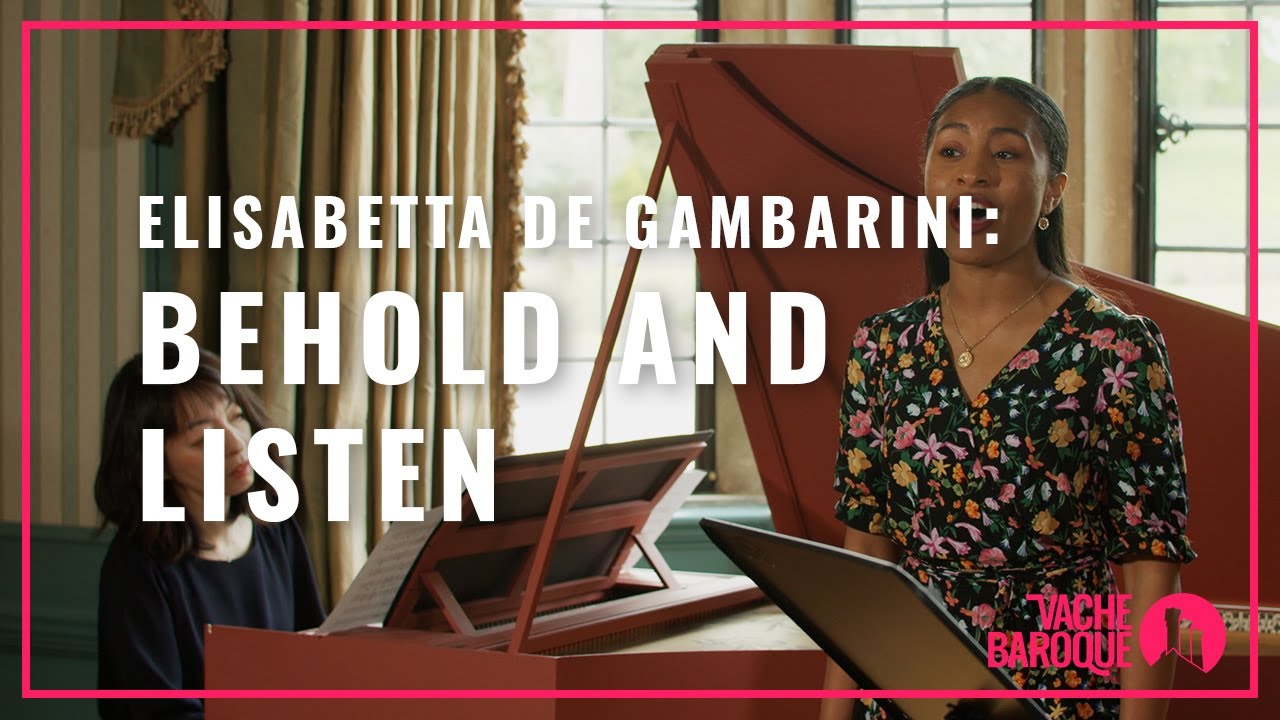 ▶
▶Elisabetta de Gambarini: ‘Behold and Listen’ | Vache Baroque
I also took some creative liberty in my setting of her Italian song, ‘Se mai fosse la mia forte’, which I chose to expand with some additional instrumental interpolations. To capture the darker, G minor atmosphere, I took inspiration from one of my favourite Handelian orchestral colours: the combination of bassoon and viola. It begins with a bleak, stark opening with viola and bassoon answering the initial violin phrase in unison without a bassline, before the strings add warmth and expression with an additional passage propelled by hemiolas.
My aim was always to amplify what Gambarini already invited us to hear, rather than imposing my own creative vision on the music.
How did working so closely with her musical materials change your understanding of Gambarini as a composer?
I learned that, as well as appealing to her consumers, Gambarini also liked to surprise and challenge! The first movement of the orchestral ‘suite’ that AAM will perform is a pompous March from her Sonata IV. However, it’s no traditional march. The phrasing is rather quirky and lopsided, with the ‘consequent’ phrase coming in half a bar early to create a three-bar structure! Combined with a notational curiosity in the bass line in this bar that I thought might have been a typographical error, I initially attempted to rationalise the phrase structure by adding an additional bar. It soon became clear that this did a significant disservice to Gambarini’s conception of the music! The three-bar phrase structure creates a delightful surprise that keeps the listeners joyfully on their toes, and I’ve celebrated it in my choice of orchestration.
The ‘March’ from Gambarini's Sonata in G, Op. 1 No. 4 | Margherita Torretta
What does reinstating a figure like Gambarini tell us about how musical canons are formed and who is historically left out? How does hearing Gambarini’s music in this context help reposition her as a remarkable voice of her time?
Any form of ‘canon’ is not neutral. It’s a convenient myth that only ‘great’ art survives – implying as it does that lack of greatness – as opposed to systemic inequalities and cultural gatekeeping – explain the lack of representation of women and people of colour. What we know today as the canon of Western Art Music, featuring familiar musical Gods like Bach, Beethoven and Brahms, was formed and cultivated under very specific socio-cultural conditions. For example, there was an active programme of self-conscious, monumental history making in the wake of the French Revolution – attempts to consolidate a cultural and political Teutonic legacy in the 19th century. It saw the construction of impressive museums and libraries, the production of ‘complete’ editions of works by composers like Haydn, Mozart and Bach, the later foundation of collected volumes like the Denkmäler der Tonkünst series.
It is no surprise that women were left out of the musical canon at this time – despite famous female composers achieving international acclaim and recognition in their lifetime, like Marianna Martinez and Maddalena Lombardini – for all of the usual patriarchal notions of female modesty, virtue and – perhaps most importantly of all – the consequent need to operate in the privacy of the home. I recently came across an intriguing idea from the brilliant salonnière, performer and composer, Madame Brillon-de-Jouy, in her correspondence with Benjamin Franklin (documented in the Franklin Archives), whom she famously hosted in her Parisian salon in the late 18th century. She describes how her music was not intended for ‘greatness’ in the public sphere; it was merely written for a social encounter, to be experienced by two people in a private moment, not to be repeated. Repetition is, of course, an essential element in the process of canon formation – requiring access to published scores.
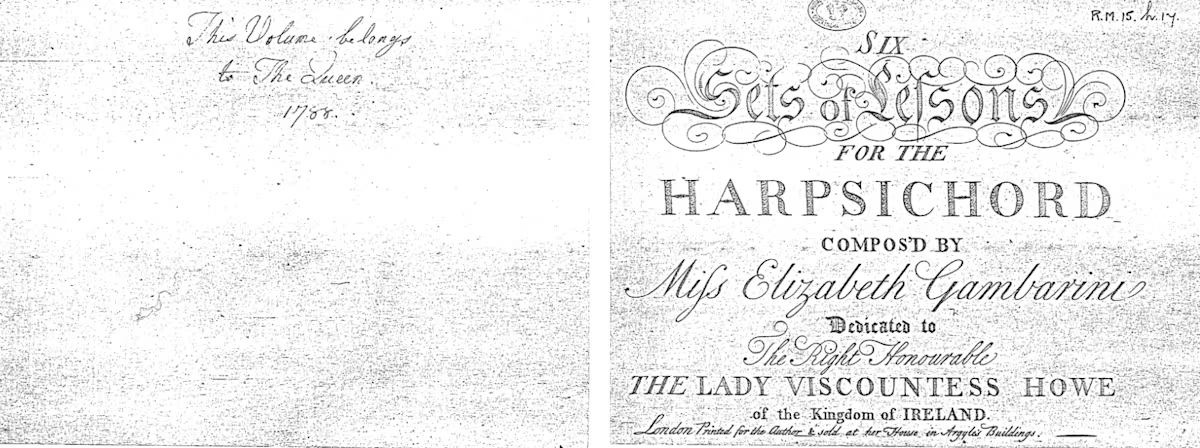
In this light, Gambarini’s strategies of self-promotion and marketing stand out as particularly efficacious! Printing her name in close proximity to an impressive list of subscribers not only sanctioned and gave prestige to her music, but it also ensured its survival in history. After all, the digital copy of her Op. 1 that appears on IMSLP, bears the inscription ‘this volume belongs to the Queen.’
What do you most hope audiences will take away from encountering Gambarini’s music today?
I hope that hearing Gambarini’s music, clothed in sparkling orchestral splendour, will not only dispel lingering myths about musical ‘femininity’, but also spark curiosity to discover more of her brilliant music – and, of course, to challenge limiting historical narratives.
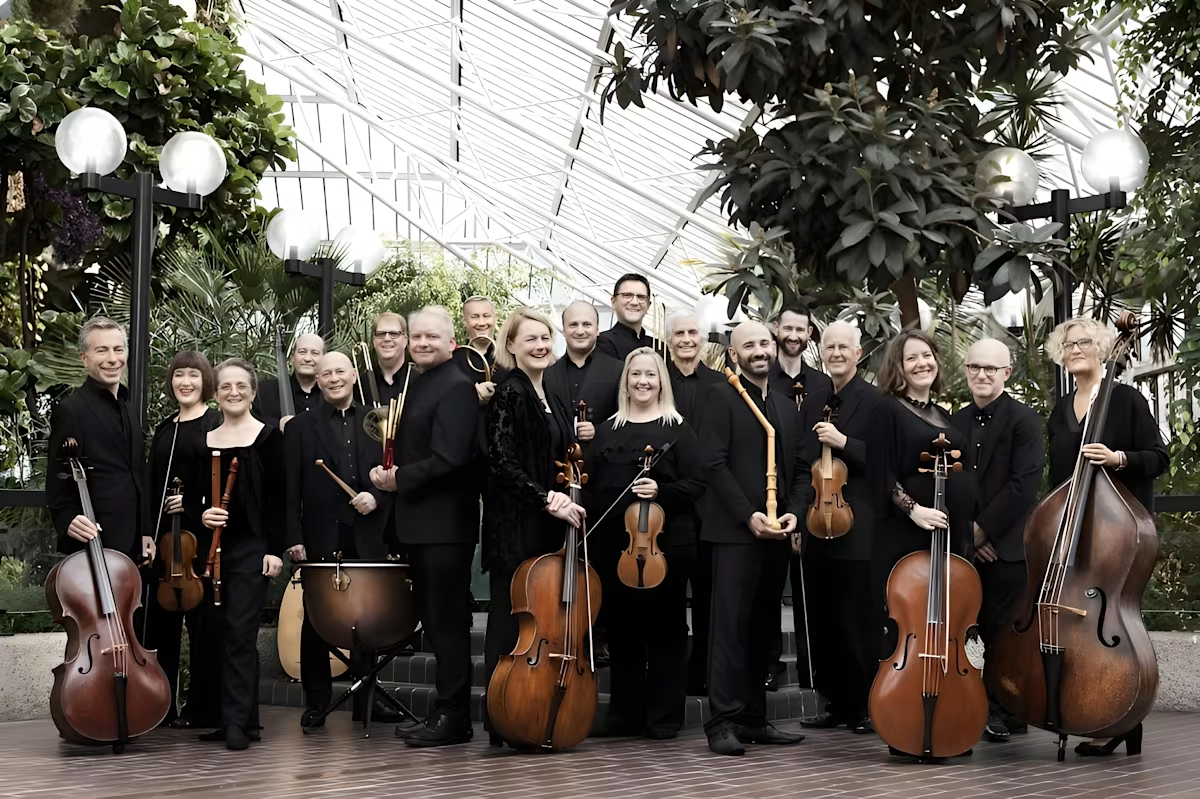
The Academy of Ancient Music will perform the programme curated by Rachel Stroud – ‘Gambarini: English Impressario’ in Cambridge on 11 March and in London on 12 March. To view AAM's 2025-26 Season, visit the orchestra’s profile page.
Share this
Keep reading
From kitchen to cathedral: the accidental art of festival-making
Rachel Podger, a Continuo Foundation Patron, has spent two decades creating a festival as open-hearted and inquisitive as her own music-making. She tells Ashutosh Khandekar how the Brecon Baroque Festival evolved almost by chance.
The Best of Rachel Podger
This playlist celebrates 'the unsurpassed British glory of the baroque violin' (The Times) - that is of course Rachel Podger.

Sam Brown on Dowland and filtering history through a modern lens
Lutenist Sam Brown of Dowland's Foundry chats with Simon Mundy about how we interpret John Dowland, the formation of the ensemble around Emma Kirkby's kitchen table, and an exciting recording project in the pipeline.